
Holidays and GDP

‘Spain and Italia at the limits of their tourism capacity’. Turkey and Egypt poised for a surge

The CEO of Tui, the world’s leading tourism group, has sounded the alarm over the two EU countries that ‘have reached the limits of their infrastructure capacity’. Other nations are able to capture market share thanks to infrastructure development. Croatia’s boom is due to the growth in short-term rentals. This is an issue on which we need to set aside ideology and devise industrial policy strategies.

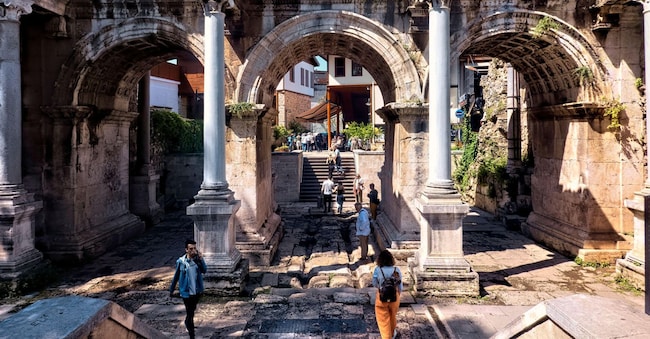
Porta di Adriano, Antalya, Turchia (Alamy Stock Photo)

3' min read

Translated by AI
Versione italiana

3' min read

Translated by AI
Versione italiana

Spain and Italia are reaching their maximum capacity for tourist accommodation. There is a risk that Turkey and Egypt will benefit from this in the coming years.

The warning was issued shortly before Ferragosto by Sebastian Ebel. The CEO of TUI, the world’s largest travel group based in Germany, gave a lengthy interview to the Wall Street Journal and outlined a scenario touching on numerous social and political issues.

Loading...

These range from overtourism to the use of private homes for short-term lettings. These are issues that are also of direct relevance to Italian politics.

Figures for 2024 show that the European Union has exceeded 3 billion tourist overnight stays, a new all-time high. Spain, Italia and France recorded approximately 500, 458 and 451 million nights in accommodation establishments respectively, confirming the concentration of demand in the major tourist economies of southern and western Europe. Growth across Europe was driven primarily by international visitors.

Competition from the East

The result is that the Mediterranean has fully recovered from the impact of the pandemic, albeit not uniformly: for example, Southern Europe has exceeded 2019 levels, whilst Turkey has increased its share and grown. Morocco has set national records. Tunisia and Albania have recovered rapidly, whilst Israel has suffered an extraordinary contraction due to the war;

Morocco recorded 17.4 million visitors in 2024, 20 per cent more rthan in 2023 and 35 per cent higher than in 2019. Classified overnight stays reached 28.7 million and tourism revenue totalled 112 billion dirhams.

Tunisia had already welcomed around 8.6 million tourists, recorded 24.4 million hotel overnight stays and generated nearly 6.2 billion dinars in revenue in the first ten months of 2024. The ministry estimated that tourism accounted for 9 per cent of GDP and provided around 400,000 jobs.

If we look at the situation two years ago compared with today, we can see that trends are on the rise and that, essentially, the Mediterranean is entering a new phase in terms of tourism. Competition is no longer just about the ability to attract people. It is about the ability to select, distribute and manage visitor flows.

Rome still boasts the greatest demand and the most extensive heritage. Istanbul, however, operates on an intercontinental scale. Antalya has the most industrialised seaside resort system. Venice and Dubrovnik illustrate the cost of demand that is disproportionate to the resident population. Valencia demonstrates that competitiveness can still grow without immediately reaching saturation point. For Barcelona, the wider destination recorded over 32.6 million hotel nights and 12.5 million hotel guests in 2024. Overnight stays across all types of accommodation rose by 3.9 per cent and exceeded 2019 levels by approximately 4 per cent.

The example of hospitality in Split

In Croatia, accommodation booked through the major platforms generated around 37.7 million overnight stays in 2024. Split alone recorded around 2.8 million; Zagreb 1.5 million. This figure demonstrates that platforms such as Airbnb are no longer a marginal component, but a pillar of Mediterranean accommodation capacity. The Croatian example is also useful for the Italian government and legislature.

Loading...

For years, numerous Italian mayors have been waging a battle against the phenomenon of short-term lettings and have sought to impose restrictions that clash with national legislation and the concept of private property. Italy’s property sector has long been under pressure due to taxation and the difficulty of ensuring a steady income and financial return.

On the other hand, there is a shortage of hotel accommodation, and holiday lets are a useful, convenient and almost always cheaper alternative. Critics point to the effects this system would have on individual local authorities, discouraging medium- and long-term rentals. Regardless of this correlation – which has not been proven by scientific data – the issue should be considered from an industrial policy perspective.

Taxation

If Ebel’s warning is true – and the figures from the Mediterranean region suggest he is right – we need to set aside all forms of ideology and focus on national projects capable of strategically mapping the tourism offering.

Competition is certainly healthy, but countries such as Spain and Italia should start to regard Turkey and Egypt as nations capable of replacing traditional Western destinations. Moderner infrastructure and more efficient transport links can be more attractive than monumental sights. For this reason, TUI’s warning should not be underestimated.

Copyright reserved ©
Loading...

Brand connect

Loading...

Newsletter

Notizie e approfondimenti sugli avvenimenti politici, economici e finanziari.

Iscriviti