Star swallows its planet: new discovery by NASA's James Webb Space Telescope
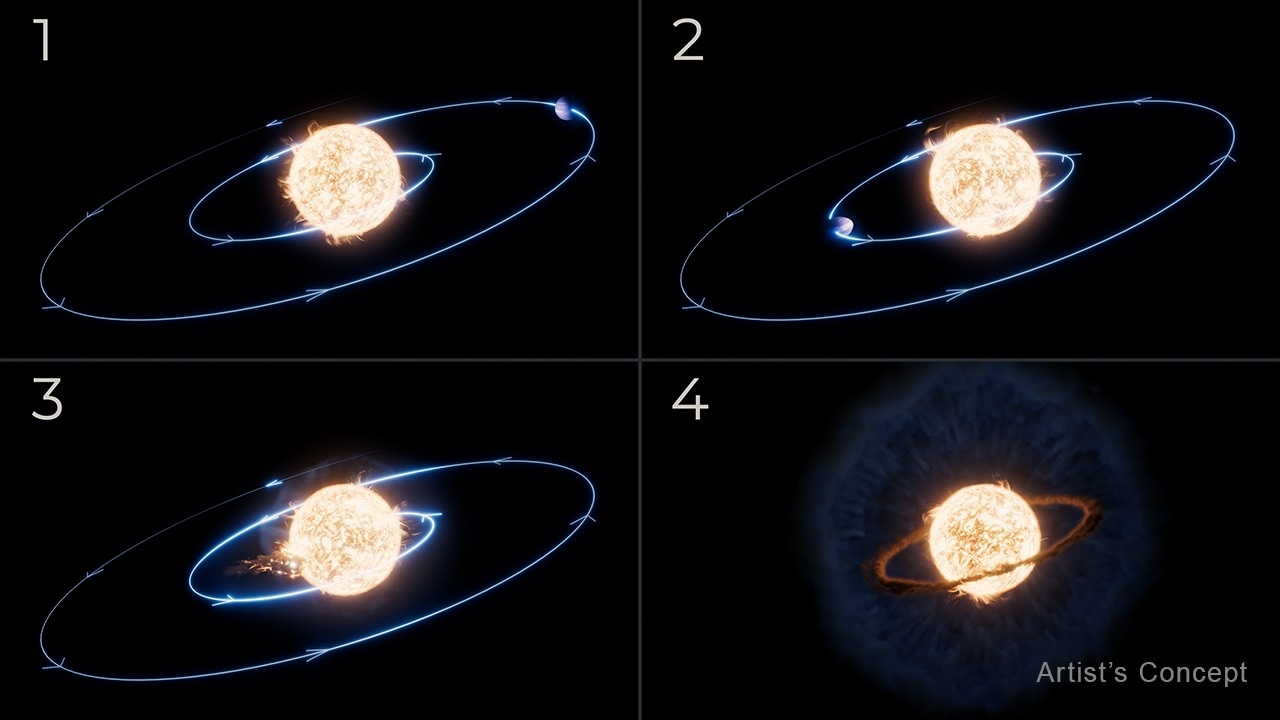
A planet the size of Jupiter about 12,000 light years from Earth, having reduced its orbit, was drawn towards the star and was eventually sucked into it

3' min read
3' min read
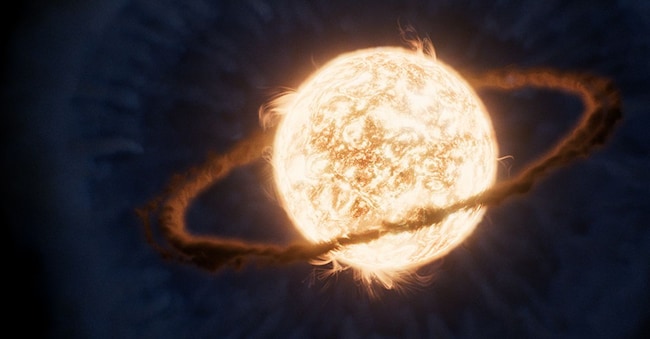
A new, important clue as to how the planets of the solar systems in our Galaxy end up, sooner or later. This is yet another excellent result from NASA's James Webb Space Telescope, which has added a new chapter to this subject that concerns us all: a star has been observed for the first time as it literally swallows up one of its planets, thanks to the force of gravity it exerts. The new findings suggest that the star did not actually swell up to encompass a planet, as previously assumed: instead, observations from the James Webb Space Telescope show that the planet's orbit shrank over time, slowly bringing it closer to its parent star until it was completely swallowed up.
The star we put in the centre of the stage is about 12,000 light years from Earth, close enough to us, then, but not too close, since the linear size of our Galaxy is estimated at about 106,000 light years
Already in 2023, astrophysicists, using an instrument in the famous Mount Palomar Observatory, had observed an important flare, a flash of light in the optical field, that of the wavelengths we normally see with our eyes.
This type of event is given a name, and that was called, ZTF SLRN-2020. Going to look up what another NASA satellite, NEOWISE, had recorded of this flash, the researchers saw that the star had indeed lit up in the infrared well over a year before the flash of optical light, probably due to the presence of dust around the star itself, which can be seen very well when looking in the infrared.
Star Expansion
.Nothing special in the preliminary conclusions of 2023: we know that stars such as our Sun, after a long stay in a state of equilibrium, such as the one we are currently experiencing, due to complicated issues related to the nuclear fusion that takes place within them, expand a lot. In the case of our solar system, calculations, based on what has been observed in other similar stars, predict that our Sun will invade the space of the nearest planets. In our case it will expand to encompass Mercury, Venus, our Earth and Mars, almost up to Jupiter, about 500 million kilometres if we want to attempt a number and consider that we are at 150 million.