
Stellantis showcases the group’s future at the Paris Motor Show
Over 5,300 square metres of exhibition space in the shadow of the Eiffel Tower. The group led by Antonio Filosa arrives in Paris with a presence not seen for years

Key points
To call it a renaissance would be an exaggeration, but at the Paris Motor Show, Stellantis is presenting a very different face compared to recent years. More than 60 vehicles, nine concept cars, eight brands and six world premieres, all within the event’s largest stand, covering an area of 5,340 square metres. These figures are significant above all for what lies behind them: new models, projects set to hit the roads and a strategy that aims to put the product back at the centre. “Five months on, here in Paris, our strategy has become a reality. And very soon our customers will be able to drive it,” said Chief Executive Antonio Filosa, referring to the FastLane 2030 plan unveiled in May. John Elkann, meanwhile, spoke of a plan “in the full implementation phase” that “is already delivering results”. The aim is also to make up ground in Europe, where Chinese competition is growing rapidly. Around twenty Chinese brands are present at the Motor Show – double the number compared to 2024 – whilst their share of the European market has reached 10.7 per cent. Stellantis is attempting to respond with new products and more affordable cars, whilst at the same time utilising partnerships with Chinese groups to reduce development times and costs.
The 2CV and the E-Car project
One of the symbols of this shift in direction is the Citroën 2CV Concept. It is not merely a nod to the past. The prototype previews a model that Citroën will unveil within the next two years; it will be produced in Europe and is expected to have a starting price of around 15,000 euros. The model is part of the direction set out by the E-Car project, announced by Stellantis in May to bring more affordable small electric cars back onto the market. Production of the first E-Car models is scheduled to begin in 2028 at Pomigliano d’Arco, whilst BEV technologies are being developed in collaboration with selected partners. “We were keen to respond to the needs of millions of customers across Europe who are looking for an affordable electric car,” explained Elkann in Paris. The stated aim is to produce competitive electric cars, whilst keeping production and a significant part of the development process in Europe.
European technology and collaboration with Leapmotor
This is where another aspect of Stellantis’ strategy comes into play: collaborating with Chinese manufacturers without losing in-house expertise. This is a key aspect of Stellantis’ strategy, as explained by Ned Curic, the group’s head of product development and technology: “We can certainly collaborate with other companies and forge partnerships, but we intend to carry out development alongside our own teams, within our European technology centres”. Stellantis maintains development centres in France, Italia and Germany and, according to Curic, aims to “continue to design and develop in Europe, building a solid European technological base and maintaining a manufacturing presence in Europe”. The most notable collaboration is with Leapmotor. “We are developing a number of technologies that can be used globally, concentrating development activities in Europe and focusing on close collaboration with Leapmotor and the other partners involved,” added Curic. It is a relationship that combines competition and collaboration. Stellantis aims to capitalise on the development speed, technologies and scale of its Chinese partners, whilst at the same time retaining in-house the expertise it considers essential.
Fiat: between the Multiplay and the Multiplina
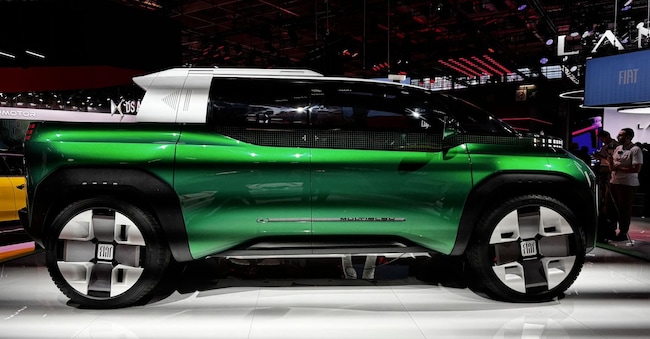
Fiat, on the other hand, is showcasing two different visions of mobility for the coming years. The Multiplay is a 4.45-metre-long concept car that combines the features of a people carrier, an SUV and a pick-up. A movable rear module allows the vehicle to switch from a 6+1 family configuration to a four-seater layout with an open load bed. It does not preview a specific production model, but serves as a laboratory for ideas and solutions that could be applied to future products. The Multiplina is a different story, designed to bridge the gap between the Topolino and a traditional car. It is a heavy-duty electric quadricycle in the L7e category, with four seats and a top speed of up to 90 km/h. A product designed for the city but capable, at least in theory, of going beyond purely urban use. Alongside the concepts are production cars, ranging from the Fiat Grizzly to the new Lancia Gamma, including the DS N°7 and the Opel Corsa GSE. This is one of the elements that sets the Paris show apart: not just stylistic exercises, but a combination of prototypes, previews and cars ready to hit the market.
Jeep makes a fresh start with the Renegade
For Jeep, the European strategy also involves the revival of one of its most important models. The Renegade will return by 2030, having sold over 610,000 units in Europe since the first generation was launched in 2014. The future European range will comprise up to six models. “All brands in Europe – and not just in Europe – are facing this situation. One of our main strengths in countering this challenge is our DNA,” explained Xavier Peugeot, Head of Jeep Europe, speaking about the growing competition from Chinese manufacturers. Looking beyond 2030, Jeep is exploring compact, electrified vehicles that could incorporate elements from the most iconic models in its history, including the Willys. At present, no specific model has been announced, nor has a decision been made regarding production.

