
Study reveals: cigarette filters persist in nature for decades
The research, published Environmental Pollution, was carried out by the Federico II University of Naples

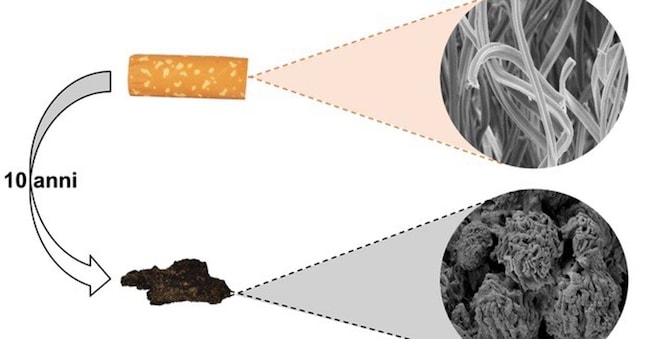
Not only smoke. With time also comes microplastics. Because the life of cigarettes, once extinguished, continues in the filter, which does not disappear even after ten years. With effects on the environment, on the soil or in the water. Reconstructing the picture, drawingthe life of the cigarette butt over a period of 120 months is the research carried out with the contribution of various laboratories of the Federico II University (coordinated by Professor Giuliano Bonanomi, Department of Agriculture) and the CNR in which the
chemical, microbiological and toxicological transformations of filters in the soil. With the result that cellulose acetate filters do not biodegrade, but instead progressively fragment into persistent microplastics.
"In a context where sustainability implies products designed to be reused, recycled or truly biodegradable, the cigarette filter is at the opposite end of the spectrum," says Luigi di Costanzo, university lecturer in the Department of Agricultural Sciences at the Federico II University of Naples, "a disposable object with an environmental permanence that can extend over many years.
The Studio
The study, also published in Environmental Pollution, followed the decomposition of filters under controlled conditions and in the field, simulating urban environments, sandy soils, and soils rich in organic matter. 'Contrary to what we think,' the lecturer argues, 'the data show that the butts do not disappear in a few months: in an urban environment, after ten years, up to half of the filter can still be in the soil.
Everything is related to the composition in cellulose acetate, a plastic derived from natural cellulose but chemically modified to increase its strength and stability. 'After ten years, the loss of mass varies significantly depending on the environment,' he adds. In the absence of soil, a condition that mimics urban surfaces or environments poor in biological activity, the loss stops at around 52%. It means that about half of the initial material is still present after a decade'.

