
Sun more active than ever: why northern lights can be seen over the Alps and Lake Garda
Our star is at the peak of activity in its 22-year cycle. A surprising amount of activity, higher than expected

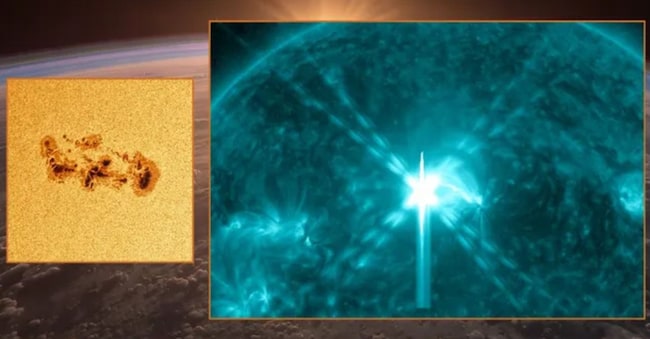
The sun has been astonishing us with its activity for a few months now. Several beautiful Boreal auras have been seen, even a few weeks ago, even as far as the latitudes of our Alps and Pre-Alps, as far as Lake Garda to get an idea. It is true that in these months it is at the peak of its 22-year cycle, but the activity is nevertheless remarkable, higher than perhaps expected.
A radio blackout on Earth, due to an X-type solar flare, the most energetic, has also occurred in the last few hours, and this while a gigantic sunspot, which can even be seen with the naked eye, continues to enlarge as it moves across the solar surface, rotating with the sun itself. As always, the radio transmission problems were localised to large but delimited areas, in this case West Africa and Southern Europe, and were fortunately resolved without causing any damage.
The emission of large quantities of very high-temperature gas from the Sun - we are talking about tongues of material tens of thousands of kilometres wide or more and up to a million kilometres long or more - is accompanied by the emission of solar wind, particles with a lot of energy launched into space at high speed and accompanied by electromagnetic radiation emissions.
Particles, unlike radiation, take hours to reach us and collide with the atmosphere. Fortunately, our atmosphere, the thin layer of various gases including oxygen that surrounds us, and also the earth's magnetic field act as a shield, absorbing or deflecting the particles. Without an atmosphere we could not live at all, and not only because we would not breathe, but because particles from the solar wind, and more, would kill us. On the Moon and Mars, which have no atmosphere (the Moon) or an extremely rarefied one (Mars), the problem of protecting possible astronauts exists and is formidable. Auroras occur because the Earth's magnetic field, especially at the poles, is weaker due to its conformation and sometimes lets through energetic particles that excite the atmosphere molecules.
It seems almost a misfortune to be where we are, but it is not: let us bear in mind, in fact, that our Sun is not a large and extremely quiet star, in a rather peripheral zone of the Galaxy. In short, we are actually a lucky case among the many billions of stars that explode, swirl whirling around other stars or live in very dense and dangerous areas, for example due to the existence of a black hole that attracts them fatally.


