
TOI-561 b: the first rocky planet with an atmosphere detected by the James Webb Telescope
Revolutionary discovery of an alien world with an atmosphere, temperature measured at 1700°C, defying expectations of exoplanets close to their star.

Today we know of at least 6,000 extrasolar planets, those revolving around a star other than our Sun. For the time being, we only manage to find the ones that are rather large and close to us, due to the limitations that our means of investigation have for the time being, even if they are highly perfected and efficient.
There are all kinds of them, large and gaseous like our great Jupiter or, in much smaller numbers, small and rocky like our Earth or Venus, never, however, has there been evidence so far of a rocky planet, like ours, with an atmosphere around it.
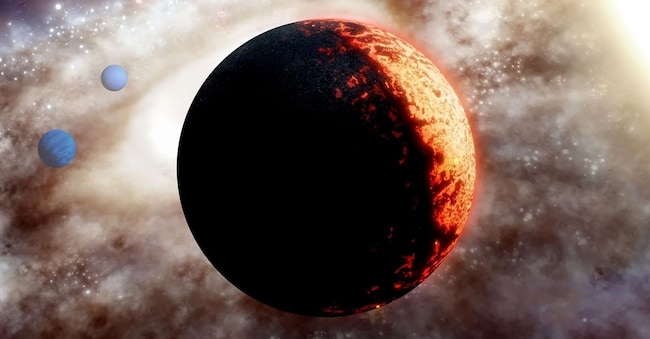
Thanks to Nasa's powerful James Webb telescope, we have the evidence today. The alien world that has been the talk of the town these days, ever since an important research, by an international group of astrophysicists, was published in the authoritative Astrophysical Journal: it is called TOI-561 b, a technical name that identifies the mother star and also one of the three planets circling it, and it would have an atmosphere, albeit a very peculiar one.
Beware that it is not easy to find an exoplanet, and even less easy to find out whether it has an atmosphere. Let's take the example of ourselves: The Earth has a diameter of about 13,000 kilometres, a little less, and an atmosphere let's say 100 kilometres thick, although the one we can breathe in is less than a tenth.
If we reduce, with our minds, the Earth to the size of a watermelon, the round kind, the atmosphere will be much thinner than a lightweight plastic sheet, the kind we use to keep food fresh in the fridge. This example shows us how difficult it is, billions of billions of kilometres away, to know whether or not the atmosphere is there, and at the same time how delicate the Earth's atmosphere is, which allows us to live by breathing.


