MercinTreno Forum

Switzerland and Germany scare rail logistics

European rail freight transport is going through a continuous storm of announced disruptions, inadequate regulations and poor coordination between nations

by Marco Morino
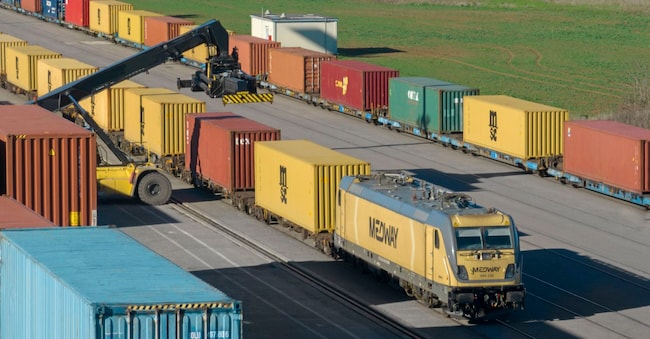
Rivalta Terminal Europa

5' min read

Translated by AI
Versione italiana

5' min read

Translated by AI
Versione italiana

The new Swiss rules on freight wagons, the implementation of which has been extended until 31 December 2026 after the Swiss Federal Transport Office had initially announced their application with immediate effect, and the maxi-works on the railway network in Germany, with total traffic disruptions of at least five months on 40 routes in the period between 2026 and 2032, are frightening Italian rail freight companies. And with them, the industrial sectors that rely on this mode of transport to reach international markets. The new Swiss regulations on freight wagons, in particular, are considered too rigid and penalising for many companies.

For these reasons, the rail cargo players openly speak of 'the risk of paralysis for rail logistics' and of 'Italian exports in danger', precisely at a time when Europe is calling for the transfer of goods from road to rail to be speeded up in order to ensure greater respect for the environment. But the storm that is affecting European rail freight, made up of announced disruptions, inadequate regulations and poor coordination between countries, is slowing down the sustainable turnaround and affecting the economy.

Loading...

This is the picture painted by operators, institutions, politicians and insiders at the MercinTreno Forum, the national event dedicated to rail freight transport. The Forum took place on Wednesday 15 October in Rome, at the Cnel headquarters.

The analysis of Fermerci

Clemente Carta, president of the Fermerci association (in September 2025, Fermerci member companies handled 77% of the traffic volumes on the national network), summarised the numerous topics touched on during the debates: "Germany and Switzerland represent the main channels connecting Italy with central and northern Europe. If these two hubs go into crisis, the entire Italian rail freight traffic is at risk. If Switzerland does not revise its technical criteria and timetables, an important part of the European fleet risks coming to a halt". Fermerci and also the Fercargo association are launching an appeal for real international coordination, involving infrastructure managers, governments and railway companies, to jointly plan construction sites, alternative routes and network management.

On the domestic front, Carta acknowledges the willingness of Rete Ferroviaria Italiana (Rfi, FS group) to dialogue with operators, but calls on the same operator to exploit every margin of flexibility, for example by selectively opening to freight some time windows currently reserved for passenger trains, allowing freight companies to hold out until the end of work on the infrastructure, scheduled until 2027.

"At the European level," Carta concludes, "we need shared planning of European rail yards, the revision of the Combined Transport Directive and a more rational regulation of the Weights and Dimensions Directive, to avoid modal imbalances between road and rail. 2026 will be a key year: on the one hand we will begin to see the effects of the Italian NRP, and on the other we will have to deal with the repercussions of choices made outside our borders. In this scenario, system associations such as Fermerci have the task of keeping the dialogue between institutions, companies and operators open, to ensure an orderly, sustainable and shared transition.

The Swiss case

One of the most pressing issues concerns the decision of the Swiss Federal Office of Transport to prohibit the use of certain technologies installed on numerous already modernised or newly built railway wagons. This is a measure that, if it had been applied from next January, as it seemed at first, would have rendered a large part of the fleet crossing Switzerland along the North-South route unusable, creating very serious difficulties for Italian companies. Now the extension to 31 December 2026 has arrived, but the matter is still in the making.

It all started with the serious accident in August 2023 in the Gotthard Base Tunnel, when a goods train derailed. The accident caused damage to the infrastructure calculated at no less than EUR 150 million and the long closure of the tunnel to allow for its restoration. In its final report of June 2025 on the causes of the accident, the Safety Investigation Service (Sisi) identified the breakage of a wagon wheel of the goods train involved as the origin of the serious accident. The Sisi report pointed out that there was collateral damage caused by the use of brake pads marked 'LL' (from 'lownoise-low-friction').

The Federal Office of Transport continued its investigations by also involving industry representatives, and the result of this investigation revealed that with the use of composite soles instead of the traditional cast iron ones, there is a systematic risk of wheel breakage. For this reason, a decision was issued in September 2025 containing numerous regulations.

This measure was like an earthquake for railway companies outside of Switzerland, which were quickly forced to come to terms with measures that also had a heavy impact on service organisation and costs. Here is a summary of the Uft's indications: minimum wheel diameters, more frequent maintenance, systematic inspections. Wheels must have a diameter of at least 864 millimetres, as opposed to the 860 currently applied at European level.

Another important factor is maintenance: depending on the type of sole, this must be scheduled systematically after 50,000 or 200,000 kilometres and not, as is currently the case, on average longer. In future, the last technical inspection must be documented for each freight wagon, so that railway companies, before using it for a train passing through Switzerland, can check whether it has been regularly maintained. In addition, the wheels must have a coloured stripe to indicate whether they have overheated.

Welcoming these indications are apparently only the Swiss Federal Railways SBB, which is already committed to applying all the provisions issued by the Uft as they drastically reduce the risk of future accidents. But outside of Switzerland (including Italy) there are more than a few worries. 'The risk is that we will have to stop most of the railway wagons when crossing Switzerland,' says Fermerci bluntly.

The German case

Non meno grave la situazione in Germania, dove il governo federale ha avviato un piano di manutenzione straordinaria della rete finanziato anche con fondi del Next Generation EU. Una programmazione che, fin qui, denunciano gli operatori presenti al Forum MercinTreno, non ha tenuto conto delle esigenze del mercato. Tra il 2026 e il 2032 verranno chiuse circa 40 linee ferroviarie, con interruzioni di almeno cinque mesi ciascuna. L’anno clou sarà il 2o28. Denuncia Giuseppe Rizzi, direttore generale di Fermerci: «A differenza di quanto avviene in Italia, dove Rfi riesce a garantire la continuità del servizio, alternando i lavori, in Germania le chiusure saranno totali. Si tratta di linee fondamentali del corridoio europeo Nord-Sud, che attraversa le aree più produttive del continente. In alcuni casi, le deviazioni proposte comporterebbero aumenti di percorrenza fino al 400%, con un impatto devastante su costi e competitività». Nel 2028, è stato spiegato durante il Forum, mostrando una serie di grafici e

Copyright reserved ©
Loading...

Brand connect

Loading...

Newsletter

Notizie e approfondimenti sugli avvenimenti politici, economici e finanziari.

Iscriviti