
01 August 2025
Tariffs, Trump's sting, against EU, Canadian and Swiss cars. Protests in Brazil
Fed 'dissidents' Waller and Bowman: the impact of tariffs on the US economy will be temporary
For feedback, please contact
english@ilsole24ore.com
 Aggiungi Il Sole 24 Ore
ai preferiti su Google
Summary by points
1 August 2025Pinned update
Tariffs against more than 90 countries are in place. Canada and Switzerland among the most affected
US President Donald Trump last night signed the executive order setting the amount of new tariffs that will affect products from dozens of countries (over ninety) that are imported into the US, disrupting the global economic order with these trade barriers, which are particularly prohibitive for Canada and Switzerland. The White House, which aims to 'restructure global trade for the benefit of American workers', granted an extension of several days. These new tariffs on imports will take effect on 7 August, and not this Friday, 1 August as originally planned, to allow US Customs to organise their collection. 'The executive order and the trade agreements concluded in recent months violate the rules that have governed international trade since World War II,' pointed out Wendy Cutler, vice-president of the Asia Society Policy Institute.
These decisions threaten to increase costs for companies and prices paid by consumers. They risk causing a global economic slowdown, despite the International Monetary Fund (IMF) being less pessimistic on Tuesday than three months ago. European stock markets opened in the red today, while most Asian markets closed slightly lower. For some countries, the new situation came as no surprise at all. It came after months of negotiations with Washington, which tried to wring as many concessions from its partners as possible without suffering retaliation. The EU, Japan, and South Korea will see their products taxed at 15%, and the UK at 10%. The EU also obtained an exemption for key sectors, but other surcharges remain in place, such as those on wine and spirits, whose French exporters said today they feared 'effects' on employment. For other countries it will be a cold shower, such as Switzerland, which will face a 39% surcharge, much higher than promised in April (31%). The Swiss federal government greeted this decision today 'with great regret', but wants to believe in 'a negotiated solution'. Canada sees tariffs on its products rising from 25% to 35%, unless they are covered by the free trade agreement between the three North American countries.
Canadian Prime Minister Mark Carney said he was 'disappointed' but called for 'buying Canadian and diversifying his country's export markets'. Ottawa has not cooperated to reduce the flow of fentanyl and other drugs into the US, according to the White House. Even Donald Trump said it would be 'very difficult' to make a deal if Canada recognised Palestine, as Carney predicted. The highest premium is on Syria (41%), followed by Laos (40%). Today, several Asian economies have expressed satisfaction at seeing their exports affected by a lower surcharge than the one initially proposed by Washington. This is the case of Thailand, with 19% compared to the initial 36%, which spoke of a 'great success'. Or Cambodia, with 19% compared to the initial 49%: Phnom Penh hailed it as 'the best possible news'.
China, engaged in negotiations with the United States to extend the trade truce until 12 August, today denounced protectionism that harms 'all parties'. One country escaped Donald Trump's wrath: Mexico was granted a 90-day extension before a possible increase in tariffs. The US executive, however, punished Brazil earlier this week. Its products, with a few exceptions, will be subject to a 50% surcharge, in retaliation for the indictment of former Brazilian President Jair Bolsonaro, a far-right politician accused of attempting a coup after his defeat in the 2022 elections. Coincidentally, yesterday a federal appeals court in Washington began hearing an appeal to determine whether Donald Trump exceeded his constitutional powers by imposing these surcharges without congressional approval. The lawyer for the plaintiffs, a number of small businesses and a dozen US states, denounced in particular 'an unprecedented seizure of power by a president in the past 200 years'.
Further reading

1 August 2025
Trump, I hear India will no longer buy Russian oil
Donald Trump said he heard that India will no longer buy oil from Russia, after he imposed 25 per cent tariffs on New Delhi and threatened a 'penalty' for buying Russian oil.
1 August 2025
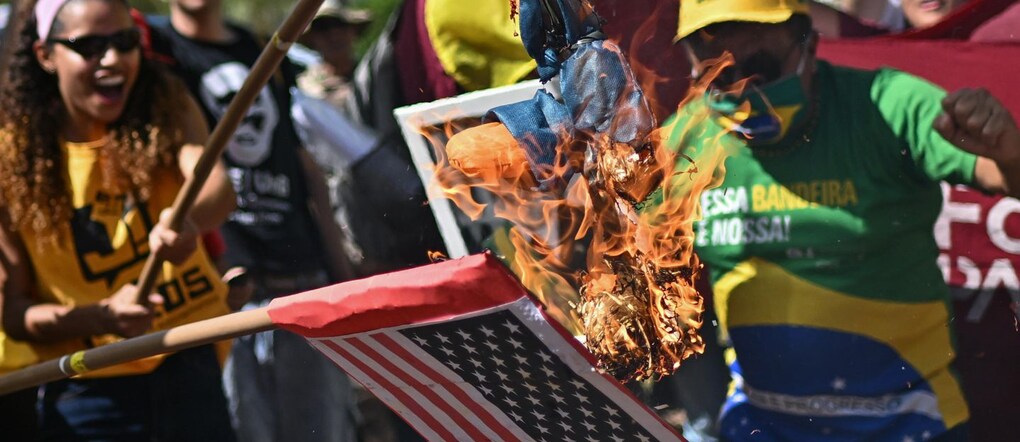
Protests in Brazil, burning effigies of Trump and Bolsonaro
Demonstrations took place in many Brazilian cities, such as São Paulo and Brasilia, to express anger against the 50% tariffs imposed by US President Donald Trump on Brazil. Al Jazeera reports. The protesters claim that Trump has imposed steep tariffs on the country, 'the highest in the world', in response to the indictment of the former president, Jair Bolsonaro, and ally of the tycoon, on trial for the alleged attempted coup in 2022, after losing the elections in Brazil. Protesters gathered outside the US consulate and burned some placards depicting the faces of Trump and Bolsonaro. Also under attack by the US administration and facing sanctions is Brazil's Supreme Court judge, Alexandre de Moraes, who is presiding over the trial against former president Bolsonaro. The magistrate declared that he will 'ignore' the sanctions imposed by the US administration. Trump had accused him of 'assuming the role of judge and jury in an illegal witch hunt against US and Brazilian citizens and companies' in Bolsonaro's trial. On 9 July, Trump had announced his intention to increase the tax on imports of Brazilian products to 50 per cent, 'in response to a series of political complaints'.
Manifestanti bruciano una bandiera statunitense e un'effigie durante una manifestazione contro i dazi statunitensi sul Brasile davanti all'ambasciata degli Stati Uniti a Brasilia, Brasile, 01 agosto 2025. EPA/Andre Borges
Ask the editorial team
Have questions or feedback about this article? Contact our editorial team.
1 August 2025
The wrath of Ottawa, 'new routes and internal market'
Diversifying export routes and strengthening the domestic market, breaking down territorial trade barriers for joint projects that could attract over 500 billion in new investments and focusing on 'buy made in Canada'. This - writes Claudio Salvalaggio of Ansa - is Ottawa Premier Mark Carney's recipe against Donald Trump's 35% tariffs, 10% less than the other North American partner, Mexico, with which the tycoon will still negotiate for 90 days. Trump formally justified the tariffs by the non-cooperation on fentanyl trafficking, but in recent days he had threatened that there would be no agreement because of Ottawa's intention to recognise Palestine: an unconsummated vendetta with other countries, for example Great Britain. In the past months Canada had evoked heavy retaliation, from increased taxes on electricity exported to neighbouring US states to the threat of a supply cut. But at the moment it seems a weapon to be held in reserve, in the hope of being able to modify tariffs in the future on the most 'heavily affected' sectors, among which Carney listed timber, steel, aluminium and automobiles.
The Canadian Prime Minister said he was 'disappointed' by Trump's move and took solace in the fact that the US tariffs increase affects exports not covered by the Canada-US-Mexico Agreement, or Cusma, the world's second largest free trade agreement. This means that 'the average US tariff rate on Canadian products remains one of the lowest of all its trading partners'. As for uncovered sectors, Carney assures, 'the Canadian government will act to protect Canadian jobs, invest in our industrial competitiveness, purchase Canadian products, and diversify our export markets.
'While we will continue to negotiate with the United States on our trade relations,' the premier explained, 'the Canadian government is focused on what we can control: strengthening Canada. The federal government, provinces and territories are working together to break down trade barriers and build a unified Canadian economy. We are developing a number of important nation-building projects with provincial, territorial and indigenous partners. Together, these initiatives have the potential to catalyse over half a trillion dollars ($500 billion, ed.) of new investment in Canada."
Carney also launched an appeal to buy 'Canadian', indirectly boycotting American products, a phenomenon that has already been going on for months. "Canadians," he assured, "will be our best customers, creating higher-paying careers at home as we strengthen and diversify our business partnerships around the world. We can give ourselves more than any foreign government could ever take away, building with Canadian workers and using Canadian resources for the benefit of all Canadians." Carney also responded to Trump's accusation of poor cooperation against fentanyl trafficking, pointing out that it accounts for only one per cent of the flow into the US and that 'the Canadian government is making historic investments in border security to stop drug traffickers, dismantle transnational gangs and end migrant smuggling.
1 August 2025
Tariffs on South Africa and Lesotho come into force
As of today, South African exporters to the US will face 30% tariffs decided by President Donald Trump. For many South African exporters, the tariffs were zero thanks to the African Growth and Opportunity Act (Agoa). The introduction of the new tariffs hits local products hard, particularly in the steel, automotive and agricultural products sectors. South Africa's first attempt to avoid the tariff increase, by submitting a proposal in May, was rejected by Washington. The second proposal, made in June, which included commitments to import US natural gas and fracking technology in exchange for tariff-free quotas on steel and vehicles, was also not accepted. Instead, Donald Trump signed an executive order, reducing the tariffs on goods from Lesotho from the threatened 50 per cent to 15 per cent. The decision came after months of uncertainty and economic hardship for Lesotho, particularly in the textile sector, which has suffered mass layoffs due to cancellation of orders by US importers.
1 August 2025
Tajani, ECB to reduce the cost of money and evaluate quantitative easing
"There is one issue that worries me: the dollar is still too weak against the euro. This means that it is more difficult to export. I believe that the central bank still needs to reduce the cost of money. We are at 2 per cent but you can also go to zero as during the Covid. You can buy government bonds from the ECB, with quantitative easing'. Thus the deputy prime minister and leader of FI Antonio Tajani, on the sidelines of the States General of Southern Italy, responding to a question on the subject of tariffs.
1 August 2025
Fed 'dissidents' Waller and Bowman: the impact of tariffs on the economy will be temporary
Federal Reserve Governors Christopher Waller and Michelle Bowman on Friday morning clarified their reasons for voting against the stability of interest rates decided on Wednesday by the Federal Open Market Committee (FOMC), the monetary policy arm of the central bank. Indeed, both officials believe that the tariffs imposed by President Trump will only have a temporary impact on inflation and therefore rates can be reduced by a quarter of a percentage point. They added that keeping monetary policy unchanged, as has been the case since December, carries risks for the economy. This is the first time since 1993 that two governors have disagreed with a FOMC decision.
1 August 2025
Trump-EU agreement brings down tariffs on Parmesan cheese
Parmigiano Reggiano not only will not have an increase in tariffs, but will even benefit from a reduction in tariffs in the United States: with the executive order signed by US President Donald Trump, after the agreement with the EU, the duty on PDO cheese will in fact drop from 25% to 15% from 7 August. The situation is particular: since the 1960s, Parmigiano Reggiano has paid a 15% tariffs and since April 2025 a further 10% has been added, bringing the total to 25%. The new 15% tariffs will be replacement and not additional, hence 'all-inclusive'. Marking, in effect, a reduction. 'While recognising that the tariff is an improvement,' says Nicola Bertinelli, president of the Parmigiano Reggiano Consortium, 'I believe that any barrier to free trade is an unfair limitation to growth and economic cooperation. Our PDO is not in real competition with American Parmesan, since it covers less than 8% of the hard cheese market and is sold at more than double the price of cheese produced by American farmers'. Bertinelli points out that in the US 'those who buy it are making a conscious choice: they have a 92% market share of alternatives that cost much less. Imposing tariffs on a product like Parmigiano Reggiano only increases the price for American consumers, without really protecting local producers'. The US is the largest foreign market for Parmigiano Reggiano, accounting for 22.5% of the total export share. More than 16,000 tonnes were exported in 2024, an increase of 13.4% over 2023.
1 August 2025
Brazil, 35.9% of exports to the US subject to 50% tariffs
As of 6 August, 35.9 per cent of Brazil's exports to the US - amounting to $14.5 billion in 2024 - will be subject to a new 50 per cent customs tariff. The measure - signed on 30 July by US President Donald Trump - represents one of his administration's toughest trade measures.
The government of Luiz Inacio Lula da Silva reacted with concern but also with a clear strategy: to negotiate. 'The negotiation is not over, it starts today,' Vice-President Geraldo Alckmin told Brazilian national TV. Finance Minister Fernando Haddad spoke of a real 'injustice in the measures adopted by Washington' and anticipated a meeting with US Treasury Secretary Scott Bessent.
Key products such as coffee and meat, of which Brazil is the world's leading exporter, will be affected. On the other hand, some 700 items, including aeroplanes, orange juice, and oil, will be exempt from the new tariffs, for which the 10% tariffs already introduced in April will remain. According to economist Reginaldo Nogueira, director of the Ibmec school of commerce, the exemptions 'alleviate some of the pressure, but mainly protect strategic goods for the US economy'. The Brazilian government will announce a support plan for the most affected sectors in the coming days.
1 August 2025
Swiss watchmakers: 'Tariffs are a threat to the entire economy'
The 39% tariffs announced yesterday by the United States are neither understandable nor justified and are clearly a threat to the entire Swiss economy, as they jeopardise the competitiveness of Swiss companies and products in an important market. This is the reaction of the Federation of the Swiss Watch Industry (Fh) to the latest moves of US President Donald Trump. Given that Switzerland has abolished all customs barriers on industrial products imported into our country, it is unjustified to speak of a lack of reciprocity on the Swiss side, says Fh in a statement collected by Keystone-Ats. If services are taken into account, the trade balance between the two countries is more or less balanced. "We regret that the Federal Council and the Swiss authorities were unable to reach an agreement favourable to the Swiss economy. We now expect the authorities to give this matter top priority and do their utmost to negotiate a better solution quickly," writes Fh. 'These new tariffs represent a heavy burden on economic relations between the two countries,' the organisation concludes.
1 August 2025
Swiss press calls for rapprochement with the EU
While in the EU the trade agreement with the US attracts criticism from the European Commission, in Switzerland the perspective is quite different. In their comments on US President Donald Trump's 'tariff hammer', most of the Swiss press sees a solution in a closer relationship with the EU. Tamedia headlines claim that special relations with the US are now a thing of the past. The Blick-Online calls on the right and the left to present a united front. A Tamedia commentator speaks of a fiasco: according to him, it is time to say goodbye to the idea of a special relationship with the US. On the contrary, US President Donald Trump wants to put Switzerland under pressure and profit from it. Switzerland, posing as a special case, is rather lonely. When a superpower makes chaos its principle, a small state has little room for manoeuvre. For better or worse, Switzerland should come to terms with Washington's 'arbitrary machine'. And move more towards reliable partners, especially Brussels. The online platform Watson notes increasing pressure on Switzerland. Trump's world is putting the Swiss success model to the test. A model that tries to come to terms with everyone and somehow still works. However, Switzerland is in danger of falling into oblivion.
The 'Luzerner Zeitung' wonders whether diplomacy has not bluffed enough. After President Karin Keller-Sutter's first conversation with Trump, the impression was created that Switzerland was 'small but influential'. Now Trump is showing Switzerland how important a world with rules for conflict resolution, such as those negotiated by the Federal Council with the EU, is. The online edition of 'Blick' headlined the comment with 'the biggest defeat since Marignano', fought in September 1515 for control of the Duchy of Milan. For Blick, political unity and reliable partners are needed. It is necessary to close ranks, otherwise the years of the 'fat cows' are destined to come to an end. The right must come to terms with the rapprochement with the EU, the left must give up the fight against free trade agreements. The online edition of the French daily 'Le Temps' notes for its part that a long series of economic arguments might have worked for another US president, but not for Trump. After all, Switzerland is the sixth largest investor in the US. Politics and business were quick to express confidence in a solution. However, the special relationship turned out to be a chimera. Not being prepared for the worst today would be a grave mistake.
1 August 2025
Switzerland's president: 'According to Trump we steal 40 billion'
Donald Trump is convinced that Switzerland 'steals' 40 billion francs from the United States every year because of its trade deficit, Federal President Karin Keller-Sutter said today. The Federal Council rejects this 'absurd' position and wants to relaunch negotiations with Washington. The 39% tariffs imposed on Switzerland are "a surprise" and a "disappointment" because the amount negotiated with members of the US government was much lower, said the President of the Confederation, interviewed by journalists on the sidelines of the August 1st celebrations on the Grütli meadow (canton Uri). The head of the Federal Department of Finance (FDF) also emphasised that this point in the negotiations, on which the utmost secrecy had been maintained, had been accepted by the representatives of the Ministries of Trade and Finance in the stars and stripes.
The Federal Council rejects the White House chief's analysis. Taking services into account, the trade balance between the two countries is actually balanced, Keller-Sutter emphasised. The St. Gallen politician also noted that until now President Trump had not only focused on the trade balance, but also on job creation in the United States. The fact that now only the first topic matters is 'new', according to the federal councillor. Switzerland will resume negotiations with the US, the 61-year-old added. Keller-Sutter acknowledges that the US decision damages the Swiss economy. And commenting on the demands of business circles, she emphasised that 'her door is always open' to discuss ways to reduce bureaucracy or improve framework conditions.
1 August 2025
Switzerland aims at a negotiated solution on tariffs
The Swiss federal government wishes to continue negotiations with the US administration, which intends to impose a punitive 39% surcharge on Swiss products imported into the US as of 7 August. The Federal Council noted "with great regret" that the US - despite the progress made in the bilateral talks and "Switzerland's very constructive attitude from the outset" - intends to levy additional unilateral tariffs "of a considerable amount on imports from Switzerland", a Finance Ministry spokesman told the Swiss news agency Keystone-Ats.
1 August 2025
15% tariffs for now not on cars, exemptions on stand-by
The US executive order on 15% reportedly does not yet implement the other elements of the EU-US agreement, in particular the commitment to reduce US Section 232 tariffs on automobiles and automotive components to a maximum rate of 15%, nor does it provide for the specific treatment agreed upon for certain strategic products, such as aircraft. The new 15% tariff will be implemented as of 8 August. For goods already in transit or stored for consumption before 8 August, the previous tariff rate (10% + Most Favoured Nation rate) will apply until 5 October 2025.
1 August 2025
Canadian PM against tariffs also 'Buy Made in Canada'
Ottawa Premier Mark Carney also points to 'buy made in Canada' as a reaction to the high tariffs imposed by Donald Trump, arguing that Canadians will be their 'best customers'. "We can give ourselves more than any foreign government could ever take away, building with Canadian workers and using Canadian resources for the benefit of all Canadians," he said. Carney also objected to Trump's accusation of a lack of cooperation in "curbing the current flow of fentanyl and other illicit drugs," recalling Ottawa's efforts to crack down and increase border security. "Canada accounts for only one per cent of fentanyl imports from the United States and is working hard to further reduce these volumes," he said.
1 August 2025
Ft: Switzerland 'in shock' over 39% US tariffs, franc falling
US President Donald Trump yesterday imposed tariffs of 39% on imports from Switzerland. The Swiss government expressed 'deep regret' at a decision deemed 'significantly different' from the understanding that was being negotiated with Washington. "It's not clear what the US wants from us," a Swiss parliamentarian told the Financial Times, speaking openly of a "state of shock" for the government. The Swiss franc fell 0.4 per cent against the dollar to 0.816 francs per dollar, making it one of the worst G10 currencies on the day. Despite this, the currency remains more than 8% stronger than its pre-April levels.
The new tariffs place Switzerland among the most heavily penalised countries in the world along with Syria, Myanmar, Laos and Brazil, even exceeding the 31% initially imposed last April.
According to Simon J. Evenett, lecturer at the Imd business school in Lausanne, the main cause would be the 'soaring Swiss trade surplus with the US in 2024'. The US deficit reached USD 38 billion last year, a figure that prompted Trump to react strongly.
In 2023, Switzerland exported $60.9 billion worth of goods to the United States. The main items were pharmaceuticals, medical devices, watches, coffee and gold, which alone accounted for 11.5 billion. The hardest blow fell on the pharmaceutical industry, which accounts for about half of the exports to the US. Novartis and Roche - which have announced billions in investments in the US market this year - risk a double penalty: in addition to tariffs, they have received letters from the Trump administration demanding cuts in drug prices, bringing them into line with those in other countries.
Industry organisations are also sounding the alarm. Swissmechanic calls the 39% "a dangerous measure" and calls for the negotiating window still open until 7 August to be used. Swissmem, which represents the manufacturing sector, emphasises that Switzerland 'lives off its exports'. Director Stefan Brupbacher called these tariffs 'completely irrational and arbitrary'. Bern now has a few days to try to renegotiate an agreement and avoid the tariffs coming into force on 7 August.
1 August 2025
Copa-Cogeca, discouraging there is still no agreement on exemptions for agribusiness
"It is disheartening to see that 1 August has arrived and the US and Europe have still not reached any agreement on a 15% tariffs exemption on any of the EU's agri-food products. Including spirits and wines, on which lawmakers and producers on both sides agree on the need for a zero tariffs agreement'. This is what is stated in a message published on X by Copa-Cogeca, the main organisation representing the interests of farmers and agricultural cooperatives in Europe.
"European producers risk losing significant market share in the US market, while some competitors - who continue to enjoy 10% tariffs - have already announced their intention to expand their presence in the US due to this advantageous situation. The European Commission must continue the negotiations and conclude an agreement with better conditions for our producers'.

