Trade

China, tariffs are harmful and illegal. India postpones talks with the US

The earthquake triggered by the US Supreme Court ruling could call into question many of the agreements signed with Asian countries

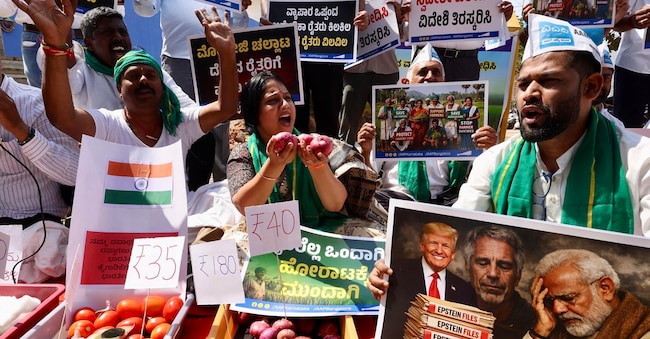
Una manifestazione di un partito di opposizione a Bangalore contro l’accordo commerciale tra India e Stati Uniti

5' min read

Translated by AI
Versione italiana

5' min read

Translated by AI
Versione italiana

NEW DELHI - After a few days of silence, the Chinese government has commented on both the US Supreme Court's decision to invalidate the so-called reciprocal tariffs sought by Donald Trump and the US President's subsequent decision to impose generalised tariffs of 10 per cent, later raised to 15 per cent within less than 24 hours. Beijing, said the Ministry of Commerce, is making a "thorough assessment" of the ruling, but in the meantime has returned to urging Washington to eliminate "unilateral tariff measures" against its trading partners, warning that a clash between the two countries would be "harmful".

"Unilateral tariffs by the United States violate international trade rules and American laws and are not in anyone's interest," the ministry made known. What is certain is that the Supreme Court ruling indirectly served Beijing's interest. When Chinese President Xi Jinping receives Trump next 31 March, his negotiating power - with tariffs now down to 15% for the next 150 days - will be 'much stronger' than expected, explains Wu Xinbo, director of the Center for American Studies at Fudan University. For example, as part of the previous tariffs negotiations, China had pledged to buy some 25 million tonnes of soya. 'If those tariffs are now deemed illegal, the 'soybean card' goes back into China's hands,' Wu explains.

Loading...

Most Asian governments have decided to respond with a mixture of caution and tactical wait-and-see attitude to the U.S. Supreme Court decision that on Friday invalidated most of the tariffs imposed over the past ten months by the Trump administration. The caution is dictated by the awareness that, despite the resounding legal defeat, the extortionist negotiating style practised in recent months by the White House is not destined to suddenly fade away. The wait-and-see attitude is the result of a ruling that could legitimately invalidate the agreements made in recent months (weeks in the case of India, even hours in that of Indonesia) and that in many cases have not yet been ratified by national parliaments, where hostility to concessions made under blackmail could mount.

The Indian Answer

For the time being, the one who has decided to stall is India, by far the most difficult customer among those the American negotiators have been dealing with in recent months. New Delhi was about to send a delegation to the United States to work out the details of a deal outlined in broad strokes in recent days, but nothing came of it. "The decision to postpone the visit was taken after a discussion between officials on both sides," an unnamed source told the Reuters news agency, adding that "no new date has been set". On Saturday, India's Ministry of Commerce had let it be known that it was studying the Supreme Court's ruling and subsequent moves by the White House, which on Friday, in response to the stinging legal defeat, announced generalised tariffs of 10 per cent, rising the next day to 15 per cent.

Despite Saturday's increase, a 15% tariffs is still an unhoped-for improvement for India. In recent weeks, New Delhi had pledged not to import any more Russian oil in return for the abolition of punitive tariffs of 25 per cent, tariffs that had been imposed using the International Emergency Economic Powers Act (Ieepa), which the Supreme Court ruled was unusable. In the coming weeks it will be interesting to see whether the tapering of Russian oil purchases will continue or Delhi will feel disengaged from the commitment.

India had also agreed to a future scaling back to 18% of the remaining 25% tariffs on its products, pledging in return to more than double its imports from the US and make some customs concessions. The executive led by Prime Minister Narendra Modi is in an awkward position: by caving in to American pressure a few weeks ago, it has exposed itself to criticism from both the evanescent opposition and the far more fearsome farmers' lobby. Today a summit is scheduled between the farmers' organisations to decide when and how to put pressure on the government. Farmers are by far the most influential, and feared, electoral constituency in the country. This is a factor to be taken into account as next month the Electoral Commission will announce the dates of the upcoming elections in West Bengal, Assam, Tamil Nadu, Kerala and Pondicherry, four states and a Territory in which some 265 million people live.

The risks of a Japanese reversal

In Japan, a government spokesman said that Tokyo would 'carefully study the content of the ruling and the Trump administration's reaction before responding appropriately'. Separately, an anonymous government official told Nikkei Asia that the Supreme Court's decision will not affect the first three Japanese investments in the US already agreed, part of a USD 550 billion package agreed in exchange for a reduction in tariffs from 25 per cent to 15 per cent (from 27.5 per cent to 15 per cent for cars).

A backtrack would have heavy repercussions on relations with Trump, not least because the project sites - Ohio, Georgia and Texas - were clearly chosen by the Republican administration with next November's mid-term elections in mind. Not only that, if Tokyo broke its commitments, the United States could raise sectoral tariffs applied to the automotive industry, which is by far the scenario most feared by Japanese policymakers. Speaking on TV on Sunday about the agreement reached in recent months Itsunori Onodera, a former minister and one of the heavyweights in the Liberal Democratic Party of PM Sanae Takaichi, said that "at that time for Japan, the top priority was cars, but those tariffs are not covered by the Supreme Court decision. It would not be good if we start to see an impact in that sector while we try to renegotiate the agreement'. Asked to comment on what is happening in the US Onodera said: "If I have to be very frank, it's a disaster". Takaichi will see Trump on 19 March on his first official trip to the US.

South Korea: 'Tariffs null and void'

For the time being, 'prudence' and 'wait-and-see' also seem to be the watchwords in Seoul. South Korean Industry Minister Kim Jung-kwan said that 'although the ruling has increased uncertainties regarding exports to the United States, the framework of the South Korea-US tariff agreement remains intact'. That said, the ministry also bluntly pointed out in a statement that the 15% (and before that 25%) tariffs applied until Friday on South Korean goods entering the US are null and void. Relations between Seoul and Washington have been strained since last January, when Trump complained about the slowness with which the South Koreans were deliberating on investments to be made in the US, threatening to raise tariffs back to 25 per cent.

Loading...

The Bangladesh Escape Route

A senior official of the Bangladesh Ministry of Commerce, speaking to the local Daily Star newspaper, recalled that there is a clause in the agreement signed between Washington and Dhaka that can be invoked to invalidate it. The agreement, reached in the final days of the interim government led by Nobel Peace Prize winner Muhammad Yunus, was criticised by many in the Asian country because the consultative process that preceded the signing was allegedly rushed and the commitments made to the United States were deemed too onerous.

Copyright reserved ©
Loading...

Brand connect

Loading...

Newsletter

Notizie e approfondimenti sugli avvenimenti politici, economici e finanziari.

Iscriviti