Trade war

USA, Supreme Court rejects tariffs. Trump's first response: '10% tariffs for everyone'

The decision focuses on tariffs imposed under an Emergency Powers Act, including 'reciprocal' tariffs imposed on almost all other countries

Aggiornato il 21 febbraio 2026

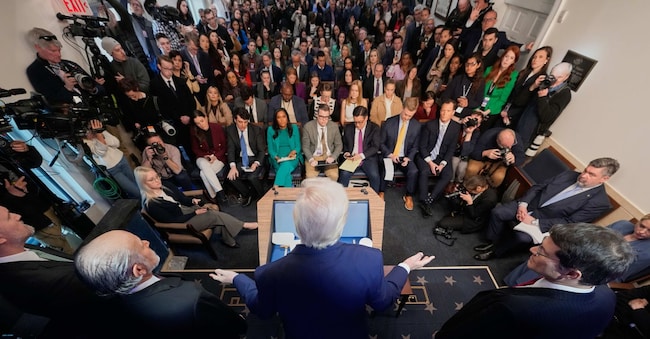
President Donald Trump speaks during a press briefing at the White House, Friday, Feb. 20, 2026, in Washington. (AP Photo/Evan Vucci)

4' min read

Translated by AI
Versione italiana

4' min read

Translated by AI
Versione italiana

The Supreme Court overturned President Donald Trump's far-reaching global tariffs, inflicting a significant defeat on him on an issue crucial to his economic agenda.

The decision focuses on tariffs imposed under an Emergency Powers Act, including the 'reciprocal' tariffs he has imposed on almost every other country. It is the first major piece of Trump's broad agenda to be presented (and rejected) directly to the US Supreme Court, which he helped shape with the appointment of three conservative jurists during his first term.

Loading...

Trump's reaction: 'Very disappointed'

"I was very disappointed in the Supreme Court ruling, I'm ashamed for some of the justices who didn't have the courage to do the right thing for America." Donald Trump said this at a press conference, adding that "tariffs remain, as he has "alternatives".

Indeed, the president announced new measures and an additional tariff on imports on top of those already enacted. "It is a great honour to have just signed, in the Oval Office, new global tariffs of 10% on all countries that will go into effect almost immediately," Trump said on his social Truth, also stating that the Supreme Court ruling makes him "more powerful", and stated, "I wanted to be a good guy, but now I'm going to take a different path." The president also launched a direct attack on the Supreme Court, which he accused of being influenced by 'foreign interests'.

The issue of refunds

The Supreme Court has not made a decision on the refunds that American companies and importers will demand from the US government after rejecting the tariffs, which is why the US president anticipated that 'we will end up in court for the next five years'. Criticising the timing of the Supreme Court's decision to reject the 'reciprocal' tariffs, Donald Trump explained: 'They take months and months to write an opinion and they don't even discuss that part'. At a press conference, Trump said the opinion was not written 'by smart people'.

Vice President JD Vance also criticised the Supreme Court, calling the ruling on tariffs 'illegal'. In a social media post, the US vice president argued that 'the only effect' of the decision will be to make it harder for Donald Trump to 'protect American industries and supply chain resilience'.

"I have a feeling that Americans will not see tariffs refunds," said Treasury Secretary Scott Bessent in response to questions about whether Americans will receive tariff refunds. According to some calculations there are almost 200 billion in refunds at stake, to be exact in the order of 175 billion, other estimates instead speak of 133 billion. On average, the US has been collecting USD 30 billion per month from tariffs.

European Parliament will assess impact of US court ruling on Monday

The chairman of the European Parliament's International Trade Committee, German Social Democrat Bernd Lange, has convened a meeting of the shadow rapporteurs of the different political groups for the EU-US agreement on new tariffs for next Monday, 23 February, at 2.30 p.m. in Brussels, in order to assess the consequences of today's US Supreme Court decision on this issue.

The meeting will take place in view of the vote, already scheduled for the morning of the following day, Tuesday 24 February, on the EU regulations implementing the agreement, reached in August in Turnberry, Scotland, between US President Donald Trump and European Commission President Ursula von der Leyen, and subsequently formalised in a joint statement. The agreement provides for zero tariffs for the import of a large part of US-made industrial products into the EU, in return for the reduction of US tariffs on many European products to 25 per cent.

Court ruling in favour of tariffs: serious consequences in the future

"The Court's decision is likely to generate other serious practical consequences in the near future. One of the issues will be repayments: repayments of billions of dollars will have significant consequences for the US Treasury". This is what is written in the dissenting opinion written by Brett Kavanaugh, the Supreme Court justice who, along with Clarence Thomas and Samuel Alito, voted to uphold most of the tariffs imposed by Donald Trump that the majority of the Court rejected instead. "The Court today is not saying whether, and how, the government should return the billions of dollars it collected from importers, but the process would likely be chaotic," added the judge appointed by Trump during his first term.

The roads Trump can still travel

The Constitution gives Congress the power to impose tariffs. However, the Trump administration has argued that a 1977 law that allows the president to regulate imports in an emergency also allows him to set tariffs. Other presidents have used the law dozens of times, often to impose sanctions, but Trump was the first president to invoke it for import taxes.

The plaintiffs argued that the Emergency Powers Act did not even mention tariffs and that Trump's use of them failed several legal tests, including one that condemned then-President Joe Biden's $500 billion student loan forgiveness programme.

The estimated economic impact

According to the Congressional Budget Office, the economic impact of Trump's tariffs has been estimated at about $3 trillion over the next decade. The Treasury collected more than $133 billion from import taxes imposed by the president under the Emergency Powers Act, according to December federal data. Many companies, including the large department store chain Costco, have already gone to court to seek refunds.

Tajani: 'More than tariffs I am concerned about the euro-dollar relationship'

In light of the US Supreme Court ruling that effectively rejected the tariffs launched by the Trump administration, 'I don't think much will change, let's not delude ourselves. Instead, what worries me more than tariffs is the euro-dollar relationship: if the dollar, by American will, continues to fall too much, it will be worse than having higher rates. That is the only concern I have, which is why I have insisted on the need to lower the cost of money'. This was said by Foreign Minister and Deputy Prime Minister, Antonio Tajani speaking in Forlì, at the Chamber of Commerce of Romagna, at the 'Export and Competitiveness' meeting. In the opinion of the vice-president of the Council, 'on tariffs, all things considered, it is not a bad agreement. Much higher tariffs have been imposed on other countries and the Italian ability to know how to ski, as we are doing well at the Olympics, will also allow us to occupy spaces that others might leave free,' Tajani concluded.

Copyright reserved ©
Loading...

Brand connect

Loading...

Newsletter

Notizie e approfondimenti sugli avvenimenti politici, economici e finanziari.

Iscriviti