
Tennis and water polo: algorithms analyse athletes’ movements
Cameras and deep learning to analyse movements and identify potential risk factors without standardising individual style. ENEA’s research also focuses on functional classification in Paralympic sport.

Data and algorithms to enhance athletes’ performance whilst reducing the risk of injury. All this is achieved by converting actual sporting movements into objective data, without losing the technical specificity that makes each athlete effective and distinctive. From water polo to tennis, and on to Paralympic water polo. This is the focus of an innovative line of research carried out by experts at ENEA, published in the scientific journal Bioengineering.
To obtain measurable data, video cameras, deep learning algorithms, pose estimation and three-dimensional reconstruction were used, with sensors integrated only where necessary.
“In elite sport, an athlete’s movement does not necessarily have to conform to a standard model, because it is often precisely its uniqueness that makes it effective,” emphasises Andrea Zanela, a researcher at ENEA’s Energy and Data Science Laboratory and the lead author of the study. “ ‘Quantitative analysis helps us understand which characteristics are beneficial to performance and which, on the other hand, may represent a risk factor.’
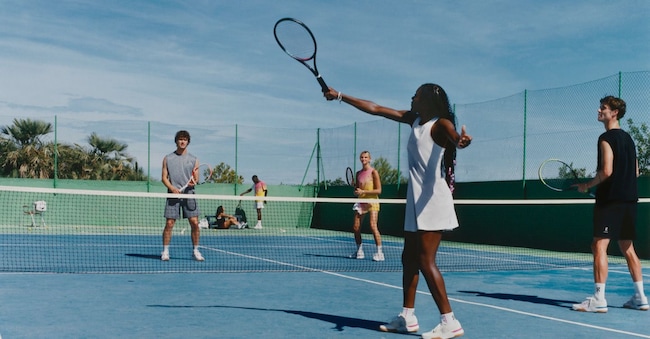
In tennis, the kinetic chain, timing and quality of the stroke were analysed, whilst markerless video analysis enabled the study of posture, joint angles, trunk rotation, hip engagement, the action of the dominant arm and the sequence of movement. This analysis is complemented by acoustic analysis to automatically detect events such as ball-racket impact and the ball bouncing on the court.
“The aim is not just to measure ‘how well’ the athlete performs,” continues the researcher, “but to understand ‘how’ they achieve that performance, how they coordinate their body segments, manages timing, distributes the load, maintains balance and posture, and whether certain individual characteristics of the movement represent a strength or not.” Then there is water polo, a particularly significant case because it brings biomechanical analysis into a challenging environment such as water. Paralympic water polo has also been the subject of study using the same technological approach, which is particularly useful for objectively assessing how a physical disability affects actual sporting movements, highlighting which functional limitations affect buoyancy, vertical propulsion, trunk control, use of the upper limbs, passing, shooting and response to physical contact.

