

Terrorism and infrastructure: Algeria secures its Sahel border
Tebboune’s government has come out in support of the junta in Niger following the failed coup at the end of August. The strategy is more pragmatic than ideological
from our correspondent Alberto Magnani
 Aggiungi Il Sole 24 Ore
ai preferiti su Google
NAIROBI – On the morning of 30 August, Niger appeared to have already escaped the fate suffered by the allied governments of Mali and Burkina Faso between 2021 and 2022: a coup within a coup against Abdourahamane Tchiani’s military junta, which had come to power three years ago through a putsch and was now under pressure from a widespread mutiny by rebel soldiers that had broken out the day before. “It all seems to be over, for now,” a source familiar with the situation confirmed to NextMed, noting that one of the peaks of tension in recent months had subsided.
The Nigerien Ministry of Defence has officially confirmed that the attack had been thwarted just a few hours after an offensive was launched against ‘sensitive targets’ such as the presidential palace, Diori Hamani International Airport and Base 101: the military base that serves as a hub for the Sahel States Alliance command and hosts an Italia contingent of 300 soldiers from the Bilateral Support Mission in Niger (MISIN), the only Western mission to have survived the coup leaders’ severing of ties with their former partners in the EU and the US.
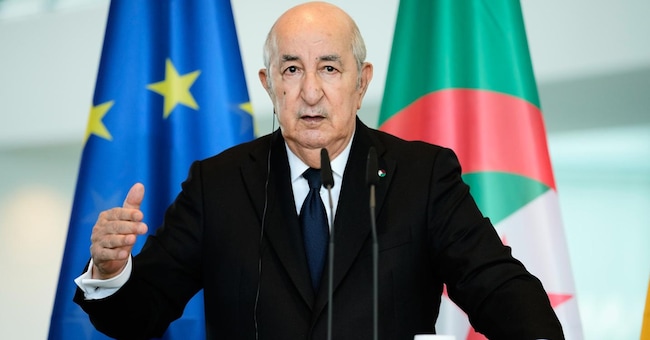
Russia has claimed credit for the decisive contribution made by its Africa Corps – the former Wagner Group contractors linked to the Sahelian military governments – who intervened to protect the junta at the height of the mutiny. But there is another player that has landed – literally – in the fray, following the aftermath of the attempted coup against Tchiani: Algeria. On 30 August, Abdelmadjid Tebboune’s government dispatched four Sukhoi Su-30MKA jets – heavy Russian-made fighter aircraft – in a mission supported by an Il-78 tanker and an Il-76 transport aircraft. The Algerian Ministry of Defence, according to the Turkish news agency Anadolu Ajansı, stated that the aircraft had been deployed at Niger’s request for a mission to counter the ‘attempt to destabilise’ Niamey, carrying out an order issued by the Chief of the General Staff of the Algerian Army and President Abdelmadjid Tebboune. The underlying objective, the ministry emphasised in a statement, is to ‘strengthen security and stability’ in the region.
Algeria’s renewed engagement in the Sahel
Algeria, with a population of fewer than 50 million across Africa’s largest land area, has always espoused the doctrine of non-alignment and continues to defend it today as a ‘sovereign choice’ within the new global balance of power. However, its intervention in support of the ‘brother nation of Niger’ consolidates and expands an increasingly clear interest in the Sahel, the semi-desert region bordering its southern frontier, which for years has been mired in a vicious circle of violence by armed groups and military coups: five in three years across Mali, Burkina Faso and, indeed, Niger – the three juntas now united within the Alliance of Sahel States. On 9 August, just a few weeks after the mutiny in Niamey, Algiers donated a fleet consisting of two Mi-24 SuperHind attack helicopters and two Mi-171 transport helicopters to the junta. The month before, in July, there had been a rapprochement with the Malian junta and the reopening of airspace one year after the incident that triggered the rift: the shooting down of a Malian surveillance drone flying beyond Algerian borders, although the Bamako junta has always denied the territorial violation alleged by Algiers.
Algeria, explains Dario Cristiani of the Atlantic Council, has always regarded the Sahel as a sensitive region and has adopted a policy of ‘influence without interference’: a doctrine exemplified by diplomatic initiatives such as the 2015 Algiers Agreement between the Malian government of Ibrahim Boubacar Keïta and the Tuareg separatists, which was subsequently torn up in 2024 by Assimi Goïta’s junta. ‘The spread of Al-Qaeda in the Islamic Maghreb into the Sahel and migratory pressures,’ says Cristiani, ‘have increased the region’s importance for Algerian security, prompting the government to adapt its relations with the juntas’. The results have been diplomatic rapprochements initiated with the governments or more robust interventions in the defence sphere, culminating in support following the ‘non-coup’ of 29 August. This moment “marks a turning point and reflects a shift towards a more pragmatic and resolute Algerian foreign policy”, explains Dalia Ghanem, an analyst at the German Marshall Fund of the United States. In this light, Ghanem adds, the approach towards Niger should not be interpreted as ideological alignment with the military government but as a “realistic calculation” to prevent the collapse of neighbouring authorities and a power vacuum along 950 kilometres of border.


