Industry

Tesla, Roadster further away and Cybertruck flop. Where the company that will pay Elon Musk a trillion is going

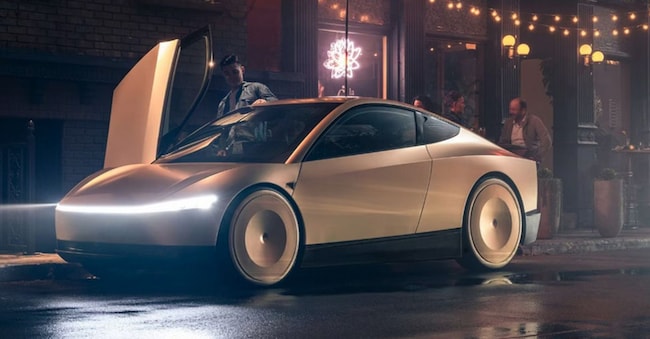
2026 will be a pivotal year for Tesla, with the Cybercab robotaxi, the Semi electric tractor and the Roadster unveiled back in 2017 going into production.

by Simonluca Pini

3' min read

Translated by AI
Versione italiana

3' min read

Translated by AI
Versione italiana

Wow announcements, headline presentations and fans in a frenzy. Elon Musk's modus operandi for all Tesla launches, capable of approaching the concept of a 'Copernican revolution' at every presentation. Hype on a par with Apple's first iPhones, when more than a phone it seemed that Cupertino had put Star Trek's Tricorder into production.

A few examples? The second generation Tesla Roadster; presented in 2017 as the fastest car in the world, expected on the market in 2020, articles making comparisons with Ferrari and Lamborghini but to date remaining a project (told very well) on paper and postponed to April 2026. Slightly different situation for the Cybertruck pick-up, which actually arrived on the market but with exponentially different numbers from the interest generated at launch. Because despite the almost 2 million orders reached in July 2023, against a down payment of $100, in 2024 deliveries did not reach 40,000 vehicles and in the first quarter of 2025, according to data from S&P Global Mobility, there were around 7,100 pick-ups. These numbers are a far cry from the 250,000 vehicles per year announced by Musk, with production capable of reaching 500,000 vehicles. Flop in contrast with the results of the Model Y, which on the one hand shows significant declines compared to the past, but on the other continues to be at the top of the best-selling models.

Loading...


Targets for the 1 trillion dollar salary


How will Elon Musk conquer the $1 trillion package recently approved by shareholders? By achieving goals of similar complexity to putting a man on Mars. Putting the financials aside for a moment, with capitalisation to reach $8.5 trillion by 2035, more than eight times its current value, industry expectations have been described by Tesla itself as 'extraordinarily difficult to achieve'. The first challenge will be to reach 20 million vehicles produced, have 1 million Cybercab robotaxis in service, sell 1 million Optimus robots and have 10 million active Full Self Driving subscriptions.


Chips and Artificial Intelligence


Goals that leave many questions open, especially in the face of declining general sales and the announcement made in 2024 by Tesla itself confirming that it would be impossible to deliver 20 million cars per year from 2030. This is in addition to an increased focus on the world of artificial intelligence with the growth of xAI, Musk's company engaged in AI, and the desire to build a factory christened Tesla Terafab for chip production.


Tesla robotaxi Cybercab, produced in 10 seconds


Continuing with the goals to be achieved, the production of Cybercab robotaxis expected by 2026 stands out, built at the incredible rate of 10 seconds per vehicle (as opposed to barely a minute for a Model Y). How is this possible? Thanks to the use of the Unboxed system, where production is divided into independent sub-assemblies that can be built at the same time and then assembled on the final line. Hence the ten-second lead time. This innovation follows Gigacasting production, which uses gigantic presses, or 'gigapresses', to cast large underbody structural components into a single piece of aluminium. Production confirmed by Musk himself for the third quarter of 2026, at a rate that could reach 5 million robotaxis per year. Also in 2026 will come the final version of the electric Semi, first unveiled in 2017.

Goals that find many similarities with SpaceX: aiming at Mars to get to the Moon.

Copyright reserved ©

Brand connect

Loading...

Newsletter

Notizie e approfondimenti sugli avvenimenti politici, economici e finanziari.

Iscriviti