
Textiles, not reusing waste wastes $150 billion annually
According to Bcg's 'Spinning Textile Waste into Value' study, raising textile waste recycling rates above 30% would create over $50 billion in new value and around 180,000 jobs

3' min read
3' min read
In 2023 the global production of textile fibres reached the highest ever, with 124 million tonnes, up 7% on the previous year, and a figure more than double that of 2000: these figures are reported in the latest edition of the 'Materials Market Report" by the NGO Textile Exchange, committed to the circular and most sustainable transition of the world textile industry, which reports that in 2030, if this rate is followed, production will reach 160 million tonnes. For the most part, 57%, these fibres are synthetic and obtained from virgin fossil sources, primarily polyester (cotton covers 29% of the total): although this category is also the one that has grown fastest in recent years, the share of recycled fibres is still very low, reaching 12.5% of the total, which is also down from 13.6% in 2022.
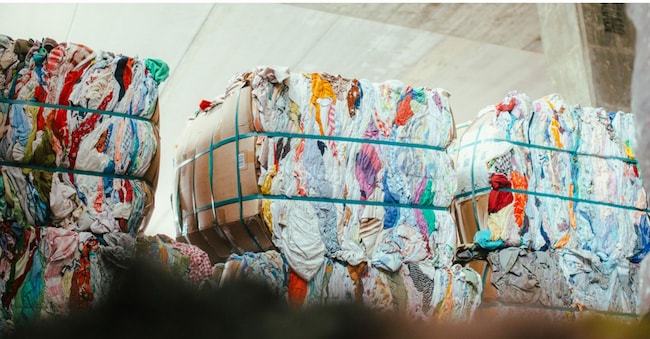
Yet, the reuse of textile waste has long been identified as a sure way for the textile and fashion industry to achieve its coveted, greater and more genuine sustainability. Another report, this one by the Boston Consulting Group, highlights the benefits of more effective recycling of textile waste. According to this study, entitled 'Spinning Textile Waste into Value', around 80% of discarded garments still end up in landfills or are incinerated, while less than 1% are actually recycled into new fibres. This is a huge loss, not only environmentally but also economically: raw materials with an estimated value of $150 billion are lost every year.
Yet, it is estimated that raising recycling rates above 30% would create over $50 billion in new value and around 180,000 jobs. By 2030, moreover, demand for recycled textiles will exceed supply by 30-40 million tonnes.
"The study highlights a fact to reflect on: today only 7% of global textile waste is available as raw material for textile-to-textile1 recycling, the rest is lost in landfills and incinerators. This is a problem that calls for the need to create new industrial and technological solutions on a large scale," says Beatrice Lemucchi, BCG's Managing Director and Partner. "Never before have we been in the right moment: in Europe, regulatory pressure is accelerating with the introduction of extended producer responsibility, which will oblige brands to finance collection and recycling in the markets where they operate. It is not just a matter of adapting to stricter rules, but of seizing a strategic opportunity to strengthen competitiveness and turn waste into a resource'..
Burning a single tonne of textiles is equivalent, in terms of emissions, to six return flights between London and New York; sending it to landfill is worth as much as eight. If, moreover, these are authorised landfills, as expanses of textile waste dumped illegally, and with serious harm to the environment and people, are multiplying from the Atacama desert in Chile to Ghana to Kenya, but also in Europe, where in Romania the Jiului valley, once a centre of mining production, is being filled with waste from other countries, primarily Germany, as a Greenpeace investigation has reported.

