

Achilles’ Shield, spanning Greece and Israel, is the most advanced defensive system and a source of division within NATO
The 3-billion deal to supply Athens with air defence systems is the largest contract ever signed by Tel Aviv-based companies with a foreign state and will cover the eastern Mediterranean. It has an anti-Turkish dimension that reignites the Cyprus issue and rearms the Aegean. A part of Europe is sharing Turkish technology within the Atlantic Alliance

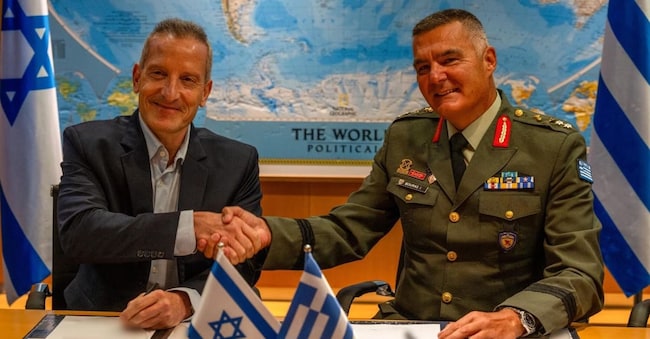
Israel and Greece have signed a 3 billion euro agreement, under which Tel Aviv will supply Athens with a multi-tiered, multi-layered air defence system that can be integrated with the various branches of the armed forces, including the Navy. This news item, dated 31 August 2026, has been explained in some technical detail by the Israeli Ministry of Defence. The Achilles Shield agreement provides for the export of various systems, including David’s Sling and SPYDER, manufactured by Rafael, and the BARAK MX, manufactured by Israel Aerospace Industries. The Ministry explained that this is the ‘largest agreement for the export of military equipment in the history of relations between Israel and Greece, and one of the largest in the history of the State of Israel’. In practice, it is a ‘comprehensive defence system against a wide range of threats’, including ballistic missiles and drones. Greek companies will contribute 25 per cent of the contracts and provide in-house technological development. From an industrial perspective, the Achilles Shield represents the most comprehensive protective system currently available on the defence market and marks the culmination of Tel Aviv-based companies’ expansion into international markets. Greece, for example, is already relying on Israeli technology for the core architecture of its future national air defence system. Last April, Athens signed an intergovernmental agreement worth approximately 750 million dollars, under which Israel undertook to supply the Greek armed forces with the Puls rocket artillery system from Elbit Systems.
Rafael's video
In addition to Greece, among the defence agreements signed by Tel Aviv this year, there is the agreement signed at the end of June between Rafael and the Romanian Ministry of Defence for the SPYDER air defence system, with an estimated value in excess of 2 billion. In short, the aim is to create a modular and integrable technological buffer zone. First and foremost, at least 12 Greek vessels, including FREMMs and others, will be able to be incorporated into the shield, thereby extending its geographical reach. If we consider that Cyprus, too, relies on Israeli systems for certain activities, it is easy to understand the actual area of operation of the ‘Achilles Shield’, which effectively encloses the eastern Mediterranean. All of this stands in stark contrast to the Turkish initiatives relaunched at the recent NATO meeting in Ankara.
The Cyprus issue
Greece’s decision, which is also linked to its long-standing hostility towards Turkey, widens an existing rift within European defence. It should be noted that Italia has put its military cooperation agreement with Israel on hold and, conversely, has stepped up relations with Ankara. As 24Ore NextMed has already reported, on the Turkish front, bilateral trade with Italy reached around 28 billion euros in 2024, with Meloni raising the target to 35–40 billion in total trade in the joint communiqué from the April 2025 summit. The most sensitive pillar of that agreement is the Leonardo-Baykar deal. Baykar — led by Selçuk Bayraktar, Erdoğan’s son-in-law — will set up a joint venture with Leonardo, based in Italia, for the development, production and maintenance of unmanned aerial systems, with facilities to be located in Ronchi dei Legionari. The Secretary-General of NATO, Mark Rutte, has outlined three priorities for Ankara: investment in defence, transatlantic industrial production and support for Ukraine, whilst the allies have pledged 70 billion euros in military aid to Ukraine for 2026–2027 at a summit hosted by the very country that Israel now regards as its emerging strategic threat. All of this takes place within the Atlantic framework that both countries share with Washington. Another detail is crucial to understanding their geopolitical positions.
The Israeli dome drone
Alongside the ‘Achilles Shield’ deal, Israel and Greece have also signed a supplementary agreement, worth 26 million euros, “for the sale of Rafael’s Drone Dome systems”, the ministry added, emphasising that Israel ‘will expand industrial cooperation in the defence sector with Greece, including the transfer of knowledge and technology to local industry’. The system is similar to the one that Fiumicino Airport was due to use. After months of suspension and appeals to the Regional Administrative Court (TAR), the contract was subsequently put on hold and later awarded to the Italian firm Elt. On 6 August, as reported by Il Messaggero, the Council of State ruled that the radar was a military device and therefore ordered the contract to be halted. This effectively marks a standstill in technological exchanges between Italia and Israel. From a strategic perspective, the Greek model could be replicated by the promise to deploy the Michelangelo Dome announced by Leonardo. It is by no means certain whether the Italian strategy will focus on markets further east, such as those in Ukraine, or whether, in future, it will seek to integrate Mediterranean security through dialogue with neighbouring Greece.

