Middle East

Beauty victim of war, but in East Jerusalem there are those who protect it

How Pro Terra Sancta preserves the art and cultures of the West Bank. And what Easter means when you watch the rockets from the rooftops of Bethlehem

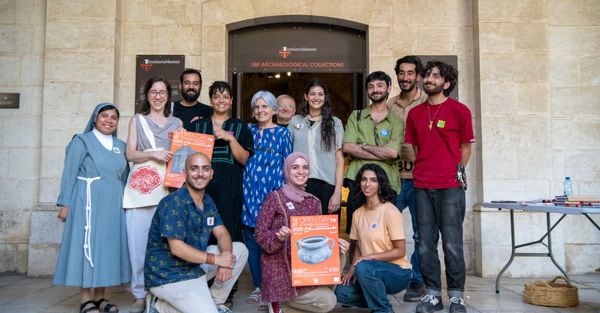
Carla Benelli (a destra) e il progetto “Noi, preziose come il nardo” a Betania Pro Terra Sancta

8' min read

Translated by AI
Versione italiana

8' min read

Translated by AI
Versione italiana

There is a place in Jerusalem that cares about preserving the cultural heritage of that land. It is located in the Old City - a square kilometre of land within the Ottoman walls, home to some 30,000 people, of whom 9 out of 10 are Muslim - housed in the courtyard of a Franciscan convent.

"It has always been a little uninviting for those who live here, because it seems reserved for Christian pilgrims, but in truth it is an archaeological collection that tells the history of this region". Speaking is Morgane Afnaim, who arrived in that part of the world from Milan almost five years ago thanks to civil service and the association Pro Terra Sancta and now, as a cultural mediator, is the project manager of Hakayet Turath - literally "stories from heritage", in Arabic - a training course aimed at educating and raising awareness among local young people about the artistic heritage of their territory.

Loading...

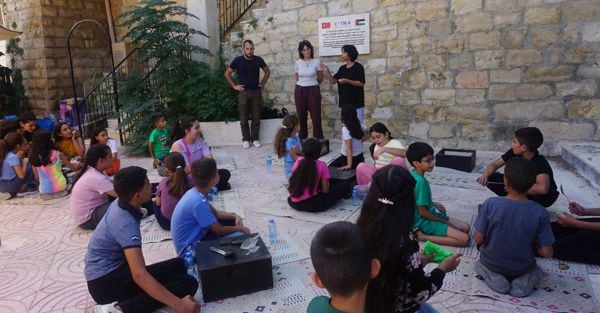
The project, carried out by the Franciscan friars and the Terra Sancta Museum with the support of the European Union Heritage Education Hub for Palestinian Youth, now employs eight Palestinian youth and opens the museum's doors to the neighbourhood's population, organising arts and crafts activities and workshops that have so far reached more than 1500 children.

"This land is not rich in natural resources, but it has a very precious artistic, cultural and spiritual heritage. Entrusted to people in great difficulty: the Palestinian population clearly has priorities for survival today", explains Carla Benelli: an art historian who grew up in Rome, she has lived in East Jerusalem for almost thirty years now and coordinates the projects of Pro Terra Sancta. Her hands have touched and restored the mosaics of Jericho together with Franciscan archaeologistMichele Piccirillo, the Gethsemane, and now work on the conservation of theHoly Sepulchre.

"But it is very important to pass on to those who live here the skills to conserve this heritage: it is a benefit for all and a hope for the future," he says. After decades of conflict, the focus "goes first and foremost on the broken lives, on those who cannot return. Together with the population, however - which is clearly the first victim - there is also a less obvious victim: history, monuments, the beauty of an area that is destroyed,' he warns.
Making art amid bombs

When asked how it is possible to talk about art in the midst of war and bombings, she replies that 'it is not difficult, because communities know what a disaster it is to lose something that connects you to your land. The important thing is to give opportunities, not to close down,' he assures. He tells of the enthusiasm of children and schoolchildren when they first opened the Sanctuary of Bethany to the public with guided tours and workshops for young archaeologists. It describes the joy of discovering that something affects you, that it is not only accessible to tourists and that it can become an economic resource to build your own tomorrow. Or a good reason not to lose hope today, when the Israeli-American attacks on Iran have further complicated the situation.

"We, precious as spikenard", for example, is a women's entrepreneurship project in Bethany, which aims to restore economic independence to women whose lives have been profoundly marked by the war: women who make scented candles by hand (10,000 were produced last year) and try not to stop, even in these hours when restrictions are even harsher.

Le attività didattiche di Pro Terra Sancta per giovani archeologi in erba fuori le mura di Gerusalemme

"They are jobs that we guarantee. They are drops in the sea of need, but we are nevertheless proof that dialogue works, that peace is possible,' Carla reflects.

There is the daily grind of being in places where "obstacles are the order of the day", says Morgane, "and every military escalation bringsan extra piece of restriction. So plan, then reschedule. With flexibility. If plan A doesn't work, there's plan B, then C and D. And if they don't exist, you invent them,' he jokes, 'because it's not like if you close the schools or the checkpoints (the Israeli checkpoints in the West Bank, ed) the children stop existing.

He who controls culture, controls history

The words of these two women capture a reality where - although conflicts and prohibitions are nothing new - the attacks of Israel and the United States on Iran are making a difference, for the worse. "The Old City is the most militarised place in Jerusalem, it is the most sensitive place in this country. Because of the presence of the al-Aqsa Mosque, because of the Wailing Wall. There are settlers in the old city, the military presence is constant and the rules on gatherings are increasingly restrictive,' Morgane Afnaim points out.

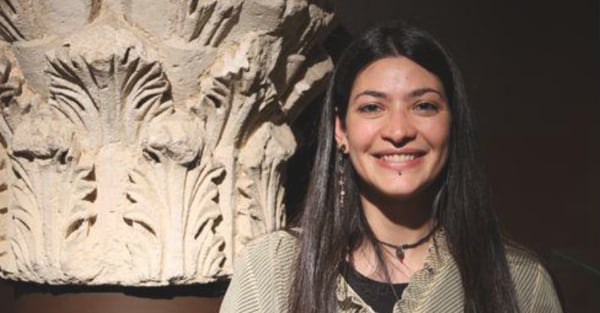
Morgane Afnaim al Terra Sancta Museum

"So with a lot of creativity we try to readapt the context each time," he clarifies. He tells of a speech therapy centre for children where "we are trying to coordinate a group of ladies, of mothers" in an activity that allows them to experience Eid al-Fitr in some way, that is, the end of Ramadan, even though it has now been a few weeks and for the first time in decades it could not be celebrated together because the esplanade of the Mosques was closed to the public. "We are developing research related to the collections of our museum, but also to the Dar Al-Tifel Museum and the Museum of Al-Aqsa, to find all the objects related to the preparation, consumption and rituals related to incense. We want to combine this with an incense production workshop,' he says.

"It isa small thing, but it makes it possible tosafeguard a culture when spaces for Palestinians are violently suppressed. Last year there were cases of police raids inside a Palestinian cultural centre during the screening of films, because one had a Gaza theme," he denounces. "With all that is going on, one has to think: if they interrupt a film or seize books, what difference does it make? But who controls culture, controls history. And now even schools in East Jerusalem have to conform to the Israeli curriculum' so that Palestinian history is in danger of ceasing to exist. That is why, according to her, 'what we do does not save lives, but it is necessary'.

The Pasques without shelters and the Israeli-American attacks on Iran

Like Al-Aqsa, Jewish and Christian holy places are also forbidden access. "The Holy Sepulchre is closed for the Passover (between 5 and 12 April, this year, the Catholic, Jewish and Orthodox Passovers will follow one another) for security reasons, because the old city - Arab, poorer and older - does not have air-raid shelters. If missiles fell, no protection could be guaranteed, so the only businesses allowed to open are food shops,' Carla Benelli continues. 'We are expecting a very strange Easter, with no pilgrims and no believers,' she predicts.

A Gerusalemme pochi frati francescani a processione per Venerdì Santo

"It is all strong and sad, strongly sad," the project manager of Hakayet Turath echoes her. "The whole world these days reads gospel passages describing this place. The Holy Sepulchre is here, the Nativity is here, Al-Aqsa is here. They are on everyone's mind, but they are empty. I always sense a great intensity in being close to these places, and a great tragicness in seeing how they are instrumentalised".

"It is deserted, a bit like during the Covid," Carla Benelli continues, "but then it was like that for everyone. Now instead if you go to West Jerusalem everything is open: it's alienating. There are shelters there, everything works,' she says.

And for those like her who live in the old city? "By now here in Jerusalem we are very fatalistic," she replies. "I'm not crazy or particularly brave, but in these situations thenyou rely. If you are a believer, to God. Otherwise to statistics,' she goes on. 'And the next morning you go to the neighbours to see if everyone is OK, if they heard the missiles, if they managed to sleep'. It is not true, according to her, that necessity makes one selfish. On the contrary: 'At times like thisyou learn to be more generous,' she assures. Because there is little desire to be alone when the sirens go off, when you are looking for other human beings. 'There is a sense of belonging, of collectivity, there is still humanity,' he says.

"In Bethlehem we go to the rooftops to see the rocket (rockets, ed)," says Morgane, "in the whole West Bank there are no shelters. But the beauty of the human being is that he adapts to everything'. So after a while one no longer fears for one's physical safety. "I am afraid, however, that this will not end. That it is another situationthat we will all have to get used to and that it will be normalised, like in Gaza."

They both talk about how, as Italians, they nevertheless feel freer: 'To go home, if necessary'. Because the Ben Gurion airport in Tel Aviv is closed, in practice, but you can always fly from Jordan or Egypt. Because their home is there - in Jerusalem for almost 30 years for Carla, in Bethlehem for five for Morgane - but home is also always Italia, in Rome and Milan respectively.

"Sometimes I feel the responsibility to have those energies that the group lacks, because I have this privilege that they don't have, so I want to try to lighten the situation, at least not to burden it," confesses Morgane Afnaim. "But what do you do with this privilege, when everything that happens is bigger than you?" she asks. A passport allows you to leave, 'to cross more checkpoints', but you cannot put it at the service of others.

Carla, who is a few years older, says she has no children or special family responsibilities. "But I recognise in the eyes of women, both Palestinian and Israeli, how difficult it is to think of raising one's children in this context," she confesses.

Looking to the past, looking to the future

The situation is complicated for everyone, and the uncertainty - "not knowing whether it will lasta week or a year and a half" - wears everyone down. "It does so much to have something to keep putting your energy into: keeping busy and working together, not being alone," explains Morgane. "It helps to keep seeing the beautiful, to want to cherish the beautiful". Even if - while morale 'goes up and down' - there, most of the NGOs and offices have closed to the public and are teleworking (on and off).

"Wondering what the future holds for us is what scares us the most," for Carla, "but there is and there will be a future," she reiterates.

Among the aspects that keep the staff of Pro Terra Sancta looking ahead, there is the commitment to education, because there is no shortage of heritage in Jerusalem and its surroundings, but academic offerings to take care of it are scarce.

Il team di Pro Terra Sancta

"We organised atraining programme in Italia for all the staff in January. Partly in Rome with Coop Culture, then with a research centre in Milan that has a master's degree at Cattolica on these issues,' Morgane explains. A 'very useful experience for everyone', she emphasises. Two of their trainees were then supposed to leave at the end of March for six months ofapprenticeship in the capital, one at the Museum of Civilisations in Rome and the other at the Vatican Museums. But after 28 February everything came to a halt. Postponed until a later date.

"I really hope the guys will be able to go to Rome and start their internships," Morgane urges. "It is a unique opportunity that we have been working on for months. They have given so much in their work here, they deserve it. And also this place, this country where opportunities are constantly being cancelled, this community deserves to have people growing up, don't they?" she concludes.

Copyright reserved ©
Loading...

Brand connect

Loading...

Newsletter

Notizie e approfondimenti sugli avvenimenti politici, economici e finanziari.

Iscriviti