
The Bundeswehr will take part in French nuclear exercises
For the first time, the German army will take part in strategic manoeuvres with its ally: an operational step towards extending Paris’s nuclear umbrella to Europe. Rafale fighter jets at the Nörvenich base, near Cologne

Key points
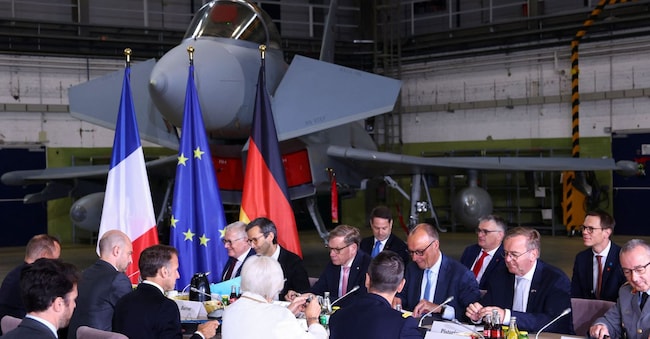
Amidst two German Eurofighter jets and two French Rafale jets, in a hangar at the Nörvenich military base near Cologne: this was the setting chosen by Chancellor Friedrich Merz and President Emmanuel Macron to formalise the Bundeswehr’s participation in a French nuclear exercise. The first of its kind in history.
The nuclear umbrella
Meeting for the Bilateral Defence Council, the delegations took practical steps towards implementing the plan, announced in March, to extend France’s nuclear umbrella to Germany. The initiative includes the United Kingdom, the continent’s other nuclear power, and will be open to European partners who wish to join.
Yesterday, military personnel from the two countries worked together on aircraft maintenance tasks, having carried out a joint in-flight refuelling exercise the day before. The Rafale fighter jets, deployed at Nörvenich, are capable of carrying nuclear weapons. And the historic participation of German forces in French nuclear exercises is scheduled for the autumn.
With the meeting in Nörvenich, Paris and Berlin are also putting the failure of FCAS advanced fighter aircraft project (Future Combat Air System), which Germany abandoned after years of dithering and disagreements over the industrial project and national strategic priorities. However, not everything will be scrapped: the two countries will continue to develop the jointly designed cloud-based solution. Yesterday, a work plan was approved for cooperation within the European defence industry, particularly in the fields of air defence and long-range systems. Just a few days ago, alongside other European countries and Ukraine, France and Germany launched the coalition for defence against ballistic missiles.
Between the Russian threat and the uncertainties surrounding NATO
From Nörvenich, Merz, Macron and numerous ministers travelled to Augustusburg Castle in Brühl for the Franco-German Ministerial Council. At the press conference following the meeting, Merz emphasised that ‘cooperation between Germany and France is essential at a time when Russia is threatening our security, China is putting our economy under severe strain and the transatlantic partnership is no longer a given’.


