
The drought has split the Rhine in two, and 70 per cent of France is under water restrictions
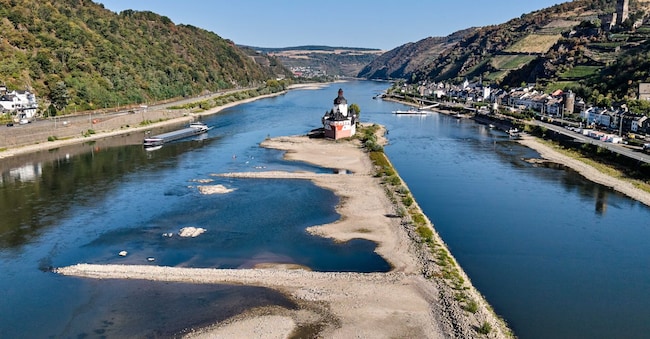
Shipping on one of Europe’s main trade routes is at risk of being disrupted in Germany: in Kaub, between Koblenz and Mainz, water levels are at their lowest ever recorded. The Danube and Vistula are also in crisis

Key points
In Germany, the drought threatens to split the Rhine – one of Europe’s main trade routes – in two. In France, water use is subject to restrictions across almost 70 per cent of the country. In Hungary, Romania, Austria, Slovakia, Serbia and Bulgaria, low water levels in the Danube are causing problems for electricity generation. In Hungary, in particular, the Paks nuclear power station has already had to virtually shut down its reactors because there is not enough cooling water and what there is is too hot. The Vistula in Warsaw is also at an all-time low.
It’s not a black swan
Alongside heatwaves and wildfires, drought is one of the many facets of the climate crisis, which takes a heavy toll in terms of lives lost and economic damage. Unlike other crises, however, this cannot be described as a ‘black swan’ event. Far from it: for decades, scientists and environmentalists have been trying to warn about consequences of global warming.
The Rhine split in two
Whilst the situation on the Po is dire, that on the Rhine is causing concern across half of Europe. According to the German Association for Inland Navigation, ‘over the course of the week, and for the first time, the Rhine will no longer be continuously navigable and will effectively be split in two’. The dividing line is at Kaub, between Koblenz and Mainz, where water levels are at their lowest ever recorded (below 20 cm). As Carsten Brzeski of ING Research points out in a note, the Rhine is ‘the infrastructure around which much of German industry has physically developed’. Around 285 million tonnes of goods pass through its waters each year, making the river ‘Europe’s most important logistics corridor after the open sea’. The Rhine links Rotterdam to the Ruhr steel-producing region, the Main steel-producing region and the Ludwigshafen chemical complex. ‘When its water level drops, the impact strikes at the very heart of German industry,’ continues Brzeski.
During the 2018 drought, inland waterway freight volumes fell by around a quarter, leading to a 1 per cent drop in industrial output. Overall, according to the ING economist, GDP growth is estimated to have been reduced by around 0.3 per cent. A repeat of such an episode would further stifle the German recovery.
The Minister for Transport, Steffen Bilger, has proposed temporarily suspending the ban on lorries travelling on Sundays and public holidays, in order to shift some essential freight from river to road transport, following the example of Saarland and Rhineland-Palatinate. As Brzeski points out, however, ‘replacing a single barge can require up to 100 lorries or an entire freight train’.


