
Interview with the UAE Ambassador to Italia

“The Emirates are working on alternative routes: ports and railway lines to Jordan”

Abdulla Ali Al Subousi describes the commitment to ensuring freedom of movement beyond the Strait of Hormuz and Bab el-Mandeb. “We can work together on the future of water. I am certain that, together with our European partners, we will implement concrete initiatives.” As for the 40-billion agreement with Italia: “It will also involve SMEs. Among the priorities are energy, cultural heritage, connectivity, high-tech industry, artificial intelligence, and technologies for water and healthcare.”

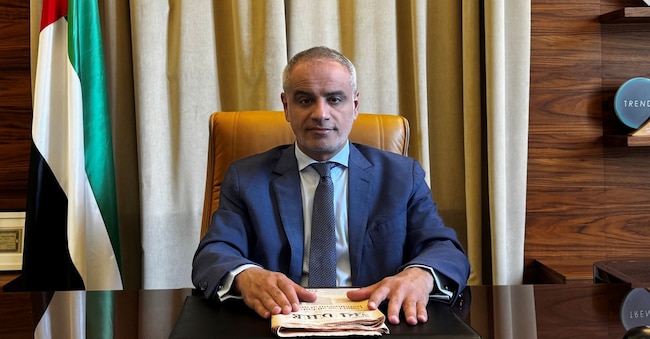
L’ambasciatore degli Emirati Arabi Uniti in Italia, Abdulla Ali Al Subousi

5' min read

Translated by AI
Versione italiana

5' min read

Translated by AI
Versione italiana

Hormuz, Bab el-Mandeb, crises, alternative routes and the attempt to ensure stability in supply chains. Amidst all this, the growing need for energy and bilateral partnerships. And the call for the rule of law. “What we can do is ensure that global trade has more than one route. Hormuz and Bab el-Mandeb are not regional issues. They are global arteries,’ summarises the United Arab Emirates’ Ambassador to Italy, Abdulla Ali Al Subousi, whom we asked to take stock of the relationship between his country and Italy.

Let’s start with the $40 billion deal. Which Italian industrial sectors will be affected by the investments, and what is the expected timeline?

Loading...

‘The commitment was announced during the visit of the President of the United Arab Emirates, Sheikh Mohamed bin Zayed Al Nahyan, to Rome in February 2025. Priorities include energy, cultural heritage, connectivity, the high-tech industry, artificial intelligence, and water and healthcare technologies. In the energy infrastructure sector, for example, I would cite the cooperation between Eni, Masdar and ADQ. Then there is the example of trilateral cooperation in Albania. There are also advanced collaborations in the defence and shipbuilding sectors, involving Leonardo, Fincantieri and Edge. The UAE’s approach is a long-term one, taking a project-by-project basis in the sectors selected jointly with both large and small companies.”

The partnership between Eni and Adnoc is evolving beyond the traditional oil and gas relationship. What is your vision for the future of hydrogen and CO₂ capture technologies in collaboration with Italian companies?

“Eni and Adnoc have a broad-based energy partnership. Eni also operates in the traditional sector in the Emirates, but today that partnership rests on a second pillar: the energy transition. Hydrogen and carbon capture are not just slogans. Blue hydrogen and carbon capture can help reduce the carbon intensity of fuels and industrial energy whilst demand continues to grow. In the long term, green hydrogen and renewable energy can help expand the supply of clean energy in the Mediterranean. Italia brings tangible industrial capacity to this process. The UAE brings its industrial scale.’

Tensions in the Red Sea and the Middle East are threatening the security of trade routes and the India-Middle East-Europe corridor (IMEC). How will you ensure stability and continuity in supply chains?

‘What we can do is uphold the principle that international shipping must remain open and ensure that global trade has more than one route. The Strait of Hormuz and Bab el-Mandeb are not regional issues. They are global arteries. Our position is that no country has the right to disrupt these flows. The solution must be sought through international forums. We have reaffirmed our commitment to IMEC. The most advanced section at present is the one between India and the UAE. We are also working on the connection with Europe and Italia. The UAE has invested in ports, logistics infrastructure and pipelines precisely to avoid dependence on a single transit point. We are modernising our role as a hub for goods, energy and data. If a route comes under pressure, trade must be able to continue flowing. This is why we have invested in the development of the Etihad Rail network, which is building a land link between the UAE’s ports and airports and will extend as far as Jordan. We are also strengthening the capacity of the port of Fujairah, which is located outside the Strait of Hormuz, to deal with the current crises.’

He took part in the Euro-Mediterranean Water Forum. Which of the issues raised in Rome will we see again at the United Nations Conference scheduled to take place in Abu Dhabi in December?

‘One of the key points that emerged in Rome concerns how to make water projects more attractive to investors. The problem is not a lack of capital or technology. It is primarily about the conditions that make a project sustainable. Sovereign investors are looking for credible projects, a clear allocation of risks, predictable regulatory frameworks and sound financial structures. These factors apply in the Mediterranean just as they do in other emerging markets, and they determine how quickly interest translates into a project. The Abu Dhabi Conference is intended to be a moment for concrete action. There will also be an interactive dialogue on water investment and the Oasis platform, organised by the UAE, which will bring together investors, innovators and policy-makers to discuss practical solutions. Over the decades, we have also invested in desalination, water reuse, efficiency and innovation. This has strengthened our conviction that water is an essential piece of infrastructure, upon which economic growth, food systems, energy, cities and long-term prosperity depend. Our model, which combines development finance, investment, technology and long-term partnerships, is the one we also apply at an international level. One example is the Abu Dhabi Fund for Development, which launched the Abu Dhabi Global Water Platform in January 2026. The aim is to mobilise $2 billion between 2026 and 2030 and reach around 10 million people. We will bring this commitment and our expertise to the UN Water Conference. I am confident that, together with our European partners, we will be able to deliver concrete initiatives not only for our two regions, but also for the rest of the world.’

Could cooperation between Europe and the UAE on desalination become a model for political stabilisation in the Middle East?

Loading...

‘Many argue that the wars of the future will be over water. Working together on new water desalination and purification systems would bring enormous benefits to a large number of communities. The Emirates have a great deal to offer in this field, both in terms of expertise and the experience they have gained. Our approach to water has been shaped by our own experience as an arid country with limited freshwater resources. Over the decades, we have therefore invested in desalination, water reuse, efficiency and innovation. This has strengthened our conviction that water is an essential piece of infrastructure, upon which economic growth, food systems, energy, cities and long-term prosperity depend. Our model, which combines development finance, investment, technology and long-term partnerships, is the one we also apply at an international level. Let me give a concrete example: the Abu Dhabi Fund for Development, which launched the Abu Dhabi Global Water Platform in January. The aim is to mobilise 2 billion between 2026 and 2030 and reach around 10 million people. I am certain that, together with our European partners, we will be able to deliver concrete initiatives not only for these two regions, but also for the rest of the world.”

Copyright reserved ©
Loading...

Brand connect

Loading...

Newsletter

Notizie e approfondimenti sugli avvenimenti politici, economici e finanziari.

Iscriviti