Street art

The end of Banksy's anonymity: criminal liability profiles for Italian works

Lawyer Eliana Romanelli discusses how artist identification has reignited the debate on the relationship between artistic anonymity, criminal liability and cultural heritage protection

by Giuditta Giardini

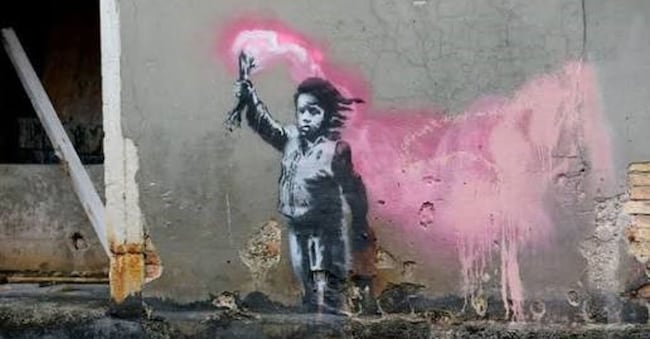
“Migrant Child”, 2019 Palazzo San Pantalon, Venezia

8' min read

Translated by AI
Versione italiana

8' min read

Translated by AI
Versione italiana

On 13 March, an extensive investigation by the international news agency Reuters revealed that behind the pseudonym Banksy would be Robin Gunningham, an artist born in Bristol in 1973, who would later also use the name David Jones.

The discovery would be the result of a long process of investigative journalism, based on the cross-fertilisation of testimonies collected in the field (especially in Ukraine), video analysis and reconstructions of the movements of the elusive British street artist.

Loading...

The revelation of the artist's identity also opens up a number of legal questions, especially in countries - such as Italia - where some of his mural works can be found, including 'Madonna with a Pistol', 2010 in Naples and 'The Migrant Child', 2019 in Venice. Now that the author may be identifiable, autographed or claimed works, created without authorisation, on public or private buildings raise questions of possible criminal liability, as well as balancing against the author's right to anonymity.

To explore the topic further, ArtEconomy interviewed lawyer Eliana Romanelli, PhD student at the Università Cattolica del Sacro Cuore and administrative officer at the National Museums of Genoa - Regional Directorate National Museums of Liguria.

The possible identification of Banksy poses a balancing problem between the author's right to anonymity, recognised by Art. 8 of Law no. 633/1941 (Copyright Law, 'LdA'), and possible criminal liability for works made without authorisation. How is this conflict between the protection of the artist's moral right and the application of criminal law resolved?

Copyright law famously grants the author of "works of human ingenuity of a creative nature" the right to use pseudonyms or stage names or to 'remain anonymous' (Art. 8, 9 and 21 of the LdA). This choice, of course, does not 'cancel' the moral-personal link between the author and his creation: as also sustained in jurisprudence "The protection of the moral copyright does not necessarily imply the disclosure to the public of the relationship between the author and the anonymous or pseudonymous work, so that some of the faculties attributable to the right of authorship can be exercised directly by the author himself covered by the pseudonym-mask" (thus Trib. Milan, 29/11/1995).

It follows that the author is 'always' recognised as having "the right to reveal himself and make his authorship known in court". If, on the one hand, recourse to such forms of 'external representation' of one's artistic work is therefore configured as an author's right and is an expression of one's personality and artistic freedom (falling within 'legitimate' modalities of expression of one's freedom of thought), on the other hand, it prevents (or, at least, makes it more difficult) the traceability of any unlawful conduct to one's person and the ascertainment of the relative liability profiles.

In the criminal legal system, the incorporation of a criminal act by an author-artist who has decided not to reveal his or her identity creates, therefore, a tension between the protection of the author's anonymity, the cardinal principle of personal criminal liability and the exercise of the State's punitive claim, which presupposes the certain identification of the offender in order to bring justice. With a view to preventing the protection of the artist's personality from turning into an instrument of 'legal irresponsibility', the right to reveal or not to reveal one's identity to the public cannot be considered absolute, having to yield in the face of the demands of justice, provided, of course, that the author of the offence is identified following criminal investigation.

For works already existing in Italia, such as the murals in Naples and Venice, what was the applicable legal regime?

The artistic form of street art, by its very nature, inherently inhabits a borderline zone between the value of the creative gesture and the violation of the norm, and Banksy's works do not escape this ambivalence.

From the point of view of a possible criminal liability, the works realised (and claimed) by Banksy on Italia territory impose a crucial distinction based on the legal nature of the support: on the one hand, an urban public good, such as the wall hosting the 'Madonna with a Gun' in Piazza Gerolomini, in the historical centre of Naples; on the other hand, the façade of a private, listed historical property, immersed in the water of the canal, in Rio Novo, Venice, hosting the work 'The Shipwrecked Child'.

In the first case, the legal qualification of the real estate on which the work was carried out allows to configure, in abstract terms, the artist's conduct (dating back to 2010) as an offence of defacing and defacing other people's property, pursuant to Article 639, paragraph 2, of the Criminal Code. This is a type of offence that protects the property of the offended party (i.e. one's own property) from minor impairments and damage that is purely aesthetic and, in any case, easily and completely eliminable and, therefore, not permanent.

The conduct of defacing and defacing, therefore, must have "removable effects and must not affect the functionality of the property". The offence is prosecuted ex officio and carries a penalty of imprisonment from one to six months or a fine of between 300 and 1,000 euro.

In the second case, the execution of the work on a private historical building (Palazzo San Pantalon, listed by the Superintendence of Venice with a Ministerial Decree. of 10 December 1959, and owned by Banca Ifis) allows, always in the abstract, to classify the artist's conduct as a contravention of the offence of illegal works (i.e. carried out without the necessary public authorisations) on cultural heritage referred to in Article 169 of Legislative Decree no. 42/2004 (Cultural Heritage Code) or the offence of defacing and defacing things of historical or artistic interest.

The latter, in particular, is configured as an aggravated case of the offence of defacement and common defacement, which - at the time of the unlawful conduct, i.e. 2019, on the occasion of the inauguration of the 58th International Art Exhibition - was always regulated by Art. 639, para. 2, second sentence, of the Criminal Code (being punished, however, with imprisonment from three months to one year and a fine from 1,000 to 3,000 euro).

The scenario outlined so far, however, now appears to have radically changed following the 2022 reform of the penalty system for crimes against cultural heritage (Law No. 22/2022). From a judicial point of view, however, the hourglass of justice has run out for both of the aforementioned events: the statute of limitations provided for by the Criminal Code has expired, extinguishing any possible offences and making any charges against the artist improper today.

If an intervention similar to 'The Migrant Child' in 2019 were to be carried out in 2026, in Italia, on a listed building such as Palazzo San Pantalon, what consequences could the artist face?

Today, the artist would be faced with a completely changed penalty scenario. With the 2022 reform of the Criminal Code, the legislator has, in fact, introduced enhanced protection for cultural goods, bringing the aggravated offence set out in Article 518-duodecies of the Criminal Code (now repealed) into the new offence set out in Article 639(2), second sentence, of the Criminal Code.

According to case law, 'there is regulatory continuity between Article 639, paragraph 2, second sentence, of the Criminal Code and Article 518-duodecies, paragraph 2, of the Criminal Code, in that the latter provision continues to include the conduct criminally sanctioned by the repealed provision' (thus Criminal Court of Cassation, Sec. II, 16/11/2023, no. 51260). The reform, therefore, introduced an autonomous figure of offence in the new Title VIII-bis of the Criminal Code, which, however, reproduces the contents of conduct previously already criminally sanctioned, as aggravating circumstances of the corresponding general type of offence under Article 639 of the Criminal Code, "with respect to which [the new offence] stands in a relationship of greater sanctioning rigour and, structurally, in a relationship of unilateral speciality by specification, represented by the cultural nature of the good" (thus Criminal Court, Sec. III, 13/02/2025, no. 12518).

The recently introduced autonomous offence, in fact, identifies a 'new' material object of the conduct, now speaking of "cultural or landscape heritage of one's own or of others" and no longer of "things of historical or artistic interest". Moreover, in terms of the subjective element necessary to constitute the new offence, today the rule requires the existence of an actual knowledge, on the part of the offender, of the cultural or landscape value of the property that is the material object of his unlawful conduct. This is not easily provable in court. However, it is at the level of sanctions that the most relevant differences with the previous codified provision are to be found, with imprisonment from six months to three years and a fine ranging from Euro 1,500 to Euro 10,000.

In criminal proceedings, is an assessment of the artistic value of the street art works of Banksy conceivable, given his international recognition?

On this point, the jurisprudential landscape appears fragmented. Although the works in Naples and Venice are now protected - the former protected by a sheet of glass installed by citizens to prevent the work from being damaged and the latter saved thanks to a complex restoration financed by private individuals in the two-year period 2024-2025 - the prevailing, but older, orientation that has been expressed with regard to Article 639 of the Italian Criminal Code considers that "For the purposes of assessing the existence of the crime of defacing and defacement, the alleged artistic nature of the graffiti created is not relevant. [...]

Therefore, in application of such interpretative criteria, if the criminal conduct was carried out on property that had its own well-defined aesthetic physiognomy, the non-constitutability of the offence of defacement and defacement cannot be considered evident, pursuant to Article 129 of the Code of Criminal Procedure. If the author of such graffiti managed to obtain recognition in the art world, this does not exclude that the offence was committed [...]" (thus Trib. Milan, Section VI, 12/07/2010, no. 8297).

There is no lack, however, of hermeneutical openings that suggest assessing whether the aesthetic and cultural value of the work and the social dimension of the intervention can act as objective causes of non-punishability in the strict sense, excluding the punishability of the agent, or can lead to the non-punishability of the author due to the absence of offensiveness of his illegal conduct or, again, to the mitigation of the penalty due to the existence of a special tenuous damage.

Banksy torna a Londra con un nuovo murale

Precisely in the case of "The Migrant Child" in Venice, the same Superintendence - which reported the case pursuant to the aforementioned Article 169, paragraph 1, letter a) of Legislative Decree no. 42/2004 - pointed out that Banksy's work, notwithstanding its unauthorised genesis, could be anyway subject to protection under the provisions of the Code of Cultural Heritage and Activities, since it cannot be considered an act of vandalism but rather a mural painting of artistic value. Based on these arguments, the case was dismissed by the Judge for Preliminary Investigations of Venice (at the request of the same Public Prosecutor).

Ultimately, the case highlights how the most recent jurisprudence seems to be oriented towards finding a delicate balance, where the rigour of the rule gives way to the artistic value of street art works and the social function that this artistic form often pursues.

Copyright reserved ©
Loading...

Brand connect

Loading...

Newsletter

Notizie e approfondimenti sugli avvenimenti politici, economici e finanziari.

Iscriviti