
The comment

The EU Action Plan for the Mediterranean is moving forward. But it is time to involve the regions

This autumn, Europe will present the operational update to the Pact first unveiled in 2025. It will be underpinned by universities, digital transformation and cable interconnectivity. Beyond the funding, what Mare Nostrum can offer is the intersection between administrative areas and a third path to innovation, beyond the techno-right and techno-left models that monopolise the debate

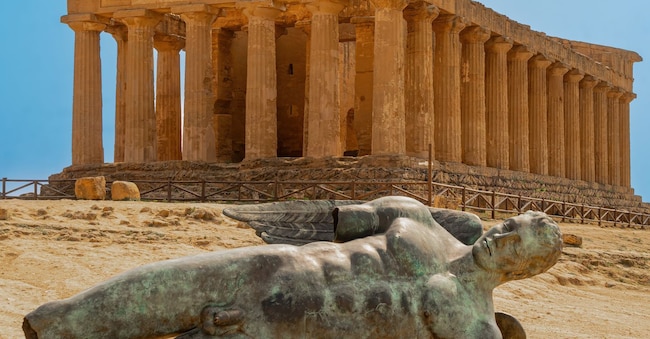
In primo piano, Icaro caduto, di Igor Motoraj. Sullo sfondo, il Tempio della Concordia, nella Valle dei Templi ad Agrigento  Adobestock

8' min read

Translated by AI
Versione italiana

8' min read

Translated by AI
Versione italiana

Thirty years separate the Barcelona Declaration from the Pact for the Mediterranean, adopted by the College of Commissioners in October 2025 and officially launched on 28 November, on the very day of that anniversary. The Barcelona Process was, in fact, launched in 1995 with an ambition that today moves us with its courageous and necessary naivety: to build an area of peace and shared prosperity through trade liberalisation and cultural dialogue. The Union for the Mediterranean also inherited its original flaw: a structure in which one side planned and the other received. Cooperation was, in reality, a neighbourhood policy, where ‘neighbourhood’, in the implicit lexicon of Brussels, refers to what lies outside. Thirty years on, the outcome is clear: an imposing institutional framework, but a capacity for action that falls short of expectations.

The new Pact appears to have taken this on board. It is explicitly based on co-creation, co-ownership and shared responsibility, and on 17 April produced an initial Action Plan comprising twenty-one initiatives organised around three pillars. Above all, it is conceived as a dynamic document: a second edition of the Plan is expected in the autumn. This means that, as these lines are being written, the text that will guide the next cycle is currently being drafted in its new version.

Loading...

Traffic and demographics

The fact that the Mediterranean has returned to centre stage is no longer a theory to be explored. It is a fact. It must be managed, developed and put to good use. The Mediterranean, also known as the Mare Nostrum, accounts for 1 per cent of the world’s waters and carries over 20 per cent of global maritime traffic, with 3,500 ships passing through it every day; the Strait of Sicily alone, just 145 kilometres wide at its narrowest point, is home to two gas pipelines, twenty telecommunications cables and two power cables. Over 95 per cent of intercontinental data traffic travels via submarine cables, and the Mediterranean has become a strategic global hub. Despite the crises in Suez and Hormuz, in 2025 the region’s main container ports handled over 72 million TEUs, representing growth of 5.9 per cent, and the Euro-Mediterranean area now accounts for around 31 per cent of world trade, worth almost 7,600 billion dollars; SRM estimates point to a further increase of 15 per cent by 2030, exceeding the global average.

Overlaid upon this geography of migration flows is a demographic trend of the opposite direction and equal strength. The median age in Africa is now 19.5 years; by 2050, one in four people on the planet will be African, and more than a third of young people aged between 15 and 24 will live on that continent. Nowhere else in the world brings an ageing Europe into such close contact with the greatest reservoir of youth in human history. It is a proximity that Europe can continue to treat as a border issue, or recognise for what it is: an opportunity.

A third way between technology and humanism

There is, however, a deeper – and less widely discussed – reason why the Mediterranean matters at this stage. The global debate on innovation and future agendas is currently dominated by two visions that are clashing with increasing intensity. On the one hand, there is a techno-right-wing capitalist vision that promises to transcend the state, limitations and the community, moving towards private frontiers where the sovereign individual is emancipated from fragility through technology. On the other, a techno-left-statist vision that promises the containment and planetary management of variables, the algorithmic governance of risk, and the engineering correction of injustice. They appear to be antagonistic, and in many respects they are. They certainly are in their approach. But their para-metaphysics is identical: both regard the human condition as a solvable defect; both are nihilistic. Mimetic rivalry, then, as Girard would have said: they clash not in spite of being twins, but precisely because (deep down) they are.

The Mediterranean can and must be the place where a third vision becomes conceivable and achievable. Here, history is not a straight line: it is a layering of layers, and every place is a palimpsest. For this reason too, the Mediterranean acts as a hinge between past, present and future; a hinge between the energies of youthful Africa, the ambitions of the ancient East and the tradition of the Atlantic West. The proposal of Harmonic Innovation stems precisely from this: the most economically sustainable value is that generated where competitiveness and cohesion, speed and purpose, technology and humanism are combined rather than pitted against one another. The Mediterranean: the oldest place of the future.

For this vision to become industrial policy, however, adequate infrastructure is needed. Posters alone are not enough. The Pact already has some of these in embryonic form: the Mediterranean University Initiative, the Digital Transformation Programme launched with partners in North Africa and the Middle East, and the interconnection of cables. These need to be strengthened and, above all, properly directed and systematised.

In this regard, it is both possible and useful to put forward a proposal. The second edition of the Action Plan should recognise, consolidate, support and fund a stable network of the most mature and productive innovation ecosystems across the three shores, establishing it as a permanent infrastructure for industrial policy and the future. They already exist, yet are not sufficiently well known. Málaga TechPark, established in 1992, is now home to over seven hundred businesses and, on its own, accounts for around 20 per cent of the city’s employment and GDP. The Moroccan Technopark spans Casablanca, Rabat and Tangier. El Ghazala in Tunisia and Berytech in Lebanon were the pioneers of the 2000s; Sophia Antipolis is the hub on the French side; the Harmonic Innovation Ecosystem covers southern Italia and serves as the Mediterranean gateway for southern Europe. These are hubs that already cooperate on their own initiative, without any public policy ever having brought them together into a single system.

A Mediterranean innovation network

There is a precedent, and it has a European name. Since 2020, the New European Bauhaus has mobilised around two thousand organisations and funded over seven hundred projects, with 840 million from the Cohesion Fund and 530 from Horizon Europe, evolving into the Neb Facility, which will operate for the three-year period 2025–2027. The historic Bauhaus was not a funding programme: it was the place where a nation decided that the form, function and social destiny of technology were, in some respects, one and the same issue. A Mediterranean Bauhaus would do for the region what Weimar and Dessau did for Germany: give a vision of the future a form, a network, a method, a pedagogy and a discipline.

And yet, on closer inspection, the Bauhaus is not even the most relevant model. There is an older one, and one that is Mediterranean in origin. Around the middle of the 6th century, with the Greek-Gothic War over and his career in the service of the Gothic kings drawn to a close, Cassiodorus retired to his family’s lands on the Ionian coast, near Squillace – the very same Calabrian isthmus on which the Harmonic Innovation Hub Pitagora now stands and where the Harmonic Innovation Ecosystem – and there he founded the Vivarium, so named after the fishponds that dotted the landscape. It was not a monastery in the conventional sense: it was a space for synthesis, built to bridge the divides of its time – between Romans and Goths, between East and West, between Greek and Latin, between classical and Christian learning. It housed a library, a scriptorium, a centre for translation from Greek, a collection of medical texts, and the stewardship of water and the land. And the community was not governed by a disciplinary rule, but by the Institutiones divinarum et saecularium litterarum: a book that laid down what was to be studied, preserved and passed on.

Loading...

The Vivarium was not, originally, a network: it was the node from which a network emerged, because its model of the scriptorium was adopted by the monasteries of Europe, including the Benedictines, and through that widespread network, ancient knowledge survived centuries that might otherwise have erased it. This is precisely the role we now expect innovation ecosystems to fulfil: not to produce individual successes, but to ensure that knowledge is not interrupted, but rather that it is cultivated and passed on continuously across generations.

A Mediterranean Bauhaus that bears more resemblance to the Vivarium than to Weimar would therefore have a distinct character. It remains to be defined what that network of ecosystems for innovation can and must guarantee. I propose calling them Essential Levels of Innovation, by explicit analogy with the essential levels of service. If innovation has become the key determinant of economic citizenship, then access to computing power and data, the availability of patient capital, the openness of laboratories, the mobility of researchers across borders, the building of long-term, stable networks of expertise, effective technology transfer and interdisciplinary training cannot remain the privilege of specific geographical locations. They must be enforceable standards, wherever the hub is located: in Málaga as well as in Casablanca, in Sophia Antipolis as well as in Tiriolo. I was delighted to learn that our Ministry of Universities and Research is exploring this approach in greater depth, thanks in part to the invaluable work of an experienced and competent manager such as Fabrizio Cobis, who has been responsible for coordinating recent programmes in support of national innovation ecosystems. I hope that this vision will soon become concrete policy. For once, Italia could be at the forefront in this sector.

Measuring innovation

None of this works, however, if assessed using current criteria. The mainstream measures innovation in terms of capital raised, valuations and ‘unicorns’: flashy, self-referential metrics, the product of a quantitative, incremental and extractive mindset that can count what accumulates but cannot create new value, nor recognise it. It fails to capture the biodiversity of an ecosystem, nor the cultural stratifications that make lateral thinking possible, nor the trust that allows disparate skills to come together. With metrics of this kind, the Mediterranean will always lag behind, because they are designed to reward what the Mediterranean is not.

We need a different tool; we need a new approach to the mathematics of finance, business and policy. The Harmonic Innovation Index – comprising 105 indicators spread across twenty-one variables and seven dimensions, calculated using the harmonic mean rather than the arithmetic mean, so that no single dimension can compensate for the collapse of another – was created precisely to measure the generative capacity of an organisation, a region and a community. It would be wonderful if the Commission were to explore its framework in greater depth as an experimental metric for evaluating the (we hope) forthcoming Mediterranean innovation network that we have taken the liberty of proposing.

The intersection of projects

None of these proposals, however, can stand on its own. Without the necessary provision in the forthcoming Action Plan, and without coordination with the Mattei Plan, they will inevitably remain mere words on paper. Credit must be given to the Executive Vice-President Raffaele Fitto for having shifted the focus of the European debate precisely to this point. The mid-term review of cohesion policy – which accounts for a third of the Union’s budget – has introduced a flexibility that has long been called for but never granted; and the approach taken to the negotiations on the 2028–2034 financial framework, based on the simplification and integration of territorial policies, is precisely the framework within which a Mediterranean innovation network can be supported without having to invent new instruments. In Sorrento last May, Fitto said that Italia is, and can become, the European bridge in the Mediterranean context. This is a statement to be taken literally, bearing in mind that a bridge is built span by span. And one of the essential spans of this bridge is undoubtedly the innovation ecosystems.

The Regional Innovation Valleys initiative, promoted by the EU, has set things in motion in this direction. However, this is still insufficient. We need to move from a project/programme-based model to the consolidation of a stable infrastructure and policy framework. The Regions can also make a decisive contribution in this regard, and the CRPM’s Inter-Mediterranean Commission, which brings together forty regions from eight countries and has been working in recent years on the project for a Mediterranean macro-region, may be the right forum to ensure the necessary coordination.

Francesco Cicione, chairman and founder of Entopan

Copyright reserved ©
Loading...

Brand connect

Loading...

Newsletter

Notizie e approfondimenti sugli avvenimenti politici, economici e finanziari.

Iscriviti