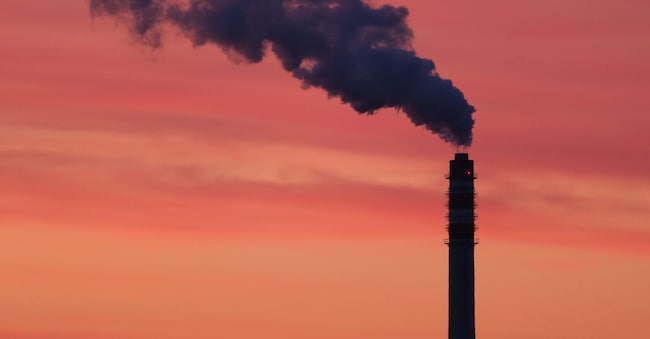
Harmful emissions

EU, new ETS: free allowances beyond 2030 for businesses at risk of relocation

Among other things, the reform introduces a requirement to use the revenue generated by the market to decarbonise the economy

 (AdobeStock)

4' min read

Translated by AI
Versione italiana

4' min read

Translated by AI
Versione italiana

BRUSSELS – The European Commission today, Friday 17 July, presented a long-awaited reform of the emissions trading scheme, known by the acronym ETS. The proposal attempts to strike a balance, responding to pressure from certain industrial sectors, but without calling into question the scheme established twenty years ago. Among other things, the reform includes a requirement to use the revenue generated by the market to decarbonise the economy. Brussels is also proposing an electrification target of 46 per cent by 2040 (up from the current 23 per cent).

Towards climate neutrality by 2050

“Our aim is to ensure that the ETS becomes an investment tool that is compatible with our climate, competitiveness and energy independence objectives,” explained Climate Commissioner Wopke Hoekstra to a group of European newspapers, including *Il Sole 24 Ore*. Ultimately, the reform must serve to align the ETS market with the new climate target of reducing harmful emissions by 90 per cent by 2040, with a view to achieving climate neutrality by 2050.

Loading...

It should be noted that the emissions trading scheme requires the most polluting companies to purchase emission allowances. Companies at risk of relocating, on the other hand, are eligible for free allowances. The allowances are auctioned off by member states. The ultimate aim of the ‘polluter pays’ principle is to encourage economic activities that are environmentally friendly. Brussels explains that the ETS market has contributed significantly to the reduction in harmful emissions.

However, some industrial sectors argue that, in certain areas, energy efficiency has reached the highest possible level given current technologies, to the extent that they now regard the ETS as a form of tax. They also complain about price volatility in the market. In this regard, business associations in Germany, France and Italia – BDI, Medef, Confindustria – called last week for a radical overhaul of the market.

The proposal

The proposal provides for the continued distribution of free allowances, even after 2030, by revising the reduction schedule for the number of allowances distributed free of charge to economic sectors at risk of relocation. Initially, from 2031 to 2035, the decline will be less steep. In the period 2036–2040, when the number of allowances allocated free of charge begins to dwindle, companies will be able to contribute up to 2 per cent of decarbonisation projects developed in third countries.

Over the past twenty years – that is, since its inception – the ETS market has generated revenue of 260 billion euros. This money has often been used to bolster Member States’ public finances. The European Commission is proposing that, from now on, at least half of the revenue must be used to fund decarbonisation projects. “Currently,” explained Commissioner Hoekstra, “barely 10 per cent of the revenue is spent on industry.”

Terms and conditions

In this regard, 80 per cent of the allowances allocated free of charge will only be made available to companies once they have published concrete annual decarbonisation plans. The remaining 20 per cent will be allocated only once the companies’ plans have been effectively implemented. The aim, once again, is to use the ETS not only to incentivise environmentally friendly economic activities, but also to support new investment.

Furthermore, the European Commission proposes to gradually incorporate waste management into the ETS as well. The reform includes a number of safeguards to address the sector’s concerns. Recently in Brussels, representatives of several large companies, such as the French firm Veolia and the Italian firm ACEA, pointed out that the client commissioning waste management services is often a public body and that companies in the sector do not have control over the input.

Finally, the reform provides for the expansion of the ETS market to include private flights and commercial flights up to 5,000 kilometres from the centre of Europe and, in the maritime sector, to certain ports in third countries within Europe’s wider neighbourhood. “We must abandon the idea that the climate and the economy cannot go hand in hand. In fact, they can go hand in hand,” explained Commissioner Hoekstra, whilst also noting that European industry is deeply divided on how to assess the ETS market.

Ultimately, the reform put forward by Brussels reflects the recent trend towards watering down the Green Deal. It weakens “the most effective tool for climate protection”, notes Mats Engström, an expert at the European Council on Foreign Relations. Business Europe, on the other hand, argues that the conditions attached to obtaining free allowances “risk increasing bureaucratic complexity”. Meanwhile, the European airline association A4E warns that there will be an increase in ticket prices, without any benefits for the environment.

Still on the energy front, the European Commission has also proposed an ‘indicative’ target for the electrification of the economy of 46 per cent by 2040. Currently, the share of electricity in final energy consumption has remained at 23 per cent for a decade. In this regard, by 2030, the cost of electricity must not exceed two and a half times the price of gas for households, or more than twice the price of gas for industry. This latter issue is a tricky one because the tax authorities require unanimity among member states.
(This article was updated at 09:35 on 18 July 2026)

Copyright reserved ©
Loading...

Brand connect

Loading...

Newsletter

Notizie e approfondimenti sugli avvenimenti politici, economici e finanziari.

Iscriviti