Single Market

The EU reforms public procurement rules; ‘European preference’ is introduced

The European Commission has put forward a proposal to reform public procurement, with the aim of reducing fragmentation in the single market in a sector that accounts for 15 per cent of GDP.

From our correspondent Beda Romano

Aggiungi Il Sole 24 Ore
ai preferiti su Google
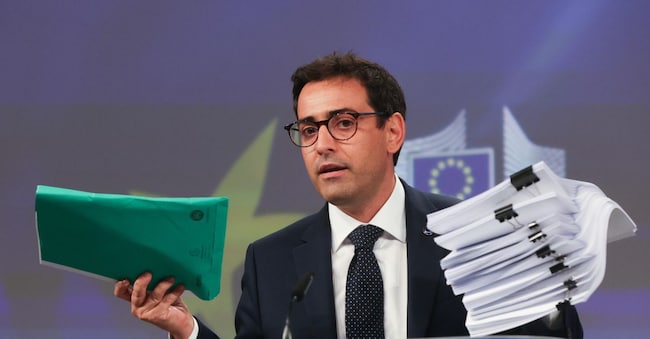
Il vicepresidente esecutivo della Commissione europea Stephane Sejourne mostra una grande pila di documenti da compilare accanto a una pila più piccola che rappresenta le pratiche burocratiche richieste dalle nuove norme proposte, durante una conferenza stampa sulla legge sugli appalti pubblici e sulla legge europea sull’innovazione a Bruxelles, in Belgio, il 9 settembre 2026.  EPA/OLIVIER HOSLET EPA/OLIVIER HOSLET

3' min read

Translated by AI
Versione italiana

3' min read

Translated by AI
Versione italiana

BRUSSELS – The European Commission today, Wednesday 9 September, presented an ambitious proposal to reform public procurement, with the aim of reducing fragmentation within the single market in a sector that accounts for 15 per cent of gross domestic product.

Among other things, the European Commission intends to create a single digital platform on which public sector bodies can publish calls for tenders and thereby attract businesses from across the European Union.

Loading...

“Our aim is to make public procurement more effective for both buyers and sellers,” explained Stéphane Séjourné, Commissioner for the Single Market, speaking to a group of European newspapers, including *Il Sole 24 Ore*. “The value of public procurement in Europe is around 2,500 billion euros a year, in other words more than one EU budget over seven years. This reform could have a substantial economic impact.”

In practical terms, the regulation, which is due to be approved by the Parliament and the Council, replaces three directives dating from the last decade.

The aim is to simplify the rules and to reduce costs for public sector bodies and private companies. At the heart of this simplification is the creation of a digital platform to which all European businesses will have access.

Over the years, many companies have been clamouring for this tool in order to open up a market that often remains confined to national borders. The proposed regulation, the European Commission explained, stipulates that best value for money must be the standard award criterion, with quality criteria accounting for at least 30 per cent. ‘Contracting authorities,’ explains the European Commission, ‘may deviate from this approach, provided they explain how quality will nevertheless be guaranteed, for example through minimum requirements.’

No ‘Buy European’ obligations introduced

The European Commission is not introducing any ‘Buy European’ obligations beyond those already provided for in two legislative texts currently under discussion in the Parliament and the Council: the Industrial Accelerator Act and the Cloud and AI Development Act. These two regulations provide for ‘Buy European’ policies in sectors deemed particularly strategic, such as the automotive industry, green technology, nuclear energy, databases, critical medicines and so on.

The new EU proposal introduces some interesting changes in that, by simplifying the rules on public procurement, it will allow public bodies to include criteria in the tender process that will ultimately enforce the ‘Buy European’ policy.

Until now, European rules have effectively hindered public authorities from making such choices, with public bodies tending to avoid criteria of this kind for fear of, for example, legal challenges.

In this regard, the text introduces ‘a horizontal framework of European preference for public procurement, in line with the Union’s international legal obligations’.

Loading...

In other words, the ‘Buy European’ rule will not apply if the goods or services originate from countries with which the European Union has reciprocity agreements. Think of Norway, Switzerland, Japan, Australia and New Zealand.

The requirement for reciprocity, however, excludes China and India, amongst others.

Commissioner Séjourné observes: ‘We live in a world in which the major powers use public procurement as an instrument of power. Against this backdrop, I expect the “Buy European” issue to become a topic of election campaigns, even at local level.’

Whether public tenders are opened up to other Member States depends on specific thresholds. Two examples: in the case of concessions, the value must exceed 5.4 million euros; in the case of supplies and services, the minimum value is 140,000 euros.

As mentioned, public procurement plays a central role in the European economy. It covers many sectors, ranging from transport to infrastructure and energy systems, right through to schools and health services.

The European Commission estimates that the proposal will lead to annual administrative savings of €649 million, resulting from a reduction in administrative burdens of €80 million for public sector bodies and €570 million for economic operators.

Copyright reserved ©
Loading...

Brand connect

Loading...

Newsletter

Notizie e approfondimenti sugli avvenimenti politici, economici e finanziari.

Iscriviti