
Frecciarossa lands in Germany: from Rome and Milan to Munich
Connections to start by 2026, then extension to Berlin and Naples in 2028

2' min read
Key points
2' min read
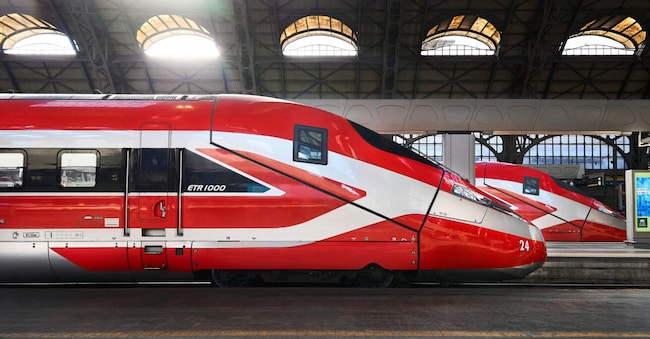
Frecciarossa train of Europe. After France and Spain, it is now the turn of Austria and Germany. This is provided by the agreement signed by Trenitalia with the German railways Deutsche Bahn (Db) and Austrian Öbb. A new step for the international growth of the FS (Ferrovie dello Stato) group through its flagship train: the Frecciarossa 1000, which aspires to become the train of Europeans. By December 2026, the new high-speed cross-border connections Milan-Munich and Rome-Munich (and vice versa) will be activated. The services will be gradually extended to Berlin and Naples from December 2028. Thus, the development of the so-called metro of Europe continues with the Frecciarossa, the train manufactured in the Italian factories of Hitachi Rail, a Japanese multinational.
The announcement was made in Munich by Gianpiero Strisciuglio, managing director of Trenitalia (SBB group); Michael Peterson, board member for long-distance passenger transport of Db; Sabine Stock, board member for long-distance passenger transport of Öbb. Apostolos Tzitzikostas, European Commissioner for Sustainable Transport and Tourism, participated with a video message.
Strisciuglio sums up the meaning of the day as follows: 'Connecting Italy with the main European cities by train is one of the strategic objectives of the FS group. The Frecciarossa is also confirmed as a protagonist on international markets, with the ambition of becoming the train of Europeans and not just Italians. These new connections will be added to those already operating between Milan and Paris. In addition, there are Eurocity and Euronight connections between Switzerland, Austria and Italy, which improve and make connections for work, study and tourism with the rest of Europe more sustainable'. In recent weeks, FS had announced another very ambitious international project: the EUR 1 billion plan to launch a high-speed link between London and Paris through the Channel Tunnel.
L’offerta
The commercial offer will start with four daily connections on the Milan-Munich and Rome-Munich routes. For the Milan-Munich, with a travel time of six hours and 30 minutes, the main intermediate stops will be in Brescia, Verona, Rovereto, Trento, Bolzano and Innsbruck. As for Rome-Munich, with a travel time of eight hours and 30 minutes, the main stops will be in Florence, Bologna, Verona, Rovereto, Trento, Bolzano and Innsbruck. The opening of the Brenner Base Tunnel will reduce travel time by approximately one hour. From December 2028 the complete offer will consist of 10 connections between Italy and Germany covering the routes between Milan and Munich; Milan and Berlin; Rome and Munich; Naples and Munich; Naples and Berlin.
The new service will be operated with the Frecciarossa 1000, which complies with European interoperability specifications. It has also been designed and built to run in Italy and on the European rail networks of France, Germany, Spain, Austria, Switzerland, the Netherlands and Belgium, being able to overcome the differences in power supply and signalling in the various countries. The new link will offer a direct service between Italy and Germany, passing through Austria, and will have a significant impact on rail connections between the two countries. With the support of the German infrastructure, which connects to numerous other countries, the line will also intercept transport demand for other destinations such as Frankfurt and Krakow.


