Digital Economy

Google's redemption: from the Spark assistant to the Omni model. All the news from Google I/O

Gemini exceeds 900 million users. This year's planned investment, says CEO Sundar Pichai, will be six times higher, reaching $180-190 billion

by Luca Tremolada

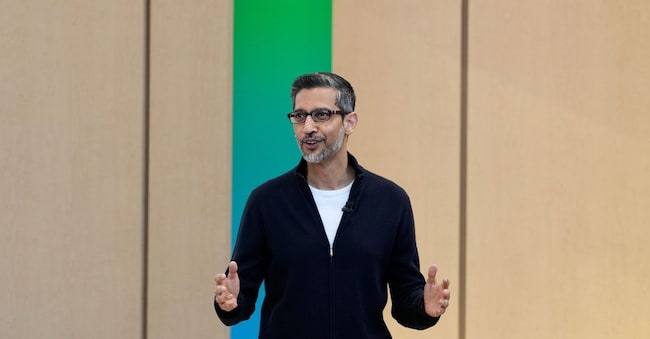
Il CEO di Alphabet, Sundar Pichai, interviene durante un evento Google I/O a Mountain View, in California, martedì 19 maggio 2026. (Foto AP/Jeff Chiu)   APN

8' min read

Translated by AI
Versione italiana

8' min read

Translated by AI
Versione italiana

They don't say it explicitly, but at this height of AI evolution, Google has freed itself from the ghost of OpenAI and, after years of chasing, can now show the most mature and coherent ecosystem. Four years after the birth of ChatGPT and ten after the announcement of the change of strategy to become 'AI First', CEO Sundar Pichai, during a preview meeting with journalists pre-Google I/O 2026, dictated what seems to be the new law of the era of 'hyper-accelerated progress', using tokens - the 'building blocks' with which an artificial intelligence model works - as the unit of measurement. 'Only two years ago,' explained Silicon Valley's highest-paid CEO, 'servers were processing 9.7 trillion tokens a month; last year, the figure had jumped to 480 trillion. "Today, that volume has grown almost sevenfold to an astronomical 3.2 quadrillion-plus tokens per month generated across all of the company's platforms. The ecosystem for insiders is no different: over 8.5 million developers build applications using Google's templates monthly, and the API alone processes about 19 billion tokens per minute.
But it is on the consumer usage front that Google consolidates its dominance. The company now boasts 13 products that exceed one billion users and no less than five of these have crossed the three billion mark. Artificial intelligence is no longer just an experiment confined to laboratories, but a reality that moves billions of people and data on a global scale.But it is on the consumer usage front that Google consolidates its dominance. The company now boasts 13 products with over a billion users, and no less than five of these have crossed the 3 billion mark.

Loading...

Google's numbers.

Gemini's dedicated app has seen its audience explode: from 400 million active users last year, it has now surpassed 900 million, with the volume of daily requests multiplied by seven. On the creative front, the image generation models, called 'Nano Banana', have already churned out over 50 billion images. However, sustaining this insatiable hunger for computation requires titanic resources. Pichai concluded his overview by highlighting the enormous financial effort faced by the infrastructure. If only four years ago, in 2022, Google's capital expenditure (capex) stood at $31 billion, this year the expected investment will be six times higher, reaching the incredible figure of $180-190 billion. A colossal commitment that lays the physical and technological foundations for the dawn of the new 'agent era'. And after the numbers we come to the novelties of this Google I/O, of which there are many.
Gemini Omni is born for multimedia creativity

Gemini Omni Flash debuts, the first member of the 'Omni' family, a natively multimodal model designed to combine Gemini's typical reasoning capability with pure content creation. The real revolution promised by Omni lies in the interaction and flexibility of the inputs. Indeed, the system is capable of generating high-definition video from any combination of elements: images, text, audio or other pre-existing video. Once the video has been generated, the user only has to 'converse' with the artificial intelligence to edit it. Using simple text commands in natural language, it is possible to transform the background, add new characters, apply cinematographic styles or alter the action itself, while maintaining a physical consistency of movements, gravity and fluids that, according to Google, exceeds the limitations of previous models.

Among the most striking features is the possibility of creating videos using one's own digital avatar, capable of speaking faithfully with the user's voice. A powerful technology that inevitably raises questions on the security front; for this reason, the Mountain View giant has announced the automatic and invisible integration of the SynthID digital watermark in each clip produced, allowing its origin to be verified via the Gemini app or Google Chrome.
The invisible watermark technology SynthID comes out of the experimental phase and is integrated into Chrome and Google Search. To find out whether a photo, video or audio fragment is the work of a machine, simply circle the content on the phone screen or right-click in the browser. The system will give an immediate answer as to the synthetic origin of the material, a standard of transparency that competitors such as OpenAI and Eleven Labs have already adhered to.

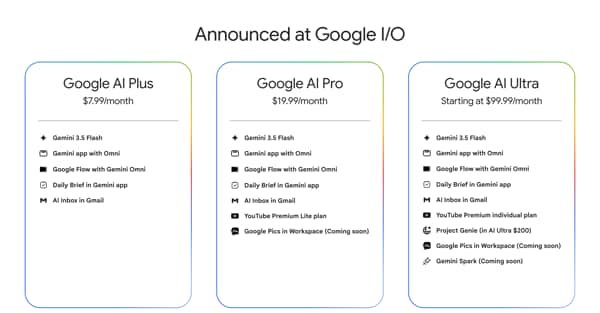
The Mountain View innovation is available starting today for subscribers to the Google AI Plus, Pro and Ultra plans. Gemini Omni Flash is also being released free of charge for content creators on mass-market platforms such as YouTube Shorts and the YouTube Create app, bidding to radically redefine the rules of digital video production.

Gemini 3.5 Flash arrives for the age of intelligent agents.

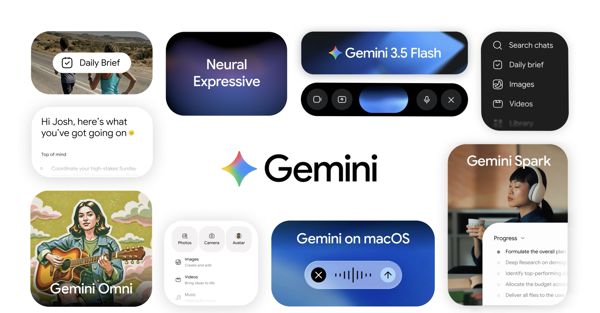
Josh Woodward, VP of Google Labs, unveiled the new roadmap for the official Gemini app, which now has over 900 million monthly users, introducing a major aesthetic and functional restructuring driven by proactive agents ready to operate around the clock. Unlike traditional chatbots, Gemini 3.5 Flash was presented as a model designed to perform 'agent workflows' and logical tasks at scale.

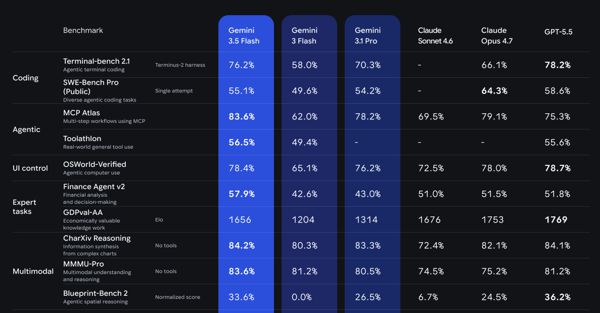
The new model focuses on the concept of 'frontier intelligence with action': no longer a simple text assistant, but a real engine capable of planning, programming and acting autonomously to solve real problems over 'long time horizons'. Four times faster than its competitors in logical reasoning and outperforming its predecessor Gemini 3.1 Pro in programming benchmarks, Gemini 3.5 Flash makes its global debut today for both developers - integrated into the new Google Antigravity platform - and consumers.

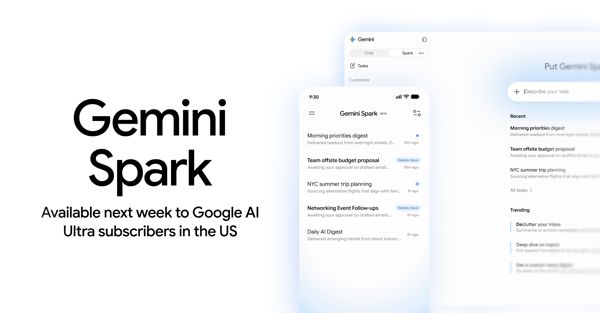
In fact, it became the default template for the Gemini app and Google Search, powering absolute novelties such as Gemini Spark, a 24/7 personal AI agent to support users in their daily digital lives. To exploit it, Google created Antigravity 2.0, a desktop platform with SDK and command line, where developers can coordinate entire teams of autonomous agents. In this environment, one agent can be ordered to write the site code, another to generate the graphics, and a third to study the software architecture.

In the area of security, Code Mender, on the other hand, uses AI to analyse entire code bases, uncover critical security holes and automatically apply corrections.

How is research changing? The 'research agents' are born.

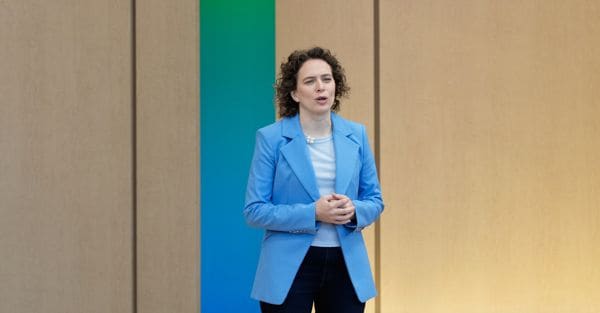
Liz Reid, Google's Vice President of Search, also spoke at the preview event. "Google's search engine is about to experience its biggest update in more than 25 years," announced the number one in Mountain View search.

What is new is the introduction of 'Information Agents'. These are specialised virtual assistants that work in the background: for example, if you are looking for a house, the agent constantly monitors the web and sends instant notifications as soon as an ad that meets your requirements is published. The user can configure them to monitor precise parameters, such as stock market trends. The agent independently determines which databases to query, keeps an eye on the situation 24 hours a day and sends a structured report only when the required conditions are met.

On the revamped search bar, users will be able to use their voice to instantly create dynamic interfaces or small applications, such as a virtual personal trainer linked to the weather and calendar to schedule workouts, all without having to write a single line of code.

But Google goes beyond pure information by introducing automatic booking capabilities. For local services such as home repairs, beauty or pet care, US users will be able to ask Google, directly from Search, to make real phone calls to businesses on their behalf.

Liz Reid, vice president, Head of Search, speaks at a Google I/O event in Mountain View, Calif., Tuesday, May 19, 2026. (AP Photo/Jeff Chiu) Associate Press/ LaPresse Only Italy and Spain

The metamorphosis also touches the way data is visualised. By exploiting instant programming capabilities, called 'agentic coding', Google Search will be able to generate dynamic user interfaces, tables, graphs or customised simulations on the fly. For complex and ongoing tasks - such as organising a wedding or planning a move - the search engine will create real customised trackers and dashboards, akin to 'mini-applications' tailored to the need of the moment.

Finally, to make the experience truly tailored to the user's life, Google is expanding its Personal Intelligence function globally, in almost 200 countries, free of charge. The search engine will thus be able to securely connect to the user's personal context, tapping into Gmail, Google Photos and soon Google Calendar, while always leaving the surfer in full control of privacy. The launch of the advanced features will start in the summer for Premium subscribers in the United States, and then gradually extend globally.

Electronic Commerce News: Universal Cart and AP2

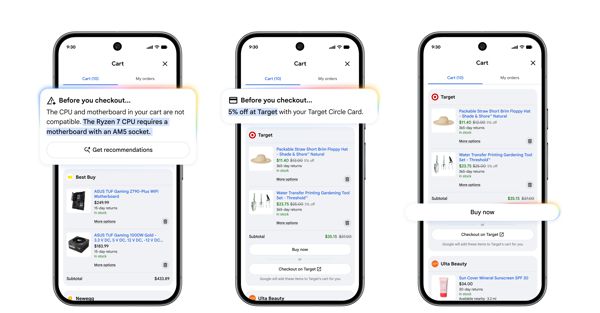
They are called Universal Cart and AP2: Google has developed an intelligent shopping cart (Universal Cart) that accompanies us on every device while we watch videos, surf or use the Gemini app. By adding products to the cart, the AI secretly monitors price drops and looks for special discounts. It also uses advanced reasoning: if, for example, the user inserts the various parts to assemble a PC from different shops, the shopping cart checks the hardware and issues a warning if the processor and motherboard are incompatible. The Agent Payments Protocol (AP2) completes the work, allowing the artificial intelligence to make payments and purchases in total autonomy, but adhering to inflexible rules set by the user, such as maximum budgets and preferred brands, and tracking a secure receipt in case of return.

The latest in productivity: Ask YouTube and Docs Live.

The Ask YouTube function allows you to ask a specific question to the system, which instead of just suggesting the right video, will take the playback to the exact minute that contains the desired information. Docs Live, on the other hand, revolutionises text writing. Workers no longer have to juggle with complex formatting or lengthy typing, as they can simply speak into the microphone, pouring out jumbled thoughts or instructions, and Gemini structures a professional, paginated document with information extracted from emails and data neatly summarised in tables.

For everyday life comes the Gemini Spark

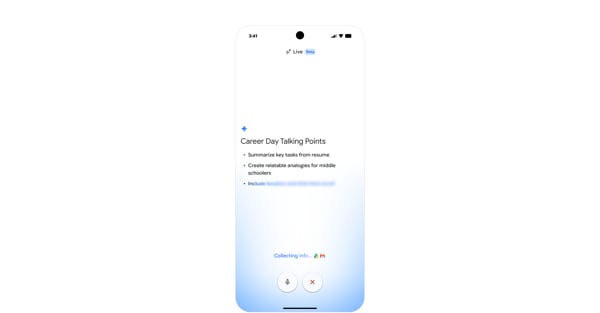
Instead, for the start of the day debuts Daily Brief, an exclusive agent for Premium subscribers that scans Gmail inboxes and calendars to generate a personalised and interactive morning summary, even suggesting immediate actions to take. Making its debut is the Gemini Spark agent. Powered by the 3.5 Flash model and based on Antigravity's cloud architecture, Spark acts as an active, independent partner. Unlike the old chatbots, it continues to work in the background even if the user closes the laptop or locks the smartphone. Its capabilities include the automatic analysis of bank statements to uncover hidden costs, the monitoring of children's school emails with deadline extraction and the creation of complex workflows (e.g. summarising meeting notes and autonomously drafting documents and project start-up emails). Thanks to the new MCP connections, Spark will immediately integrate with external partners such as Canva, OpenTable and Instacart. Working in the background in the Workspace ecosystem, Spark can handle burdensome tasks: students use it to dynamically update study guides as new material arrives from professors, while small business owners use it to man the mailbox and not let customer requests slip through their fingers.

Finally the glasses

Google showed the most concrete version of its smart glasses strategy. These are 'audio' devices based on the Android XR platform, developed together with Samsung, which directly integrate Gemini into the frame and are expected to hit the market by the end of autumn. The first models will be signed by Gentle Monster and Warby Parker, with a broader range of products expected in the following months.

Google's strategy involves two distinct families of glasses. Those shown during the keynote are audio-only models, i.e. without an integrated display. They work through voice commands and speakers positioned above the ear: the user can ask Gemini about what he sees around him, receive directions in real time, manage calls and messages, take photographs and translate live texts. An approach very similar to that already seen with the Ray-Ban Meta Smart Glasses, but built around Google's AI ecosystem.

And finally the landing on macOs

On the desktop market, the arrival of the Gemini app for macOS has finally been announced. Available for download today, the Mac application will receive in the summer both integration with Gemini Spark to operate on local files, and a revolutionary speech function capable of cleaning up speech from drafts, hesitations or linguistic tics (the classic 'ums'), transforming streams of thoughts aloud into precise, formatted text exactly where the cursor is on the screen.

Copyright reserved ©
  • Luca Tremolada

    Luca TremoladaGiornalista

    Luogo: Milano via Monte Rosa 91

    Lingue parlate: Inglese, Francese

    Argomenti: Tecnologia, scienza, finanza, startup, dati

    Premi: Premio Gabriele Lanfredini sull’informazione; Premio giornalistico State Street, categoria "Innovation"; DStars 2019, categoria journalism

Loading...

Brand connect

Loading...

Newsletter

Notizie e approfondimenti sugli avvenimenti politici, economici e finanziari.

Iscriviti