Mathematics

The Great Fear of 1789 as an epidemic: when history becomes data science

Research published in Nature shows that during the French Revolution, news followed virus-like patterns, anticipating the dynamics of disinformation today

by Francesca Cerati

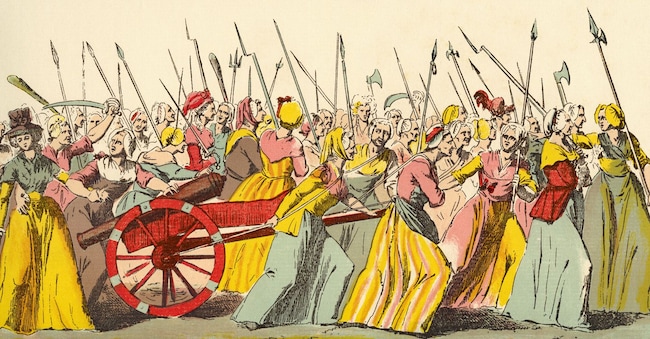
Marcia delle poissardes, o donne del mercato, verso versailles, il 5 ottobre 1789, durante la Rivoluzione Francese, per chiedere pane e giustizia. (da una stampa contemporanea. Design Pics / AGF)

3' min read

3' min read

In the summer of 1789, while Paris and France were swept by the long wave of the Revolution, a mysterious and disturbing phenomenon spread through the countryside: the Great Fear. Between 20 July and 6 August, persistent rumours of armed gangs, aristocratic plots and possible repressions triggered panic in dozens of French provinces. The peasants, fearing for their lives, took up arms, stormed castles, set fire to archives and destroyed the registers that enshrined feudal privileges.

This episode, long interpreted by historians as a kind of collective hysteria, is now being reinterpreted thanks to an innovative study published in Nature. A group of researchers from the Università Statale di Milano, Université Paris 8 and the University of Toulon analysed the phenomenon with unusual tools for historiography: epidemiological models.
Loading...

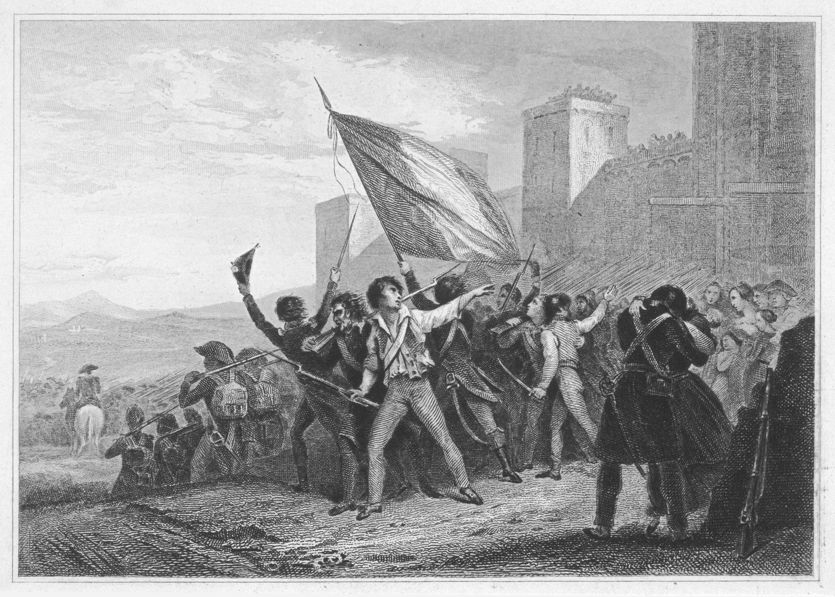
Gli uomini di Marsiglia marciano verso nord per unirsi alla Rivoluzione. Data: 1789. (Agf)

A network of roads as a vehicle for social contagion

.

"We treated the spread of fear as if it were an epidemic," explains Stefano Zapperi, physicist and co-author of the study. Using mathematical models commonly used in the study of infectious diseases, the researchers mapped the advance of panic across the French countryside.

By cross-referencing historical sources, maps of the time and socio-economic data (price of grain, literacy, distribution of land ownership), the team reconstructed the route of the rumours: they travelled along the main roads, touched villages connected by postal stations and advanced at an average speed of 45 km per day. The peak of 'contagion' occurred on 30 July 1789, a few days before the National Assembly decreed the end of feudal privileges on 4 August.

Surprisingly, about 40 per cent of the locations involved were located in the vicinity of a post station, highlighting the extent to which the communication infrastructure of the time functioned as ante litteram 'social networks'.

Not a collective madness, but a political and rational reaction

.

In addition to mapping the speed and pathways of the panic, the study analysed who was most affected. The richest, most literate areas with the highest grain prices were among those most affected: 'This shows that the Great Fear was not an irrational emotional reaction,' Zapperi emphasises. 'It was the result of real economic and political tensions. In many areas, the destruction of feudal archives had a precise purpose: to deprive the lords of legal proof of their ownership and to ease the burden on the peasants'.

The picture that emerges is therefore very different from the simple 'collective hysteria' described by some historians: it was rather a strategic mobilisation, made possible by a fast and efficient communication network for the time.

When history and science meet

.

"This work is the result of a collaboration between historians, physicists and economists," adds Caterina La Porta, Professor of Environmental Science and Policy at the State University of Milan and co-author of the study. "By combining different approaches, we have shown that complex historical events can be studied with modern scientific tools, offering new keys to interpretation.

Interdisciplinarity is at the heart of this research: statistical physics made it possible to model the spread of rumours as a contagious phenomenon, economics helped to interpret the socio-political data of the time, while history provided the context for understanding the implications of each local uprising.

A bridge between past and present

.

The lesson of the Great Fear is surprisingly timely. Just as today digital social networks can amplify information (and disinformation) very quickly, in the 18th century physical networks - roads, post offices, official couriers - acted as accelerators of news and suspicion. 'Studying the past with scientific tools helps us understand how we react to crises today,' Zapperi concludes. 'The dynamics of collective fear, disinformation and political mobilisation are as old as society itself'.

This study not only illuminates one of the crucial moments of the French Revolution, but demonstrates that history can be investigated with advanced analytical tools, opening up new perspectives on how ideas, emotions and news can spread like viruses, conditioning the course of events.

Copyright reserved ©
Loading...

Brand connect

Loading...

Newsletter

Notizie e approfondimenti sugli avvenimenti politici, economici e finanziari.

Iscriviti