
Haier’s smart home thinks, learns and acts. Even with robots

-U07001221158iTV-1440x752@IlSole24Ore-Web.jpg?r=650x341)
BERLIN – Once again, the IFA trade fair provides Haier with the perfect opportunity to reaffirm two of its key strengths: its status as a leading player in the consumer electronics sector and its strong focus on sponsoring major sporting events to boost its brand visibility. In Berlin, the Chinese firm has been confirmed as the world leader in the large white goods sector for the 17th consecutive year and has announced an agreement signed with UEFA and the European Football Clubs Association to become, from 2027 (and for the next four years) a Global Partner of the UEFA Champions League. Significant focus is therefore placed on the brand, but also on a vision of the smart home that goes beyond simply adding a new smart function to a household appliance. The new frontier is ensuring that the home learns to understand what is happening within it and can intervene, when necessary, without waiting for the user to issue a single command or configure a specific mode of use for the device. Haier Europe’s slogan at Messe Berlin, ‘Home of Intelligent Possibilities’, can therefore be interpreted as a transition from a merely connected home to an ecosystem capable of interpreting its context, learning from the habits of those living within it, and coordinating the products and services that characterise their daily lives. The artificial intelligence integrated into various appliances (from washing machines to televisions) functions in this regard as a cross-cutting infrastructure spanning research and development, design (based on consumer scenarios and needs), production, user experience and after-sales services. The ultimate goal? To make technology increasingly invisible and capable of adapting to real-life situations, whilst leaving control in the hands of the user.
-U51765504544vrv-600x313@IlSole24Ore-Web.jpg)
The intelligence that interprets
In the new product announcements made in Berlin, the concepts of ‘new intelligence’ are being put into practice across all segments. In the washing cycle, for example, the Vision 15 uses a camera built into the washing machine door to monitor the load and recognise the quantity of laundry, colours, suds and any items that may have been left in the drum. Sensors and algorithms (AI Power Sense and AI Vision Sense) detect, interpret and process information relating to weight, balance, water level and temperature to automatically set various cycle parameters. As Haier’s managers explain, this technological innovation therefore operates ‘behind the scenes’, and the same applies to kitchen appliances. The AI Food Care System integrated into fridges is able to recognise food and suggest how to store it; the AI Vision system fitted to the ID Ultimate Series 6 ovens does the same with food to monitor the entire cooking cycle, automatically stopping the programme when the set result is achieved. Induction hobs and cooker hoods are also becoming increasingly intelligent: the former can transfer a pan’s cooking settings when it is moved (by detecting its position), whilst the latter can be activated simply with a gesture thanks to the MotionSense function. The digital backbone of the entire ecosystem is hOn, the app-based platform through which Haier manages products and services remotely within a single environment to intelligently optimise energy consumption. In this regard, as explained by Haier Europe’s CEO, Neil Tunstall, the Chinese company is set to invest 13 billion euros over the next five years in AI and IoT technologies, with the aim of bringing distributed intelligence into homes and introducing appliances capable not only of seeing, recognising and making decisions, but also of interacting with machines (robots) capable of physically acting within the home environment.
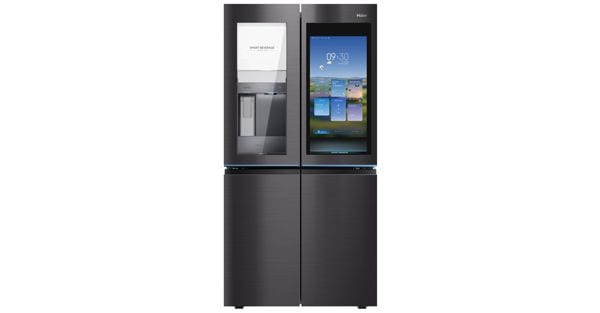
Washing machines, fridges and ovens: fewer controls, more autonomy
Whilst the Vision 15 range of washing machines represents the pinnacle of Haier’s technology in the field of laundry, the most ‘eye-catching’ new product showcased at IFA is the Multi Care Collection, a range of appliances designed to meet the need to run cycles with different loads simultaneously, thereby increasing flexibility in the home. The Multi Care Laundry Studio is, in fact, a product featuring four independent drums – one for the 10 kg washing machine, two 1 kg drums and one for the 8 kg tumble dryer – allowing each compartment to be managed separately, so that items differing in quantity, fabric or colour can be washed together. In the refrigeration sector, the Horizon Collection brings AI to the day-to-day management of food: the Hydro Hub model incorporates food and drink recognition, whilst the Maestro prototype brings together advanced proprietary preservation technologies – such as the AI Defrost Zone, designed to defrost food whilst minimising moisture loss and preserving quality – within a single system. The new I-Pro Shine A-70%, for its part, applies the same philosophy to dishwashers, using sensors and algorithms to adjust water, temperature, cycle time and energy consumption according to the load. For those with an eye for aesthetics, this functional dimension, enhanced by AI capabilities, takes shape in the Aura Collection: the various appliances (oven, microwave, hob, cooker hood and dishwasher) share the same design language and are distinguished by ‘Aura Grey’, a fingerprint-resistant finish applied to the glass that changes appearance depending on the light and surroundings.
-U73708157326SvC-600x313@IlSole24Ore-Web.png)
Smart TVs: from LED to RGB
Having entered the Italian TV market just over a year ago, Haier is now seeking to take a step forward in terms of technology by effectively adopting the same architecture used for the company’s other products. At the heart of the new range of smart TVs is UltraSense AI, a platform based on a proprietary processor that continuously analyses images and sound and adjusts the TV’s settings in real time according to the content and environmental conditions. The artificial intelligence operates on four levels. AI Cinema recognises the characteristics of individual scenes and optimises colour, contrast, depth, HDR, definition and the smoothness of movement. AI Sound, on the other hand, works on voice separation, frequency balancing and volume to make dialogue clearer and the soundscape more uniform (on some models, the audio is handled by Sound by KEF, the historic British brand). For those using the television with a games console or a PC, AI Game works to reduce input lag, screen tearing and interruptions. Finally, AI Eye Caring adjusts brightness and contrast to suit ambient lighting conditions and the content to enhance viewing comfort. The range features various panel technologies, from QD-Mini LED to OLED, with screen sizes up to 115 inches. Whilst the spectacular innovation showcased at IFA is an impressive 163-inch Micro LED screen (created by combining multiple panels), the manufacturer’s decision to pair LED backlighting with technologies such as the Pure RGB Light Engine (in the new MR92 series from 55 inches upwards) and Super Quantum Dot Colour (on the new MS 96 range from 100 inches) – which work on the three primary colour components and the colour spectrum in combination with AI algorithms that reduce interference between the different channels. The aim is clear: to achieve better visual performance and to try to narrow the gap with those who currently dominate the world of television.
-U34066717808VEq-600x313@IlSole24Ore-Web.jpg)
Humanoids serving people
The real big news (in terms of future prospects) that the Chinese company unveiled at IFA comes, however, from the field of robotics, The humanoid robots on display at Haier’s stand – capable of perceiving their surroundings and acting within them, interacting with people and household appliances – are perhaps the most striking expression of the ‘Home of Intelligent Possibilities’ vision. We’re talking about systems that load and unload the washing and organise food in the fridge, which recognise and categorise items to be cleaned, distinguishing between different types of dirt and deciding what action to take. These are companion robots that provide personal assistance through voice interaction (in Italia, a connection with smartwatches is currently being developed) in everyday activities. Intelligence is therefore not confined to software but takes shape in a physical body (‘embodied intelligence’), such as that of the W3 Exoskeleton, a carbon and titanium alloy exoskeleton that uses sensors and AI algorithms to reduce physical effort, interpreting the wearer’s movement intentions in real time and automatically adjusting the level of assistance based on their characteristics and the activity being performed. This trial, which for the time being is focused solely on the Chinese market, confirms a very specific line of thinking: the smart, connected home of tomorrow, according to Haier, will go beyond the ability of a single appliance to self-regulate and will become a system distributed across multiple devices that will require fewer and fewer instructions and offer ever greater autonomy.

