

The hidden cost of Hormuz is becoming a permanent item in industrial budgets
From energy to European factories, the Gulf crisis is turning route security into a permanent additional cost for all supply chains. The delays are, in fact, causing congestion on other routes as well. At the Salalah docks, ships are facing waiting times of up to 36 hours. In Colombo, quay utilisation stands at 110 per cent, with over 50,000 TEU backed up. Meanwhile, ships around the Strait and at Bab-el-Mandeb are subjected to constant minor attacks

Key points
On 14 June 2026, the United States and Iran announced a ceasefire agreement that provided for the reopening of the Strait of Hormuz. Four months later, the gap between diplomatic commitment and commercial security remains the decisive factor: as at 30 October, the International Maritime Organisation had recorded 122 confirmed incidents and 24 seafarers killed in the waters affected by the crisis. The problem is not merely getting a ship through, but enabling thousands of operators to plan repeat voyages, insure them and meet delivery contracts. A route may be formally accessible yet remain economically unviable. It is this disconnect – even more so than the temporary rise in oil prices – that is transferring the conflict between Washington and Tehran into corporate balance sheets, the decisions of Gulf governments and the competitiveness of European manufacturing.
The US military operation against Iran, launched on 28 February and notified to the United Nations Security Council under Article 51 of the Charter, had among its stated objectives the protection of shipping and regional partners. Mediation by Qatar, Pakistan, Saudi Arabia, Egypt and Turkey contributed to the agreement of 14 June, but the renewed hostilities reported by the UN in July revealed the fragility of the arrangement. Tehran can make transit costly without physically preventing every passage; Washington may possess conventional military superiority without guaranteeing every shipowner an insurable risk.
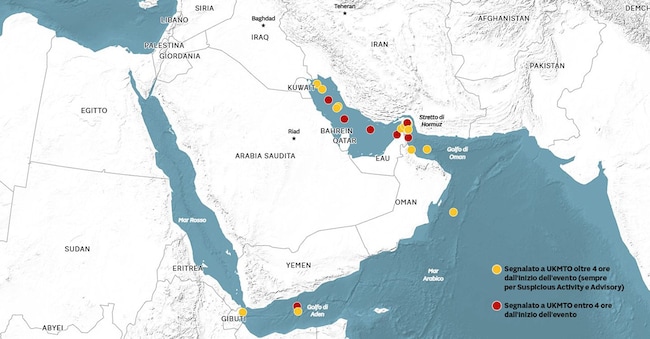
The evacuation mission itself, co-ordinated by the International Maritime Organisation, highlights the limitations of the ceasefire: between 23 and 26 June, 136 ships carrying around 2,900 seafarers were evacuated; a subsequent attack forced the suspension of the security arrangements. In October, UK Maritime Trade Operations continued to report oil tankers hit by projectiles, fires and interference with transit in the Strait of Hormuz and off the coast of Oman.
Raw material flows through the Strait
The sheer scale of the issue explains why it extends beyond the shipping industry. According to the US Energy Information Administration, the volume of petroleum products passing through the Strait of Hormuz fell from 21.6 million barrels per day in the fourth quarter of 2025 to 4.9 million in the second quarter of 2026: a decline of 77.3 per cent. Crude oil and condensates fell from 15.9 to 3.7 million barrels per day, whilst refined products fell from 5.7 to around 1.1 million. Liquefied natural gas suffered an even sharper decline, from 10.5 to 0.8 billion cubic feet per day, representing a fall of approximately 92.4 per cent.
Nor have alternative routes automatically absorbed the shortfall in volumes. Between the fourth quarter of 2025 and the second quarter of 2026, oil flows through Bab el-Mandeb rose from 5.4 to 8.1 million barrels per day, whilst those around the Cape of Good Hope fell from 9.9 to 9.4 million. The vulnerability of the alternatives became apparent in September, when attacks temporarily disrupted the Saudi East-West oil pipeline, which previously carried over 5 million barrels a day towards the Red Sea. On 15 September, Brent crude reached, according to the same agency, $131 per barrel. Relocating infrastructure away from the Strait of Hormuz does not mean removing it from the geography of the conflict.

