From the west coast to Taiz

The Houthi advance has been halted. A wider front in Yemen and 130,000 refugees

The raid by pro-Iranian militias has been contained. As a result, the front line of low-intensity fighting has expanded. Traffic through the Bab el-Mandeb Strait remains stable, but Europe should be under no illusion: the country is becoming increasingly fragile

by Arhab Mohamed Al Sarhi

Aggiungi Il Sole 24 Ore
ai preferiti su Google
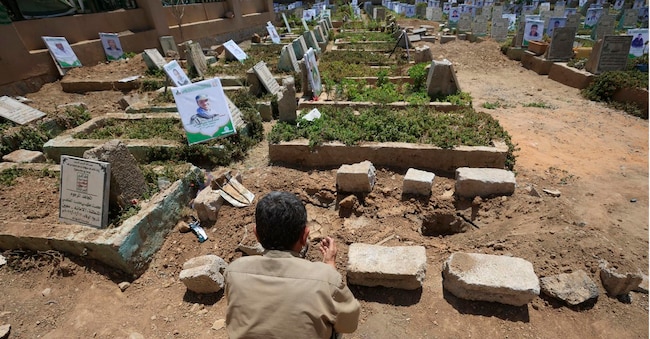
Un uomo prega davanti all’ultima tomba allestita in un cimitero dedicato alle vittime dei combattimenti in Yemen EPA/YAHYA ARHAB

6' min read

Translated by AI
Versione italiana

6' min read

Translated by AI
Versione italiana

When the Houthis took control of Mokha and large swathes of Yemen’s western coast, much of the international focus immediately turned to Bab el-Mandeb. What does control of this coastline mean for international shipping? What consequences might this have for ships passing through the Red Sea? And what impact might it have on trade heading for Europe via the Suez Canal? These are legitimate questions. But they are not the only ones we should be asking.

Behind the military maps and sea routes, another map is changing even more rapidly: that of Yemeni refugees. The war has not stopped on the west coast. The fighting has shifted to other fronts and Taiz, along with the western and southern parts of the province, has once again become the centre of clashes between the Houthis and forces loyal to the Yemeni government. Caught between the two fronts, civilians are moving in the only direction possible: away from the war.

Loading...

War maps

The capture of the western coast did not mark the end of one phase of the conflict; rather, it marked the beginning of a new one. Following the capture of Mokha and the coastal areas bordering the Red Sea, the fighting spread towards the high ground and the transport routes linking the coast to Taiz, Lahj and the southern regions.

Areas such as the Kahboub Mountains have a military significance that extends far beyond their local scope. They overlook the Bab el-Mandeb area and are situated close to the routes linking Taiz, Lahj and the west coast. Control of these high ground positions is crucial for securing supply and transport routes between the coast and the country’s interior.

In recent days, government forces have claimed to have repelled Houthi attacks on several fronts in Taiz province, whilst bombardments, clashes and attempts to capture strategic positions continued. But every time the front line shifts by a few kilometres, entire families move with it.

According to the United Nations High Commissioner for Refugees, even in the early stages of the latest escalation, fighting on the west coast had already forced some 100,000 people to flee from areas including the cities of Hodeidah, Taiz, Lahj, Aden, Abyan, Marib, Al-Dhale and Shabwa.

As hostilities have continued, the estimates have risen further. Taiz has simultaneously become one of the main areas taking in displaced people and one of the new epicentres of the conflict. But the figures, however large, do not in themselves explain what is happening. The evacuation of displaced people in Yemen is not an organised operation in which the population is transferred from a dangerous area to a safe place, where temporary accommodation and essential services await them. Families leave in a hurry, taking with them only what they can carry. Some seek refuge with relatives in other villages or towns. Others head for camps and settlements that are already struggling with shortages of water, food and healthcare. Still others simply look for any place that seems safer than the one they have just left behind.

It is a grassroots movement which, in many cases, outstrips the capacity of institutions and humanitarian organisations to respond. The problem is that Yemen is facing this new wave of refugees without ever having recovered from the previous ones.

Perhaps the most telling image of the current crisis comes from the other side of Bab el-Mandeb. The strait, which the world regards as one of the strategic arteries of international trade, has become, for some Yemenis, an escape route from the war. The United Nations has confirmed that thousands of people from Yemen have arrived by sea in Djibouti within the space of a few days. Many have disembarked at various points along the country’s northern coast, near Obock, before being transferred to reception centres.

As of 17 September, the UNHCR had recorded 2,935 arrivals in just eight days. Around 60 per cent were women and children. The UNHCR described families who had arrived after gruelling sea crossings, exhausted, psychologically traumatised and with very few possessions. Accounts gathered by the international media also reveal that among the first to cross the sea were fishermen who had loaded their families onto small boats, before larger groups began to arrive. There is a dramatic reversal in this picture.

Loading...

For years, Yemen has been a destination and transit country for migrants and refugees from the Horn of Africa heading for the Arabian Peninsula. Today, it is the Yemenis who are crossing that same sea in the opposite direction, in search of safety.

On the other side, Djibouti is facing an increasingly difficult humanitarian challenge. It is a small country with a population of around 1.2 million, which is already hosting refugees and has limited reception capacity. The UNHCR has warned that one of the main facilities could only accommodate around 5,000 more people, whilst the organisation was preparing for the possibility that arrivals could exceed 10,000 if the escalation continued.

The Yemeni crisis is already spilling over the borders

For Taiz, war is nothing new. The province has endured years of fighting, sieges, bombardments and military divisions, and its population has paid a huge price since the start of the conflict. But the danger of the current phase also stems from the fact that it comes after years in which many Yemenis had hoped the war was slowly receding. The relative lull in hostilities had created the impression that the country might have moved from open warfare to a phase of crisis containment. What is happening today shows just how fragile that belief was.

When a ceasefire does not lead to a political agreement, when institutions remain divided, military structures fragmented and decision-making bodies in competition with one another, war can return swiftly. And civilians are the first to feel the effects. Not through political statements, but when a school closes, a road is cut off, a hospital ceases to function, or a family is faced with a decision that no family should ever be forced to make: to stay in their home and risk being hit, or to leave without knowing where they will sleep the next day.

Behind the refugee figures

There is a risk that, once again, Yemen will be portrayed solely through figures: 100,000 displaced people. And now nearly 130,000. Thousands of people crossing the sea. But behind each of these figures lies a painful personal decision. There is a family leaving a home that may have taken decades to build. A child who has to stop attending school. A sick person who can no longer get hold of their medicines. A father or mother who do not know how they will put food on the table the next day. The consequences also affect schools, healthcare facilities and essential services in areas that were already extremely vulnerable before the latest escalation. These are not collateral effects of the war. For civilians, this is the war.

After more than a decade of conflict, perhaps the most dangerous idea is to believe that Yemen has become accustomed to war. No one gets used to leaving their home. Crossing a dangerous sea with one’s children does not become normal, no matter how long a conflict lasts. And the evacuation of tens of thousands of people should not become just another news story that the world stops paying attention to.

Fighting between the Houthis and government forces continues, with the front lines shifting from the west coast towards Taiz and other areas. At this stage, it is impossible to say where the new front lines will stabilise or how long the escalation will last.

But one consequence is already clear. The more the war spreads, the more the area that a Yemeni civilian can consider safe shrinks. Just a few weeks ago, the world was watching Mokha and Bab el-Mandeb, wondering what the future held for international shipping. Today, it should also be asking another question: what is happening to the Yemenis who are no longer looking for a route for ships to pass through, but for a way to save themselves?

Copyright reserved ©
Loading...

Brand connect

Loading...

Newsletter

Notizie e approfondimenti sugli avvenimenti politici, economici e finanziari.

Iscriviti