
The Vivo X500 is coming to Italia – the cinematic smartphone that pushes the boundaries

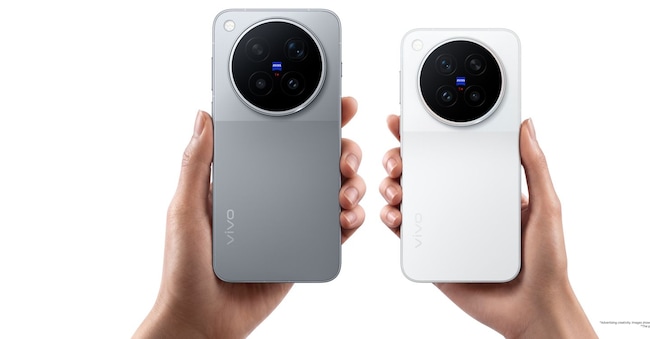
TENERIFE – vivo has chosen the natural beauty of the Canary Islands out of season to officially launch the X500 series in Europe, following its recent launch in China; this series represents the pinnacle (at least for the time being) of the collaboration between the Chinese manufacturer and Zeiss. The launch of this super-phone – two models will be available in Italia, the Pro Max and Pro, alongside three new music-playing devices: the vivo Buds Ultra, Buds Clip and Headphones Studio – took place at the Magma Art & Congress Centre, one of the most distinctive venues on an island chosen – not by chance – for an announcement centred on cinematic language. Let’s take a quick look at the prices to put the series’ positioning into context: the X500 Pro Max costs €1,599.99 for the 256 GB version and rises to €2,199.99 euros for the 1 TB configuration without the accessory kit, and 2,499.99 euros for the bundle containing the 200 mm and 400 mm telephoto lenses. The 256 GB Pro model is priced at 1,399.99 euros.
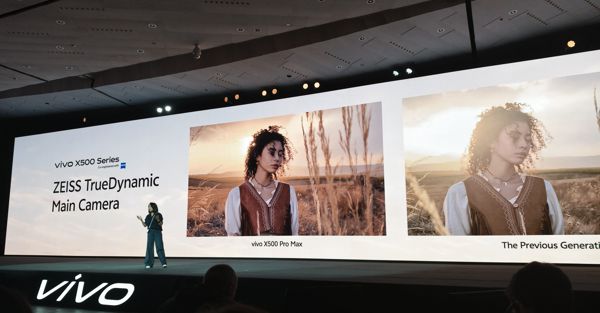
The market in which the X500 series is launching is already quite crowded, featuring the usual suspects” Apple and Samsung, Google with its Pixel 10 Pro XL, and, last but not least, Chinese brands (such as Oppo, which announced the Find X10 Pro Max last week) that have made imaging a key factor in setting themselves apart in the premium segment. It will therefore be interesting to see to what extent the impressive specifications announced by vivo at the launch will hold up in practice. One thing is certain – as reiterated on stage at the Magma Art & Congress Centre by Li Changjun, Vice President of vivo Europe – and that is the direction chosen by the Dongguan-based company: next-generation sensors and optics, advanced features (and this is where AI also comes into play) to broaden the range of shooting and filming options without compromising image quality (from zooming in on distant subjects to capturing moving scenes and backlit shots) are the key ingredients of a product designed to ensure top-tier photographic and video performance for professional creatives.
Two models, a shared imaging engine and OriginOS 7
Both the vivo X500 Pro Max and its ‘little brother’, the X500 Pro, are equipped with lenses, telephoto lenses and image-processing tools co-developed with Zeiss. Both models feature the TrueDynamic main camera (with two different sensors), whilst the most obvious distinction lies in the screen size: the Pro Max’s 2K Zeiss Master Colour display measures 6.85 inches diagonally, whilst the Pro’s measures 6.36 inches. Another feature shared by both models is the so-called ‘tideline design’ of the new X500 series, centred around the camera module: the transition between the camera island and the body follows a line designed to visually minimise the protrusion, whilst the metal module, the ring around the lenses and the cold-processed glass are the other elements of a design that pays homage to professional cameras. At the heart of the new smartphones – and moving on to the hardware specifications – is a 2-nanometre Dimensity 9600 Pro processor from MediaTek (whilst battery life is handled by two BlueVolt batteries of 6,750 and 6,510 mAh respectively, both capable of supporting 90-watt wired charging and 40-watt wireless charging. On the software front, operations are managed by the new ‘proprietary’ OriginOS 7 operating system (based on Android 16), via tools such as Workbench – which allows you to organise multiple windows and move content between compatible apps – and applications such as Quick Share, which facilitates file transfer between compatible devices.
The benefits of a telephoto lens: from concerts to nature photography
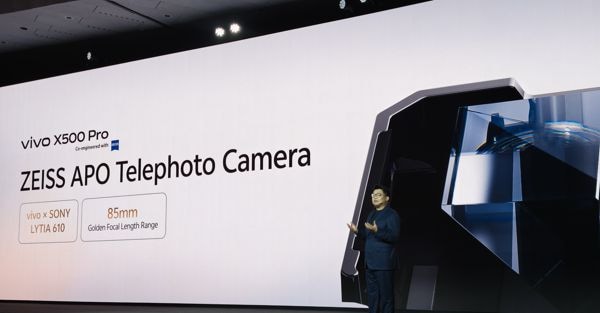
One of the factors that Vivo seems to have chosen to make the X500 series stand out from the competition is the focal length. On the Pro Max, the 200-megapixel Zeiss APO telephoto lens (equipped with special lenses to correct chromatic aberration) uses a 1/1.4-inch Ultra-Sensing HP0 sensor with a focal length equivalent to 85 millimetres, whilst CIPA 7.0 image stabilisation (the highest certified standard according to the parameters of the Camera & Imaging Products Association) allows for handheld shooting even in less favourable lighting conditions. The Pro, for its part, features a 64 MP telephoto lens based on the Sony LYTIA 610 sensor, developed jointly with Sony, again with a focal length equivalent to 85 millimetres. For those who want to go further, the Pro Max supports the Zeiss Gen 2 Ultra teleconverter, which brings the focal length to an equivalent of 400 millimetres, whilst both models support the 200-millimetre Gen 2 teleconverter. These accessories, as mentioned above, form part of the premium kit included with the ‘deluxe’ version of the new smartphone and enable the device to be used in specific and ‘extreme’ situations such as a concert or a sporting event filmed from a distance, or spotting an animal on the horizon, making the telephoto lens a true ‘companion’ for action and sports photography. Rounding off these options are various tracking features, including the X-Track Engine, which keeps the subject in focus even if it temporarily leaves the frame. For videos, autofocus tracking is available up to 4K at 120 frames per second with both the main camera and the telephoto lens.
Ambitions from the set
The Zeiss-branded TrueDynamic main camera is at the heart of the vivo X500’s imaging performance, and its standout features include the Cinematic Pro Log Video mode, designed to preserve detail in highlights and shadows and provide greater flexibility in post-production, and the 4K Cinematic Portrait Video mode for portraits, which promises to preserve natural skin tones even in complex lighting conditions (such as a sunset behind the subject). As for the wide choice of available colour styles, for moving scenes, native 4K recording is guaranteed at up to 240 frames per second and is available in Video, Video Pro and Slo-mo modes, with the stated benefit of greater flexibility when shooting in slow motion and during post-production. The top-of-the-range model also features gimbal-level OIS optical stabilisation of up to 3 degrees to provide further stability and smoothness to footage.

