
The laptop is not what it used to be. The Qualcomm-Amd challenge
Special watch Qualcomm, whose Snapdragon X platform is a candidate to bring Windows PCs into the Ai gen era. But Amd and Intel are ready for a relaunch

3' min read
3' min read
We are waiting to 'play' with 'Recall', what is widely described as the killer application of the new Copilot + PCs, but which would appear to be an evolution on steroids of Time Machine on the Macs. Let us also wait to celebrate the funeral of the x86 architecture, the one dominated to date by Amd and Intel. As also to think that now the start of chips for Windows personal computers is a three-way game with Qualcomm ready to take the whole cake. While we wait to better understand how much the new AI-enhanced Windows PCs will change, however, the first real fact is that the market for PC microprocessors has become more interesting and crowded. As we learned last Monday at the end of Microsoft's presentation, the chip chosen to power the CoPilot Plus computers is not an x86 architecture but the new ARM-based Qualcomm Snapdragon X Elite processor. The exclusivity agreement between the US giant and Microsoft for the use of the Windows on Arm (WoA) platform will expire in 2024. This will open the doors of the Windows ecosystem to other Arm chip manufacturers, who will finally be able to compete with Qualcomm by offering more choice to consumers. A giant like Nvidia could also enter the game. Nvidia's CEO Jensen Huang has hinted that he is interested in entering the notebook market with an ARM SoC in 2025.
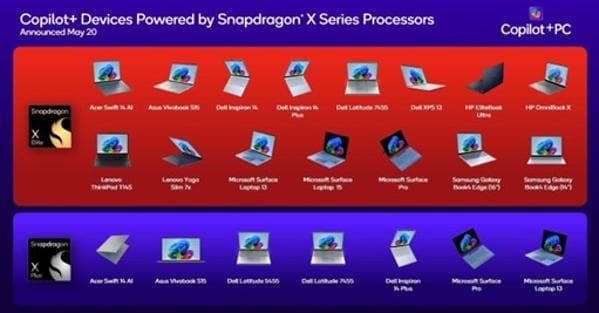
As mentioned, however, before sanctioning the end of the Amd-Intel duopoly, we will have to wait for the arrival of their next-generation chips. Moving the business there are for now three to simplify Ai chip providers: Snapdragon X Elite to be released in the summer, indeed the official debut of the ARM SoC developed in San Diego is scheduled for 18 June, the day of the debut of the Copilot+ PC. Intel's Lunar Lake is expected later this year. While in surprise at Computex Lisa Su, CEO of AMD, stated that the new Ryzen AI 300 series for laptops will be available as early as July.
So both AMD and Intel are developing next-generation mobile chips with powerful integrated GPUs, and according to experts it is not certain that they will be less performant than their rivals on the Arm platform. On the contrary, with the Ryzen AI 300 AMD promises to achieve 50 TOPS (TeraOPS) of computing power, meeting Microsoft's demands for the so-called Copilot+ PC, which were 40 TOPS.
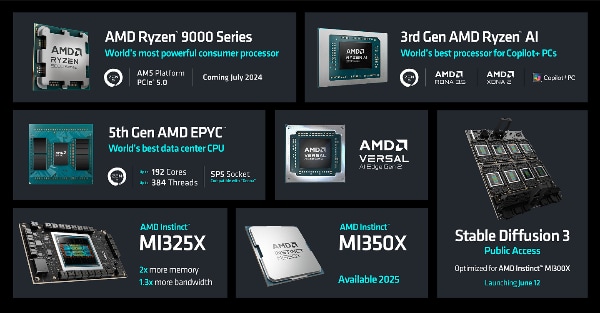
With 50 TOPS Amd announces itself to be ahead of the 45 TOPs of the NPU of the Snapdragon X Elite and Intel Lunar Lake (the future Core Ultra mobile) and the 38 TOPs of the Apple M4. As if to say overtaking is served.
As for Arm, remember that developers will now have to ensure full software compatibility also on the Arm platform, i.e. run x86 apps via emulation also on Arm PCs. The full porting of x86 applications to Snapdragon X will take time and will largely depend on the commercial success of the first laptops. As for performance, the new Ai PCs promise to be lighter, faster and more fuel efficient. The benchmarks that have so far run do not describe a notebook as superior to Apple's Macbooks. And that has not happened for years.


