
Venice

'The light in the crack': the short film giving voice to caregivers, silent heroes

A work inspired by a true story tells of the weight and beauty of caring
by Francesca Cerati

4' min read

4' min read

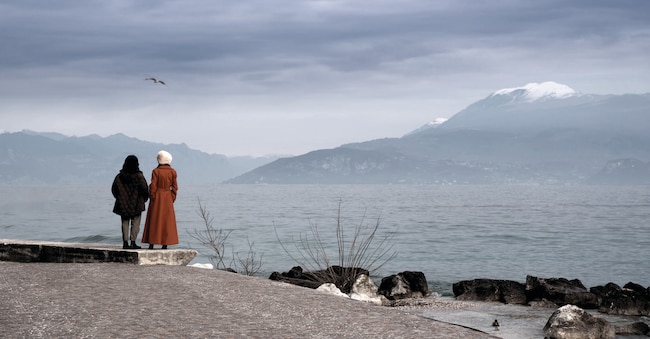
A short holiday at a spa, designed to provide some relief, turns into an emotional journey that delves into the bond between two sisters, between love and fatigue, between illness and resilience. This is the story of Luisa and Carla, freely inspired by a real-life event, which comes to life in the short film "La luce nella crepa", which had its international premiere at the 82nd Venice Film Festival in the Venice Production Bridge section.

Luisa has dedicated her life to caring for Carla, a breast cancer patient. After a cycle of exhausting therapies, she decides to convince her to spend a few days at the spa, hoping for a respite from daily fatigue. But the short holiday turns into an obstacle race: bureaucracy, tensions, misunderstandings put their relationship to the test, revealing just how much the role of the caregiver is one of love, but also of isolation, stress and a sense of powerlessness. It is through these cracks that, in the short film, light enters: a glimmer of hope and resilience that becomes the heart of the narrative.

Loading...

Directed by Anselma Dell'Olio and with a screenplay by Manuela Jael Procaccia, the short film devised by Salute Donna Odv aims to shine a spotlight on the figure of caregivers: more than 7 million people in Italy who assist a sick relative every day, often in the shadows. "Because there is a crack in everything. And it is from there that light enters,' reads the title, a quotation that becomes a declaration of intent.

The voice of those who inspired the story

.

Behind this project is Annamaria Mancuso, president of Salute Donna Odv and coordinator of the group 'Health: an asset to defend, a right to promote'. The story told in the short film is inspired by her experience as a caregiver for her brother Tonino: "The caregiver bears a high physical and emotional workload, which at certain times can become unbearable. A carer of a sick family member enters a tunnel that can last for years. It is important to ask for help, to give space to one's own needs, and to find beauty and love in spite of everything and the illness'.

Cinema as a tool for empathy

.

Dell'Olio, director, journalist and feminist historian, has turned Mancuso's personal experience into a heartfelt story: "The meeting with Annamaria was one of those moments of synchronicity that will remain marked in my personal history. I attempted, thanks to extraordinary performers and a motivated crew, to give voice and dignity to the caregiver, transforming him or her from a marginal presence into the protagonist of a profound and authentic narrative, one that is born out of the pain of illness and loss, but tries to be reborn more vigorous than before".

Caregivers: an invisible but crucial reality

The film highlights an urgent social issue: in Italy, although there are legal references such as Law 104/1992, there is a lack of adequate protection. According to Istat, 60-70% of caregivers are women, and many sacrifice work and personal life to provide care.

"The cancer patient has complex clinical, psychological and social needs,' emphasises Nicla La Verde, oncologist at the Sacco Hospital. 'The caregiver is a fundamental interlocutor for optimising care and sharing the complexity of the pathway, including in the management of adverse events.

Political engagement

.

The Venetian preview was also an opportunity to re-launch the political debate: 'Caregivers are the backbone of informal care, they deserve recognition and protection,' says MP Vanessa Cattoi, deputy and coordinator at the Chamber of Deputies of the parliamentary intergroup 'Together for a commitment against cancer'. 'We need an effective support network and dignity for those who devote themselves every day with sacrifice.

"A national regulation is urgently needed to reconcile life, work, training, and recognise the skills of carers,' adds Ilenia Malavasi, MP and member of the Parliamentary Intergroup 'Together for a Commitment Against Cancer'. 'We must give back a voice and dignity to millions of people.

"Politicians are sensitive to this figure, and laws are being discussed to strengthen the role of caregivers, also on a psychological and economic level," recalls Senator Guido Quintino Liris, coordinator of the Parliamentary Intergroup 'Together for a Commitment Against Cancer'.

The project was made possible by the unrestricted contribution of Daiichi Sankyo and AstraZeneca, which are committed to oncology research.

"Oncology is also a field of civil confrontation. We are proud to support this initiative, which promotes dialogue and inclusion,' says Mauro Vitali, Vice President Head of Oncology at Daiichi Sankyo. 'Only by starting again from real needs can we improve the course of treatment.

"Supporting this short film means enhancing the role of caregivers, who are increasingly central in the life paths of cancer patients," comments Francesca Patarnello, vice president Market Access & Government Affairs at AstraZeneca. "Patient Associations must become an integral part of the healthcare system to build more inclusive policies.

A short film that becomes a manifesto

.

Produced by Pro Format Comunicazione and MP Film, 'The Light in the Crack' is not just cinema: it is a social manifesto. It tells of the love and sacrifice behind every gesture of care, and invites institutions, companies and citizens to look at those who dedicate themselves to others, often in silence. Because in the cracks of illness, as the title suggests, there can filter a light capable of transforming pain into collective awareness.

Copyright reserved ©
Loading...

Brand connect

Loading...

Newsletter

Notizie e approfondimenti sugli avvenimenti politici, economici e finanziari.

Iscriviti