
The Marmolada glacier is shrinking ever further: nine hectares less than last year
The area covered by ice has fallen from 92 hectares to 83 over the past 12 months. It stood at 100 in 2023

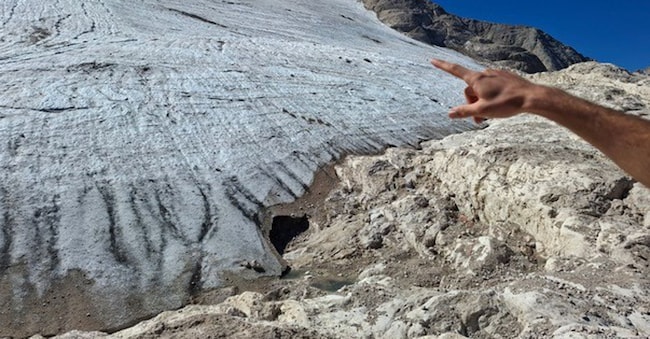
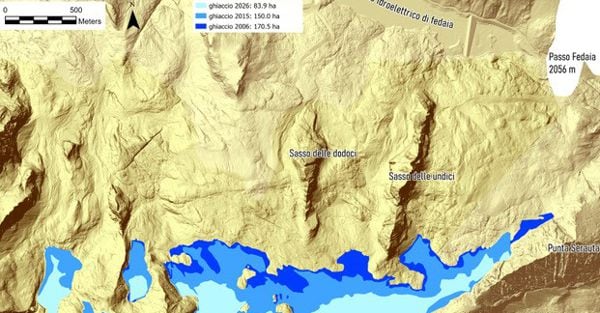
The trend is negative. This is because the Marmolada glacier is retreating and shrinking. Compared with last year, its area has decreased by 9 hectares – currently 83 hectares compared with 92 last year – and is ‘a long way’ from the 100 hectares recorded in 2023. on the western flank, a retreat of 120 metres has been recorded over two years. This is what has emerged from the eighth edition of the participatory glaciological campaign on the Marmolada, promoted by the Museum of Geography at the University of Padua, which involved collaboration between researchers from the University of Padua, ARPAV, the Italian Glaciological Foundation, students and volunteer members of the public from four different regions. ‘The 2026 campaign,’ the organisers emphasise, ‘has enabled us to collect up-to-date data, which is essential for continuing to monitor what remains of the Dolomites’ main glacier and for better understanding the impact of climate change at a local level.’
The data collected this year, as Mauro Varotto, a lecturer in the Department of Historical, Geography and Classical Studies and the campaign’s scientific lead, “exacerbate the trend already evident in recent decades, setting a new record low for the glacier’s area loss: in one year, it has lost 9 hectares, falling to a total of 83 hectares compared with 92 last year”. ‘This is a record loss that we had previously recorded only in 2022,’ he emphasises, citing the results of the analysis of satellite imagery carried out by Francesco Ferrarese, ‘following the tragic collapse of the glacier. If summers like the one just passed continue, the glacier could have only about ten years left.” Around thirty people, aged between 16 and 75, took part in the monitoring activities carried out on the glacier, including experienced hikers, teachers, as well as ordinary enthusiasts and curious onlookers. ‘Overall, measurements at the glacier’s front show a retreat three times greater than last year – 23 metres on average,’ emphasises Giovanni Benetton, who has been in charge of measurements for the Italian Glaciological Foundation since this year – “and the most dramatic situation is at the western front, where at one measuring point we recorded a retreat of 120 metres in two years, with the front now at an altitude of over 2,900 metres. The glacier is completely devoid of residual snow, and the only snow remaining is now that beneath the geotextile tarpaulins.”
Then there is the issue of temperatures. “The summer of 2026 turned out to be the hottest at high altitude in the Dolomites since at least 1991, surpassing even that of 2003 in terms of duration and average temperatures,” comments Gianni Marigo of Arpav.Taking August as an example, the deviation from the average was more than 3 degrees Celsius. During that month, at the Arpav Punta Rocca station on the Marmolada at 3,250 metres, a sub-zero minimum (-0.6°C absolute value) was observed on only three days, and no day was recorded with a sub-zero average temperature.” Not only that: ‘The intense glacier ablation processes have thus continued,’ he continues, ‘and there were no snowfalls even at the highest altitudes; similarly, the degradation of the permafrost has continued, and at the Piz Boè station there is no frozen ground at any depth.’ Alberto Lanzavecchia of the University of Padua highlighted the educational aspect of the campaign and, at the same time, the importance of the glaciers. And thus the importance of monitoring the site, one of the 150 that the Italian Glaciological Foundation ‘monitors’ each year. “‘2026 is proving to be a record year even on an Alpine scale, with losses in glacier thickness in this region tripling compared to the average of the last decade and winter snow having already melted away by the end of July, weeks earlier than usual,’ concludes Aldino Bondesansi, the regional manager for the Triveneto area. In mid-August, in Marmolada, surveys showed that the crevasses upstream of the 2022 detachment niche were filled with meltwater, the very same condition that our studies had identified as the cause of the collapse.”

