Space

The game to return to the Moon restarts: SpaceX is late, outsiders enter the field

The module for landing on our satellite is still missing, while Musk's company seems more interested in Mars. And, meanwhile, the Chinese are breathing down NASA's neck

by Leopoldo Benacchio

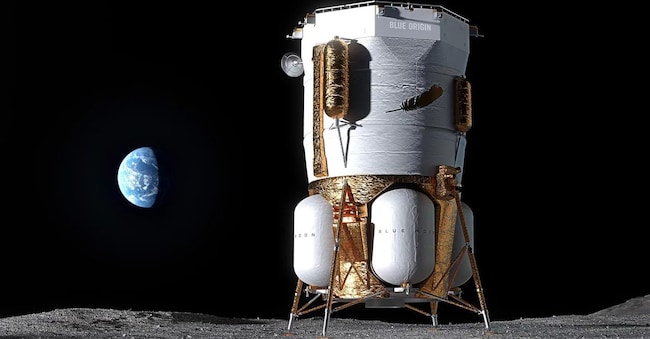
Lander lunare di Blue Origin, illustrazione

3' min read

Translated by AI
Versione italiana

3' min read

Translated by AI
Versione italiana

President Trump wants the US to get its feet on the Moon by 2029, with the Artemis programme, but almost all analysts agree that it's just not possible. The danger Trump sees is that the Chinese will get there first, and that's a real danger, plus 20 January 2029 is the end of Trump's term and what happens after that will be seen. So the date is set, but completely unrealistic.

The situation is complicated and, to some extent, very strange: the US has the rocket to go all the way to the Moon, to be optimistic, but not the vehicle to descend and get the astronauts down; the Chinese, on the other hand, probably have everything but the rocket powerful enough to get the taikonauts, the Chinese astronauts, to the Moon; getting them down seems easier for them. Both, however, want to get to the Moon's South Pole because of the alleged, but quite safe, deposits of frozen water at the bottom of the lunar craters there.

Loading...

The Artemis project, at least for the part related to the main carrier rocket that will carry astronauts and materials by the tonne to the Moon, had been entrusted to SpaceX, owned by Elon Musk, which, however, is considerably behind schedule and, above all, has set up a fascinating, but heavy, complex and costly project. NASA now feels insecure, thank goodness, say many, and reopens the game through the mouth of its interim CEO, Sean Duffy, who wants a Plan B to get to the Moon. He told two important and followed American television stations: CNBC and Fox News.

Little competition, slow development

We wrote 'thank goodness' earlier because entrusting everything to a single company, however important, solid and having shown exceptional progress in the space field, had seemed a gamble to many, what in engineering is called creating a 'single point of failure'.

To put things in order: now it is Artemis II, Nasa's SLS rocket, an upgraded version of the old 1990s rocket for the Shuttle, is ready and will take Nasa's Orion capsule around the Moon in 2026, as in the Apollo programme or in Verne's book, but no one will go down this time.

Then comes the best part: Artemis III sends SLS's 120-metre rocket into the attic and SpaceX's majestic Starship takes over, which finally seems ready after 11 tests, some of them disastrous.

Now Starship is a very large, heavy and powerful rocket because Musk also wants to put thousands more of his Starlink satellites into orbit, for the transmission of data and voice from space: he now has about 9000 of them, but he wants about 40,000. Apart from that, the Moon seems to be seen by Musk as an ATM, he is not that interested in it: his real goal, his obsession we might well say, is Mars.

It is already difficult for Starship to get to the Moon, as it needs to be refuelled in orbit by means of orbiting tanks, a fascinating manoeuvre but one that has never been attempted so far. The real problem, however, is that SpaceX is behind schedule with the lunar lander that sits atop the launcher, which must land softly on the ground and deposit the four astronauts already selected some time ago.

Possible outsiders: from Bezos' Blue Origin to Lockeed Martin

Duffy now wants to introduce Blue Origin, owned by Jeff Bezos, which is also planned in the Artemis project, but later, in the fifth mission, Artemis V, in 2030 and already costing 3 billion, to which more money will have to be added if it is to be done soon, while Musk, with SpaceX, already has the contract for the Artemis III lander in his pocket, which is delayed but worth 2.9 billion.

A few other companies could also be in the game, Lockheed Martin and others are mentioned, but the costs here are going through the roof, literally. Besides, time is short, three years in this field is nothing and everyone knows that, even Trump's advisers.

The solution could be to develop a new lander, of reduced size and capacity, to make Trump happy, for instance by using the Orion capsule that is scheduled to be decommissioned, but in the meantime the undertaking is not guaranteed, and then it risks costing, starting practically from scratch, quite a few billion more.

The goal is no longer to take 'four steps'

Finally, it must be said that going to the Moon, regardless of what the US presidents want, this time must serve to permanently inhabit it, with robots and astronauts, build houses, laboratories, mines, roads, pitches, and start a real lunar economy. And it is known that, with the almost non-existent legislation on the exploitation of space, first come, first served..

Copyright reserved ©
Loading...

Brand connect

Loading...

Newsletter

Notizie e approfondimenti sugli avvenimenti politici, economici e finanziari.

Iscriviti