
The new electric Dacia Spring: everything you need to know
The electric city car is switching to a new platform, is getting bigger and is being manufactured in Europe. It features a 27.5 kWh LFP battery, a range of up to 250 kilometres and prices starting at around 18,000 euros.

Key points
The new Dacia Spring has undergone a complete overhaul, with production now taking place not in China but in Novo Mesto, Slovenia. The small electric car from the Renault Group brand moves away from the design of the first Spring models and is built on the Rgev small platform, the same architecture used by the new Renault Twingo E-Tech. Consequently, its dimensions, interior space and performance have all changed, with the aim of extending its range beyond traditional urban use. Since 2021, the Spring has sold over 210,000 units in more than 40 countries, building its success primarily on price and simplicity. The new generation remains true to this approach, but seeks to become more of an everyday car suitable for use outside the city as well.
New Dacia Spring: dimensions and boot space
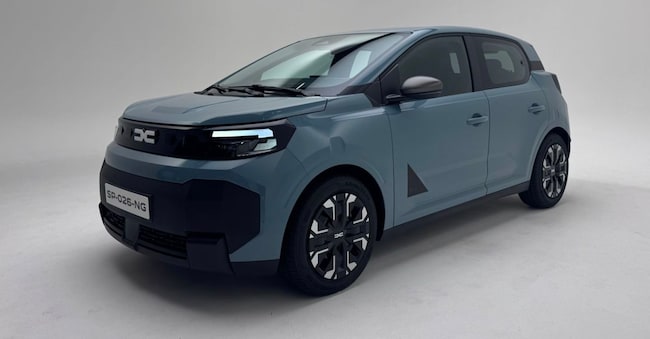
Gone are the super-compact dimensions of the Dacia Spring, although it remains one of the few A-segment electric compact cars under 3.90 metres. The length has increased from around 3.70 to 3.85 metres, whilst the width has grown from 1.58 to 1.74 metres. The height remains at around 1.52 metres. An extra 15 centimetres in length and, above all, an additional 18 centimetres in width alter the car’s proportions and improve the space available on board. The boot capacity has also increased, now standing at 337 litres and capable of reaching 1,283 litres when the 50/50 split rear seat is folded down. To this can be added the 18 litres of the front storage compartment, available as an option and designed primarily to house the charging cable. The design is also completely new, now more angular and with a more vertical profile at the front and rear. The black, mass-coloured plastic protective trim on the bumpers has been designed to be less susceptible to minor scratches and scuffs. Despite sharing the same platform as the Twingo, the family resemblance between the two models is not particularly obvious when viewed from the outside.

New Dacia Spring interior
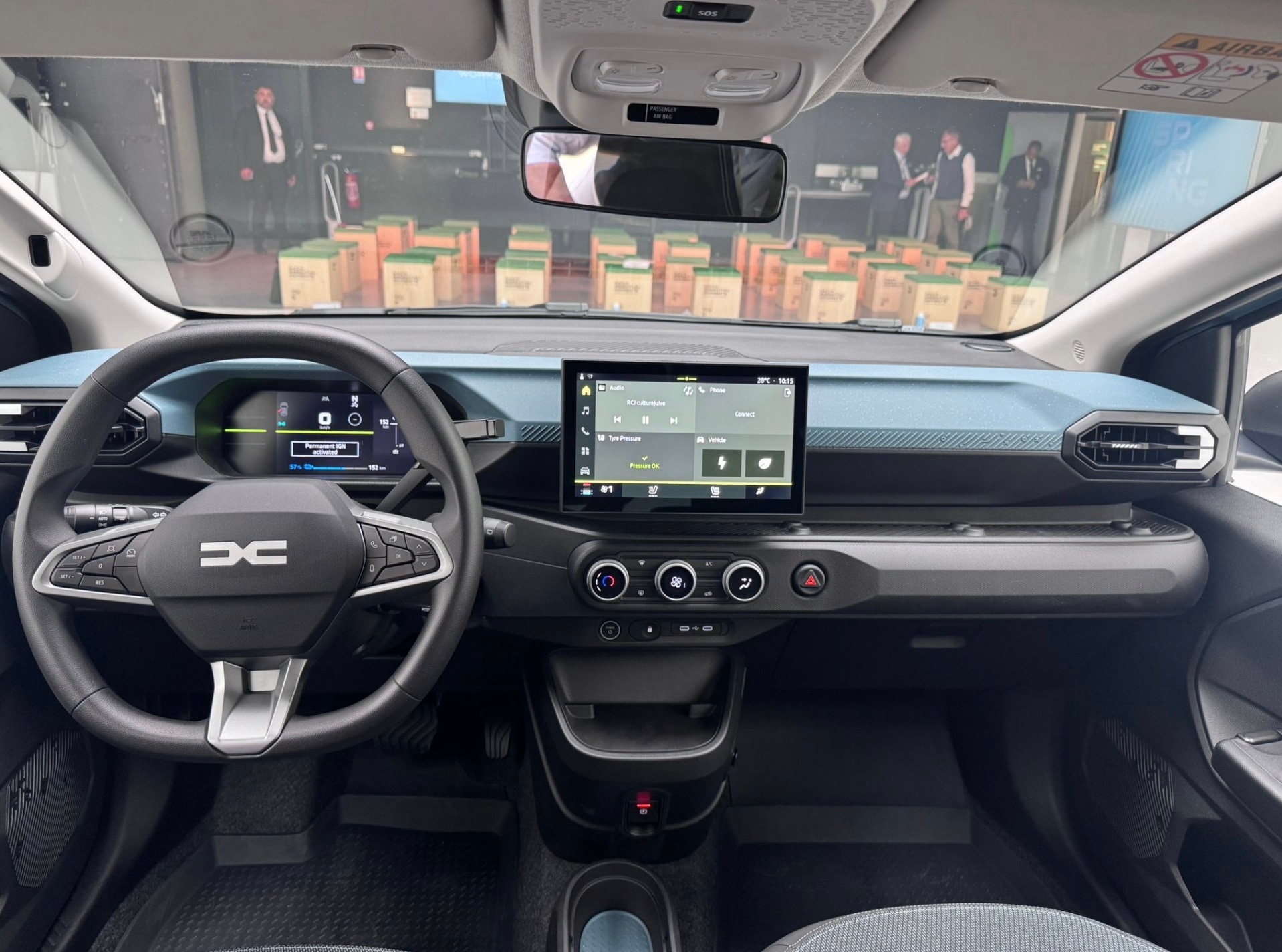
The increased width results in a significantly more practical interior than in the past. The dashboard retains a simple layout, with a predominantly horizontal design, whilst a 7-inch digital instrument cluster is fitted in front of the driver on all versions. On the Expression, the Media Control system uses the smartphone as the central hub for managing multimedia functions, complementing the steering wheel controls and the information displayed on the digital instrument cluster. The Journey, on the other hand, adds Media Nav Live with a 10.1-inch touchscreen, wireless Apple CarPlay and Android Auto, connected navigation and online services. There is also a greater focus on practicality, with YouClip mounting points allowing various accessories to be fitted inside the cabin and in the boot, whilst the driver’s seat is height-adjustable and the steering wheel can be adjusted for both height and reach. Meanwhile, the 4.95-metre turning circle ensures the Spring remains at ease in urban environments.
Dacia Spring: engine, battery and range
Under the bodywork, we find the same specifications as on the Twingo E-Tech, starting with the 60 kW electric motor – equivalent to 80 cavalli – delivering 175 Nm of torque. The new Spring accelerates from 0 to 100 km/h in 12.1 seconds and reaches a top speed of 130 km/h, figures that mean it is less restricted to city driving than in the past. The battery uses LFP (lithium iron phosphate) cells and offers a usable capacity of 27.5 kWh. The claimed range reaches 250 kilometres in the WLTP combined cycle, whilst energy consumption stands at 12.7 kWh per 100 kilometres. This performance is also aided by its low kerb weight, starting at 1,212 kg. A 6.6 kW AC charger is fitted as standard. Using a 7 kW wallbox, it takes 2 hours and 55 minutes to charge the battery from 15% to 80%. The fast-charging package increases the AC charging power to 11 kW and adds DC charging up to 50 kW. In this case, charging from 15% to 80% takes 28 minutes. With the Power Pack, the V2L function is also available to power external electrical devices using the car’s battery.
Dacia Spring: prices and specifications
The Italian range comprises two trim levels, both fitted with the same 80 cavalli motor and 27.5 kWh LFP battery. The Spring Expression starts at around €18,000 (€17,900 to be precise) and includes 15-inch Flexwheel alloy wheels, manual air conditioning, rear parking sensors, an electric parking brake, Media Control with a USB-C port, a 50/50 split rear bench seat and three YouClip mounting points.

