
The new pays and the Lady sets the Scala on fire

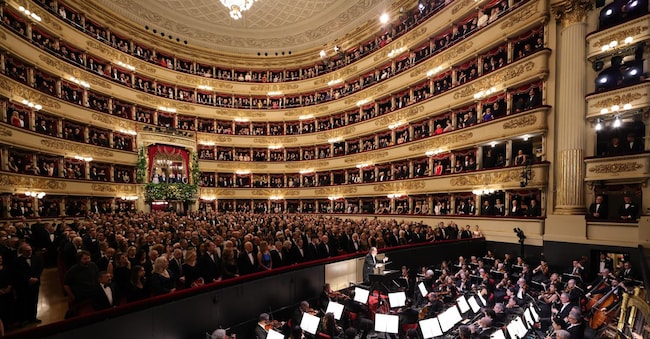
The direction in this season-opener at La Scala is an absolute winner, dramatic and imaginative, even with a surprise effect of fire at the end, with the two women burnt to death on stage, shrouded in flames. Never seen at the opera. An effect not foreseen, because in the story the two miserable rivals in Siberia are supposed to die by drowning, but one that creates a rare listening tension right to the end, rewarded with twelve minutes of triumphant applause.
Together with the brilliance of the young Vasily Barkhatov, the absolute star, he wins the whole theatre in Šostakovič's 'Lady Macbeth in the District of Mcensk' this 7 December at La Scala. Riccardo Chailly's conducting, too, seems to favour percussion and brass in the orchestra pit, with a motoric, nervous direction, punctuated by continuous bursts of sonorous clangours, but where the demand for an expressionistic articulation fits perfectly with the stage.
It was a smart choice to propose this title for 7 December, confirming that the new pays off, and that a score as disruptive as that of the then not even 30-year-old Russian composer holds like a magnet. The Milanese ritual of Saint Ambrose was for once transformed into real theatre. Modern, intelligent. With the protagonist, Sara Jakubiak, capable of restoring an extraordinary vocal and emotional magnetism, in total identification with the character. Even more poignant, dressed in the mournful brown, clerical suit, which penalises all femininity, yet at the same time makes her even more explosive in her desire for freedom. She is marvellous, but all the others in the numerically impressive cast are also excellent, with honourable mention to the cynical father-in-law, Boris Izmailov, played with perfect adhesion by Alexander Roslavets, and together with the seducer Sergej, perennially in a vest, but with the multifaceted tenor voice of Najmiddin Mavlaynov.
The whole story from the beginning is already known. Because Barkhatov's original cut is to tell us the grotesque drama according to a double narrative level: the 'Lady' already at the beginning presents herself at the table of the judicial deposition, while confessing to the two domestic murders. It will be that table that obsessively emerges from the trapdoor of the stage, like a paradoxical punctuation that solves the problem of the instrumental interludes with extreme effectiveness. There, with an easy but impressive theatrical expedient, the protagonist appears and then, in turn, all those involved in the double murders, in what is here intended to be Boris Izmailov's sumptuous restaurant - stunning in its Art Nouveau setting by Zinovy Margolin. From the minuscule confession at the table, cold but also comical, in the objective rituality of a police deposition, we move on to the giant, tripartite video, punctuated little by little with the objects of "noir", which with objective glaciality retraces the pace of the drama. Grotesque and tragic chase each other, truth and fiction. Because everything has already happened, but is repeated. Exactly as theatre is.

