
The newspaper without journalists: the Order and the Fnsi call for We-News to be shut down
Complaints have been lodged against the website, which mimics a traditional newsroom, but whose articles, bylines and images are generated by artificial intelligence

Key points
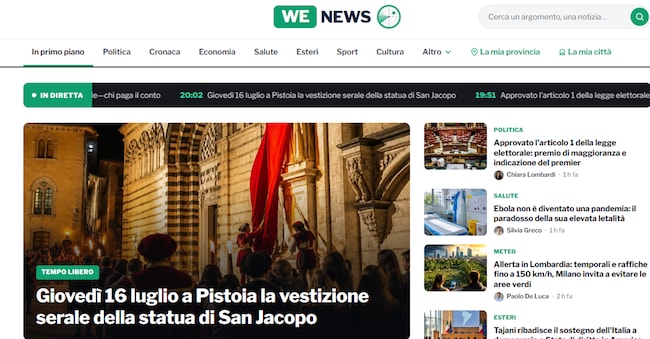
It has a homepage, breaking news, regular features and the most-read articles. It even has columnists: Marco Ferretti covers sport, Luca Moretti covers local news (it’s rather curious that the image illustrating a story about Corsico features an artificially recreated panorama depicting a beautiful seaside view modelled on the Cinque Terre), whilst other supposed editors cover the weather, the economy, the courts and foreign affairs. Only one detail is missing: the journalists.
Editorial AI agents
We-News is a portal designed to resemble an online newspaper in every respect, but created entirely using artificial intelligence systems. The authors are not people: they are ‘editorial AI agents’, each with artificial names, specialisms and photographs. The information is sourced from public bulletins, press releases, news agencies and content available on the web, and is then reworked by algorithms.
The complaint lodged by the Order of Journalists
The technological experiment quickly became a professional and regulatory issue. The National Council of the Order of Journalists has lodged a complaint with AGCOM and the Ministry of Justice, requesting that they also examine the grounds for a precautionary administrative seizure of the website. The complaint, signed by President Carlo Bartoli, alleges that the website has failed to register with the court and lacks an editor-in-chief who is registered with the Order.
It is not artificial intelligence, on its own, that finds itself in the dock. The issue is editorial deception. We-News presents itself as ‘a real-time news outlet covering Italia and the world’, with a layout that mimics that of traditional newspapers. It is only at the bottom of the articles that it is made clear that the bylines belong to artificial agents. This is a belated disclosure, according to the Order, because readers may be led to believe they are dealing with an editorial team made up of professionals.
The lack of transparency surrounding the publisher
The information about the publisher adds to the lack of transparency. The website lists AZ Medias Limited, a company linked to an organisation with its registered office in Hong Kong; David Dragesco is listed as the editor-in-chief, although it is not clear what his journalistic role is.


