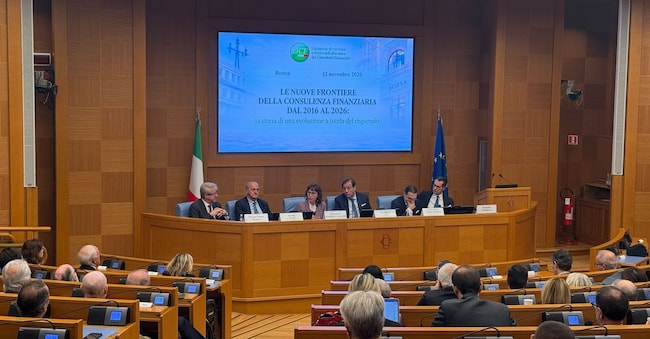
The definition of the OCF’s mission and of the profession has been firmly enshrined in the constitutional framework referred to by Antonella Sciarrone Alibrandi, a judge of the Constitutional Court. Her analysis focused on the visionary scope of Article 47 of the Constitution, which entrusts the “Republic” — and not merely to the central government, thereby paving the way for independent authorities and specialised intermediary bodies such as the OCF — the task of safeguarding and encouraging saving in all its forms. Sciarrone Alibrandi emphasised the principle of subsidiarity, which fully justifies supervision that is closely attuned to the dynamics of the profession, and the constitutional verb ‘to encourage’, which precedes and makes the protection itself possible: facilitating the channelling of resources towards the real economy and access to investment is an imperative that transcends national borders, as reflected in the OCF’s participation in international forums and IOSCO working groups.
Marco Osnato, Chair of the Finance Committee of the Chamber of Deputies, highlighted the paradox of a country characterised by extremely high levels of private financial wealth — amounting to around 6,000 billion euros — yet in which over 1,500 billion remains tied up in cash in non-interest-bearing current accounts and a mere 3 per cent is invested in listed shares, compared with much higher averages in foreign markets. Faced with a public debt that struggles to sustain growth on its own, and the challenges posed by reglobalisation and geopolitical tensions, the financial adviser plays an essential role as a bridge, channelling capital towards small and medium-sized enterprises, which make up over 94 per cent of the Italian business sector.
The Deputy Minister for the Economy, Maurizio Leo, outlined the evolution and future prospects of taxation on financial income. He traced the history of tax regimes from the 1980s up to the 1997 reform, which introduced taxation on accrued returns for managed savings – a measure that proved distorting during market downturns as it affected purely notional income. Leo also outlined the main thrust of the enabling tax law (Law 111/2023). The policy objective is to overcome the artificial distinction between capital income and other income, merging them into a single category of financial income, realigning taxation with the moment of actual realisation in accordance with the constitutional principle of contributory capacity enshrined in Article 53. Despite current budgetary constraints, the Deputy Minister confirmed the intention to continue this reorganisation through amending decrees that can be implemented up to August 2028, thereby rectifying the current asymmetries in the system.
The scope of the recent Capitali Act and the rewriting of the Consolidated Law on Finance were examined in depth by Renato Loiero, adviser on budgetary policy to the Prime Minister, who summarised the OCF’s decade of work around three key achievements: the certainty provided by a verifiable public register, the effectiveness of preventive, risk-based supervision — evidenced by the normal figure of just 15 precautionary suspensions out of over 55,000 registered members in 2025 — and the professional development of the sector through assessment tests and an openness to innovation. Loiero emphasised that the reform of the capital markets and the revision of the penalty system introduced by Legislative Decree 128 aim to promote the timely correction of errors and a focus on violations that are genuinely harmful to investors. Referring to Article 47 of the Constitution, Loiero highlighted a striking parallel: whilst recent legislative reforms are primarily geared towards encouraging market access, the financial adviser serves as the indispensable guardian of the second verb – ‘to protect’ – ensuring that greater openness does not result in dangerous exposure to risks.
The analysis of the changes currently taking place in the savings industry was carried out by Gian Luca Trequattrini, Deputy Director General of the Bank of Italia, through a detailed examination of the distribution of financial products. In a market where the assets under management of open-ended funds exceed 1,300 billion euros and the portfolios managed by advisory networks exceed 1,000 billion, digitalisation has slashed costs and multiplied access channels, fostering the spread of online platforms, ETF accumulation plans and models operated by neo-brokers that do not provide advisory services. Trequattrini illustrated the gradual penetration of robo-advisers and automated support systems for advisory networks (robo-for-advisers), whilst highlighting a marked dichotomy between highly technological operators and traditional intermediaries still anchored to conventional relationship-based models. In terms of stability, both micro and systemic risks were highlighted, such as potential algorithmic convergence — which, during periods of market stress, can trigger simultaneous and destabilising sell-offs —, technological concentration regulated by the Dora framework, and the uncertainties associated with decentralised finance and tokenisation on distributed ledgers. In this context, the ethical standards and professional integrity of the adviser remain irreplaceable: the algorithm must remain a supporting tool, as the investor’s trust is placed in the individual and in the accountability of the recommendation, not in a technological ‘black box’.