
2026 Grape Harvest: Drought reduces yields, but excess stock is weighing on the Italian wine market
The water crisis will hamper production, but producers are more concerned about the market, with high stock levels, falling prices and stagnant exports

Key points
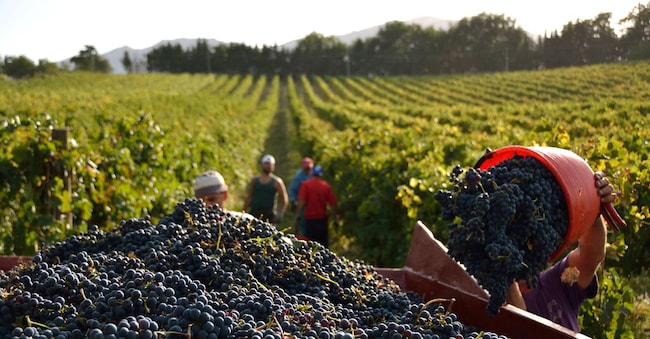
A paradoxical grape harvest. Because winegrowers, who have always seen the harvest as a source of income, if not wealth, now find themselves almost having to hope for a lower yield. And the drought, which has also affected Italian vineyards, will contribute to a reduction in production, because, together with the lack of a significant temperature difference between day and night, it has caused the grapes to dehydrate and the bunches to lose weight. However, the drop in production will be smaller than would be desirable.
Manufacturers are more concerned about the market than about production
This is the mixed sentiment prevailing amongst Italian wine producers, whilst the grape harvest – which is ahead of schedule – is already well under way. The real problem, in fact, is not production but the market. Italian wine is heading into the 2026 vintage with record levels of unsold stock: according to the Ministry of Agriculture, as at 31 July, there were 45.6 million hectolitres of wine and must in Italian cellars (+8.2 per cent compared with 31 July 2025). This quantity is equivalent to having an extra harvest in stock.
High stock levels are putting pressure on prices
The result is an oversupply that is putting pressure on prices. Last June, Italian DOC bulk wines were priced at an average of 1.57 euros per litre, down 7 per cent on the previous year. The situation was even worse for table wines (-19%). Adding to this already complex picture is the fact that, in the first five months of the year, exports fell by almost 7 per cent (to €3 billion), with exports to the US down by 15 per cent.
Castelletti (Uiv): it is difficult to guarantee an income from vineyards
This is why the prospect of a bumper harvest is viewed with some concern. “We believe there may be a decline compared with last year,” explains Paolo Castelletti, general secretary of the Italian Wine Union, “but not on the scale required. Under these conditions, vineyards in Italia are unable to guarantee an income for those who work them. We are talking about an average gross saleable yield of 4–5 thousand euros per hectare, compared with costs that often reach 7 thousand. This is a reality that must be acknowledged. Under current market conditions, we in fact consider a harvest of 35–38 million hectolitres to be sustainable – a target that cannot be achieved through improvisation; it requires planning.”
Awareness from the world of industry
There has been a sign that the wine-producing sector is becoming more aware of the situation. In recent months, many wine consortia with protected designations of origin have reduced the yield of grapes to wine – that is, the limit on the number of quintals of grapes to be used for DOC wine that can be produced from one hectare of vineyard. This decision has been adopted by Brunello di Montalcino (70 quintals/hectare, -12.5 per cent), Chianti Classico (65 quintals, -13.3 per cent), Valpolicella (100 quintals, -16.7 per cent), Soave (130 quintals, -10 per cent), Pinot Grigio delle Venezie (160 quintals, -11.1 per cent), as well as Barbera d’Alba (90 quintals, -10.5 per cent), Asti DOCG (85 quintali, -15 per cent) and, finally, Montepulciano d’Abruzzo and Verdicchio di Jesi, with reductions of -10 per cent and -21.4 per cent respectively. ‘This is an important sign,’ adds Castelletti, ‘which at least demonstrates a growing awareness. But this system has a fundamental flaw. Reducing the yield leads to a decrease in production for that specific DOC but not in overall production, because more grapes can still be produced from that vineyard to be used for IGT wines or table wines. We need to change the system and turn the yield limit into an absolute production ceiling, as is the case in France. Otherwise, excess wine will continue to flood the market, putting downward pressure on prices.”


