

The waiting list paradox: they’re getting better, but only one in two referrals leads to a consultation or test
50 per cent of prescriptions are not dispensed at National Health Service facilities. Waiting times and the decision to use private healthcare are major factors. There are significant disparities between the regions.

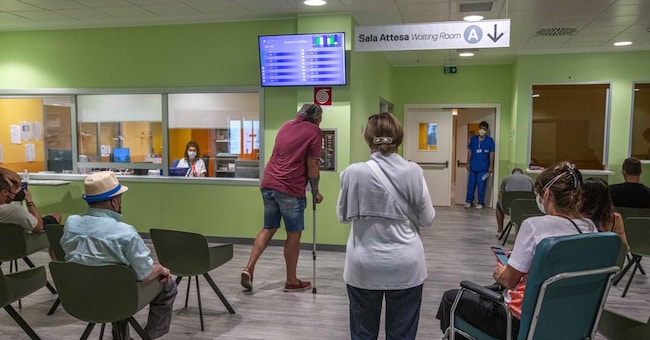
Only one in two medical prescriptions leads to a consultation or a test. In practice, only half of the prescriptions issued by doctors to Italians result in a service provided by the National Health Service. And what about the rest of the prescriptions? It is difficult to make precise estimates, but it is certain that some of these remain in drawers because patients have given up due to excessively long waiting lists, whilst another proportion of prescriptions has been used to visit private practitioners, either paying for the service out of pocket or claiming reimbursement from health insurance funds. Then there are those prescriptions that are not strictly necessary (‘inappropriate’), to the extent that they discourage Italians from taking any action at all. The fact remains that millions of prescriptions go unused: this is a significant figure that highlights a problem smouldering beneath the surface.
According to Agenas, the Regional Health Services Agency which has published data up to 2025 derived from the health card, ‘a rate of non-registration of between 25% and 30% can be considered normal’; for the rest, however, ‘further investigation is warranted’. Moreover, as always, there are very wide disparities between the regions: the national figure for initial consultations between ‘registration’ and ‘prescription’ stands at 50.3 per cent, whilst for diagnostic tests the percentage rises slightly to 54.4 per cent; however, for initial consultations, the figures range from 67.7 per cent to 59–58 per cent in Emilia, Friuli and Veneto to 33.7% in Abruzzo and 36.2% in Lazio; whilst for diagnostic tests, the figures range from 73.4% in Bolzano and 66.6% in Friuli to 37.3% in Lazio and 39.3% in Abruzzo. These figures should be borne in mind when reading the very latest data on waiting lists from the National Platform, which showed that in the first six months of 2026, healthcare facilities provided 1.6 million more medical consultations and tests on time compared with the same period in 2025, but with 2.8 million services still provided late. ‘If only the services actually provided are measured, whilst a significant proportion of prescriptions go unfulfilled because citizens give up or turn to the private sector, the indicators on adherence to deadlines risk depicting only part of the reality’, warns Marcello Crivellini , a lecturer at the Politecnico di Milano and General Councillor of the Luca Coscioni Association. In short, the data on waiting lists “still do not fully reflect the reality that citizens are forced to face when trying to access the NHS within a reasonable timeframe”, emphasises Tonino Aceti, president of Salutequità. He calls for “a thorough examination of the causes and of how to reverse the trend”. Many citizens are faced with appointment offers hundreds of kilometres away from their homes and are forced to give up, opting instead for private healthcare at lower costs. Even the so-called ‘guaranteed pathways’ are largely ineffective because they cover territorial areas that are far too vast. The State and the regions must establish the optimal ratio between prescribed and delivered care, which all regions must achieve; together with compliance with maximum waiting times, these must become performance indicators for guaranteeing the Essential Levels of Care (LEA).’


