
The positive effects of the marriage between agriculture and renewable energy
From increased productivity to a reduction in the amount of water released into the atmosphere as vapour. Here’s how Italian companies are responding

Key points
Energy and crops. From the agrivoltaic vineyard in Sarzana to the social enterprise that has set up an advanced system, right through to the cultivation of citrus fruits, olive trees and medicinal plants. The combination of renewables and crops works. Giancarlo Ghidesi, vice-president of Aias, the Italian association for sustainable agrivoltaics, highlights this, citing three examples where the experiment is yielding positive results. “Sustainable agrivoltaics demonstrates that it is possible to produce clean energy without taking land away from agriculture,” he emphasises. Energy production and agriculture are not at odds with one another; on the contrary, they reinforce each other. Combining them optimises natural resources and increases the resilience of farms, bringing together sustainability, innovation and regional development.”
The history of Sarzana
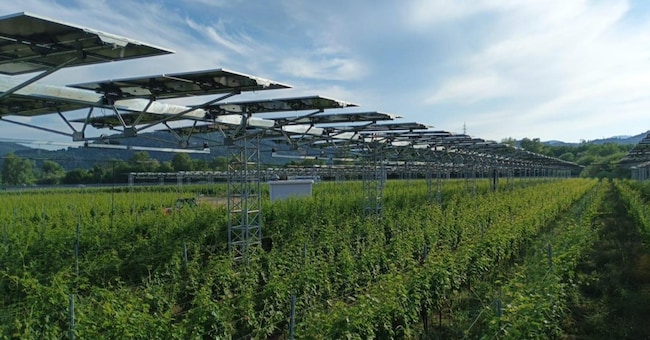
A solution adopted in Sarzana, Liguria, at the Monticello agrivoltaic vineyard. “The project is not experimental, but is based on evidence gathered over seven years of agronomic monitoring,” emphasise representatives from AIAS. “The results concern increased productivity with an average increase in agricultural yield of up to +35 per cent compared to uncovered rows.”
And then there is the quality of the wine, with an improvement in the analytical parameters, “in particular the sugar content (Brix) and the aromatic profile, thanks to reduced water and heat stress on the vine”. No less important is the “improved biomass growth”, because “the vine is more resistant to pests and diseases typical of grapevines”. Furthermore, subsequent studies have recorded water resilience, with a significant reduction in soil evapotranspiration (the total amount of water that passes from the soil and plants into the atmosphere in the form of vapour, ed.), resulting in a reduction in the crop’s water requirements. “The Sarzana project,” emphasise Aias, “stands out for its adoption of cutting-edge engineering solutions, designed to mitigate environmental impact and maximise the symbiosis between energy, agriculture and the environment.”
As for the facility, it is a structure raised 5 metres off the ground to ensure full accessibility for agricultural machinery. The steel structure is installed without the use of concrete, using foundations comprising steel screws driven into the ground.
Thanks to a dedicated agronomic algorithm, the light gradient is modulated in real time to optimise chlorophyll-based photosynthesis and create the ideal microclimate for vine growth. An ‘advanced’ system constantly communicates with the plant, monitoring environmental parameters and the physiological state of the vines to continuously refine the statistical growth models. Furthermore, ‘a second control system monitors electrical performance and irradiance, ensuring the efficiency of the energy component’.

