

Rome’s challenge in Lebanon. Not just UNIFIL
A decision on the role of the peacekeeping forces south of the Litani River will be taken by the end of the year. This is a delicate moment for Italia as it seeks to maintain its geopolitical position, with implications also for the Sahel

On 9 July, Donald Trump declared the truce with Iran to be over, less than a month after signing it. The trigger was the Iranian attacks on commercial vessels in the Strait of Hormuz, followed by further US air strikes on targets within the country and retaliatory strikes against US bases in Kuwait and Bahrain. The news reports tell of a clash over control of an oil route. However, the text of the agreement reached on 15 June links that route to a front that appears to have nothing to do with it: southern Lebanon. And it is precisely on that front that Italia commands the western sector of the longest-running UN mission in the Mediterranean. The memorandum signed by Washington and Tehran committed the parties to an “immediate and permanent” end to military operations on all fronts, “including Lebanon”. This clause was inserted at Iran’s insistence, following months during which the US administration had attempted to keep the two issues separate: on the one hand, the negotiations on the nuclear programme and the Strait; on the other, the war between Israel and Hezbollah, which had been formally under a ceasefire since 16 April but had in fact never ceased. That separation did not hold up for military reasons.
Controlled escalation
Between 16 April and 14 June, Hezbollah carried out a campaign comprising 1,155 attacks, precisely timed to coincide with developments in the negotiations. The peak on 16 April, the day of the initial ceasefire, saw seventy-one attacks in a single day, followed by total silence until the 20th. When Israel crossed the Litani River in early May – an operational border that had not been crossed since 2006 – the attacks rose by fifty per cent, with optically guided drones, immune to Israeli electronic jamming systems, striking construction vehicles and command posts. On 1 June, whilst Hezbollah’s envoy in Tehran was meeting an adviser to the Supreme Leader, the attacks rose to thirty-six. The day after Trump’s direct intervention, they plummeted to seventeen. According to sources cited by Reuters and the New York Times, around a hundred Revolutionary Guard officers are said to have returned to Lebanon following the November 2024 truce, partly to set the pace of operations.
Hezbollah
On 26 June, Israel and Lebanon signed a separate agreement in Washington which makes the Israeli withdrawal conditional upon the disarmament of Hezbollah, without a binding timetable and with a security annex that has never been made public. Secretary-General Naim Qassem branded it “a humiliation”, whilst a Lebanese military official admitted at the end of June that there was “no timetable” for its implementation. On 9 July, Washington spoke of an “implementation phase” having begun, with the first pilot zone due to be established “within a few days” – a phrase that indicates progress without specifying a deadline.
Unifil
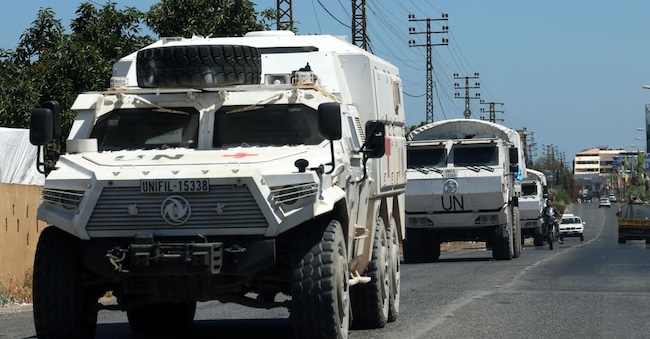
UNIFIL deploys around 7,500 peacekeepers from nearly fifty countries along the Blue Line, and Italia contributes a contingent of around 1,200 personnel, commands the western sector from Shama and, since June 2025, has also provided the force commander, General Diodato Abagnara. With UNIFIL’s mandate due to expire at the end of the year, UN Secretary-General António Guterres has already presented three options for the future to the Security Council, ranging from around 2,000 to over 5,500 peacekeepers. At the Antibes summit, Rome and Paris proposed leading an international coalition to support the transition, strengthening the Lebanese Armed Forces without replacing them and without appearing to side with Israel. It is a delicate balance: too small a presence would leave a vacuum along the most unstable border in the eastern Mediterranean; too robust a presence would risk being perceived as a party to the conflict. Any new escalation triggered by the collapse of the truce with Iran therefore has a direct impact on the Italian troops deployed in Shama, not just on the diplomatic balance in Washington.
Energy
With Russian gas imports virtually reduced to zero, Algeria has become Italia’s leading supplier, with around twenty billion cubic metres imported in 2026, accounting for an estimated thirty per cent of national demand: a dependence that shifts the centre of gravity of Italy’s energy security from the Persian Gulf to the wider Mediterranean, though it does not eliminate it, because the Mattei Plan – worth eighteen billion euros in nominal terms, an operational ceiling of 5.5 billion, involving eighteen countries – operates in a sphere that Paris has gradually abandoned following the military coups in the region, and which Russia and China have occupied by offering, respectively, military protection to local regimes and logistical infrastructure for the extraction of lithium, cobalt and rare earths. Prolonged instability in Lebanon, fuelled by the collapse of the truce in the Strait of Hormuz, is not confined to the Levant: it undermines Rome’s credibility as a stable partner in North Africa.

