
Menarini

The therapeutic power of art: how it helps psychological and emotional well-being

A monograph on Michelangelo presented: the 70th volume of the series edited by the Florentine pharmaceutical industry

by Maria Rita Montebelli

La presentazione della nuova monografia Menarini dedicata a Michelangelo presso l'Istituto degli Innocenti., a cura dell'autrice Cristina Acidini e della Direttrice dei Musei Vaticani, Barbara Jatta. Firenze 07  Marzo  2026   ANSA/CLAUDIO GIOVANNINI( NPK)

5' min read

Translated by AI
Versione italiana

5' min read

Translated by AI
Versione italiana

For a company that has always taken care of health, even beauty, that of art with a capital 'A', can represent a form of therapy. It is with this spirit that the Menarini Group has been carrying forward for 70 years a singular tradition in the European industrial panorama: to flank medicines with the diffusion of art, considered not only a cultural heritage but also an instrument of well-being and knowledge. An operation of cultural patronage with an almost Renaissance flavour that fits in well with the initiatives of art that cures, a concept that is becoming increasingly popular: the aesthetic experience can have positive effects on a person's psychological, emotional and even physical well-being.

But Menarini's love for art took shape as far back as 1956 with Il Testimone d'Egitto, a reportage among the wonders of the pharaohs that inaugurated a long publishing season. The volume dedicated to Michelangelo is part of this tradition: an invitation to look at art not only as a memory of the past, but as a living energy capable of nourishing the spirit, just as medicine cares for the body.

Loading...

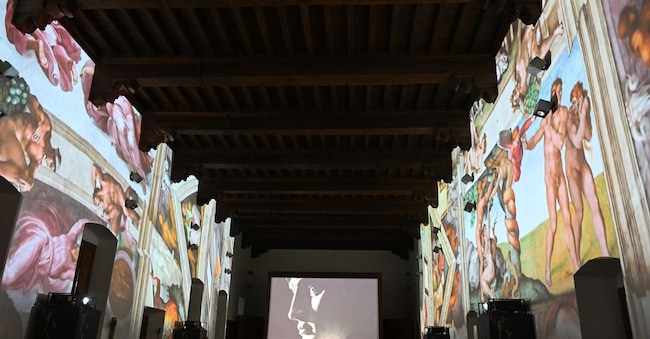
Presented in Florence by its author, Professor Cristina Acidini, masterfully introduced by Barbara Jatta, Director of the Vatican Museums, the book (Pacini editore) shows off the masterful black and white photos of the sculptures signed by the master of photography Aurelio Amendola and the magnificent reproductions of Michelangelo's frescoes, vibrant in the magnificence of their colours.

The Divine Artist's Story

Generous and stingy, thoughtful and brusque, indefatigable and ingenious. This is only part of the florilegium of adjectives that attempt to describe the immense Michelangelo, the 'Divine Artist' who worked marble until six days before his death, despite his hands being wracked by arthritis.

In his very long life he would receive commissions from many popes, two of them (Leo X and Clement VII de' Medici) from his Florence, which would compete with Rome for his artistic commuting. But it was other popes who made him immortal: Julius II della Rovere, for whom he would create the Sistine vault and his monumental funeral mausoleum that was never completed (in Rome, in San Pietro in Vincoli) and Paul III Farnese who entrusted him with the Last Judgement in the Sistine Chapel and the Pauline Chapel, a jewel hidden from the eyes of most and reserved for the sacredness of the pope's private prayers. This would be enough to fill dozens of volumes of art history, however a mission impossible because it is inconceivable to contain Michelangelo's genius in the finiteness of a printed book. Although of course, each new publication helps to discover his genius from another angle. And the latest in order of time is the magnificent Menarini Art Volume, the seventieth in this masterly series, which brings the concept of art patronage up to date. A series that has been telling the story of art with consistency and extremely high quality since 1976, returning with an unexpected encore to talk about Michelangelo, to celebrate the 140th anniversary of Menarini, the Florentine multinational present in 140 countries around the world.

And it is a plunge into the vertigo of beauty, a legacy for eternity, which speaks the universal language of Art. The one that makes you squirm restlessly in the screwed postures like the Apollo of the Belvedere of the many characters that have come out of the Maestro's brush or chisel, only to arrive at a cathartic reconciliation in the very sweet face of the Madonna 'Virgin mother, daughter of your son'. An art that soothes, that cures any wound of the soul.

The New York Million Dollar Auction

And Michelangelo has been back in the news again in recent weeks, with Christie's New York auction fetching a preparatory drawing in sanguine at the record price of $27.2 million. Perhaps it is the right foot of the Libyan Sibyl that is portrayed in the red of those rapid and decisive strokes, the one contiguous to a flap of her dress caught under a stool, "because in Michelangelo everything is movement and one story within another", recalls Acidini. A few days ago, a bust of Christ the Saviour, preserved in the Basilica of Sant'Agnese fuori le Mura (Rome) and another canvas (Pietà Spirituali), kept in a private collection in Brussels, were allegedly attributed to the Master of Caprese Michelangelo. But, leaving aside any supposed marketing operation, it is worthwhile to remain anchored to scientific orthodoxy and rediscover the great genius also through his early works, led by the hand of Professor Acidini.

And it is immediately Stendhal syndrome with the vision of the Vatican Pietà emerging as an alien beauty from the half-light of St Peter's Basilica. And then the David, now at the Gallerie dell'Accademia in Florence, popping up above a sea of heads and mobile phones ready to Instagram the male response to Botticelli's 'welcome to wonder'. But also to be discovered are the so-called minor works, such as the Madonna of the Stairs, painted when he was 15 years old, and the Battle of the Centaurs sculpted when he was 17, both conserved at Casa Buonarroti, a precious Florentine museum generally deserted by crowds equipped with radios and earphones. Then there is the Bacchus in the Bargello Museum, a little feminine for Vasari's taste, but magnificent nonetheless.

Julius II's funeral monument and the Doni tondo

But the real thrill in the heart is felt in the presence of the 'Prigioni', those monumental statues that were to go to make up the funeral monument of Julius II and that will instead remain trapped forever in the block of marble, freshly hewn by the Master. But it is here that one encounters Michelangelo, in the chisel blows that scratch the marble, in these embryonic figures that eloquently embody and illustrate what he meant when he spoke of his sculpture as art 'a levare': removing fragments of stone to free the magnificent forms trapped within. A work in progress crystallised in time, which continues to play on a loop before our eyes.

And then, again in Florence, this time at the Uffizi, the marvel of the Tondo Doni, the painting that everyone would like to have above the headboard of their bed, but which in that location was only enjoyed by Agnolo and Maddalena Doni. Here too, in the dynamism of the movements, "the painted figures seem sculpted in marble, amidst powerful chiaroscuro, iridescence and vivid colours," comments Professor Acidini. Because in the end, it was always to the chisel that Michelangelo referred and returned. Even in that divine spark that shoots out between God's finger and Adam's hand in the Sistine Judgement, one of the most paraphrased and parodied images in the history of art, without ever managing to undermine or diminish the absolute magic of that divinely timeless moment. And in the horror vacui of the vaulted ceiling and lunettes of the Sistine Chapel, "inhabited by characters that almost no one knows anything about", Michelangelo carves and sculpts in brushstrokes "habitable depths" (Acidini's magnificent eloquence always illuminates us), where furniture, women combing their hair, breastfeeding, all humanity emerges, portrayed in the trimensionality of movement, continually renewing itself. Because "se tu vôi far bene, varia sempre e fa piuttosto male" was Michelangelo's mantra (always change, even at the cost of making mistakes). It is a journey that unfolds between the pages of this magnificent book and that arrives at his last earthly effort, the Rondanini Pietà, "a palimpsest of his thoughts, a sculpted prayer that annihilates the beauty of the human body to reach the pure essence of the spirit". This is the thrilling epilogue to this volume of Menarini art, a precious example of patronage in the third millennium. Of which Lorenzo the Magnificent himself would have been proud.

Copyright reserved ©
Loading...

Brand connect

Loading...

Newsletter

Notizie e approfondimenti sugli avvenimenti politici, economici e finanziari.

Iscriviti