

Ankara’s Ministry of Defence is riding the NATO wave and holding on tight to its home-grown fighter jet
Mehmet Demiroğlu, CEO of Turkish Aerospace Industries, outlines the growth of the company that is driving the Turkish defence sector. The KAAN fighter jet remains a strategic cornerstone, whilst the T-70 and T-925 helicopter programmes are back in the industrial spotlight. “Optimism regarding the role in the F-35 supply chain”
by 24Ore NextMed
 Aggiungi Il Sole 24 Ore
ai preferiti su Google
Key points
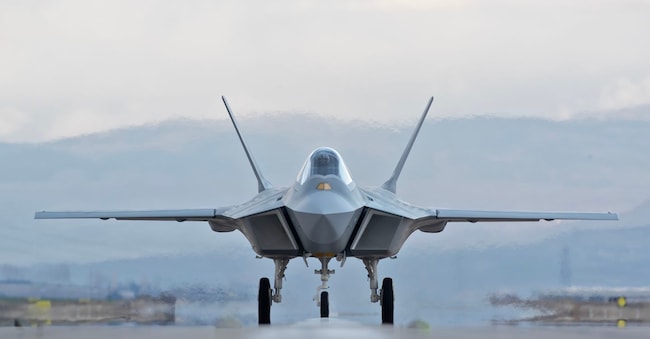
Turkish Aerospace Industries (TAI) appears to be stepping up its efforts on all fronts. At the 2026 Farnborough International Airshow, Chairman and CEO Mehmet Demiroğlu outlined an ambitious vision, in which the KAAN national fighter jet remains a strategic cornerstone, whilst the T-70 and T-925 helicopter programmes are returning to the forefront of the industry, and the company is looking with renewed optimism at its role in the F-35 supply chain.
The most critical issue in the programme — the procurement of GE Aerospace’s F110 engines — now appears to have been resolved. On 9 July, the US Congress gave the green light to the export licence, followed by the Technical Assistance Agreement. “We can say that we have the export licence for the engine,” said Demiroğlu. Ten engines are already in Ankara for the prototypes and test flights; a further 80 are being procured for the first phase of series production. As for testing, following the first flights of the initial prototype, the company is awaiting the completion of ground tests before flying the P1 within a couple of months, with the aim of having two KAANs airborne by the end of the year. The first delivery to the Turkish Air Force remains scheduled for 2028. Demiroğlu ruled out any negative impact from potential budget reallocations linked to other fighter aircraft acquisitions, citing the contract signed at SAHA 2026 for development and series production.
The T 70 programme
The T-70 multi-role programme, based on the Sikorsky S-70i platform, has resumed active development. In early 2026, an agreement was signed for an additional batch of 39 helicopters, with export authorisation having been granted. Production is expected to resume within approximately 18 months. Demiroğlu clarified that the CAATSA sanctions did not affect all the Turkish entities involved: the end-users — the Ministry of Defence, the Air Force, the Land Forces and the Gendarmerie — were exempt. Thirty-eight T-70s have already been completed; the new batch will bring the total to 77 units, with authorisation also granted for the remaining 32 of the original 109-unit plan. Far from being overshadowed by the T-70, the T-925 Heavy Utility Helicopter is positioned to meet a much broader range of requirements. TAI estimates that over 200 helicopters in the Turkish Armed Forces will need to be replaced between 2030 and 2040, in addition to a potential 200 for export: the expected production volume is close to 400–500 units over 10–15 years.
MUM-T, the F-35 and civil aerostructures
Manned-Unmanned Teaming is proceeding in parallel, with the ANKA-3 and HÜRJET already being used in the development of autonomous formation technologies. Under a 2025 agreement with BAE Systems, the use of the ANKA-3 alongside the Eurofighter Typhoon is being explored, although no formal programme has yet been established. Regarding the F-35, Demiroğlu distinguished between the purchase of aircraft — a government decision — and industrial participation, expressing the hope that Turkish suppliers would return once political and regulatory obstacles had been overcome. On the civil side, TAI is in talks with Boeing and other OEMs to expand its aerostructures portfolio, which is already active with Airbus, Leonardo and Sikorsky.
Finally, the HÜRJET is approaching 500 flight hours with two prototypes; this figure is set to rise to four by 2026, including the Light Combat Aircraft version. A single-engine naval variant is also in the pipeline, with the Turkish Naval Forces as the main customer and international interest, including from the United Kingdom.

