Central Italia

The revival of the Valnerina, ten years on from the earthquake

The earthquake of 30 October 2016 revisited 10 years on: reconstruction and artistic heritage

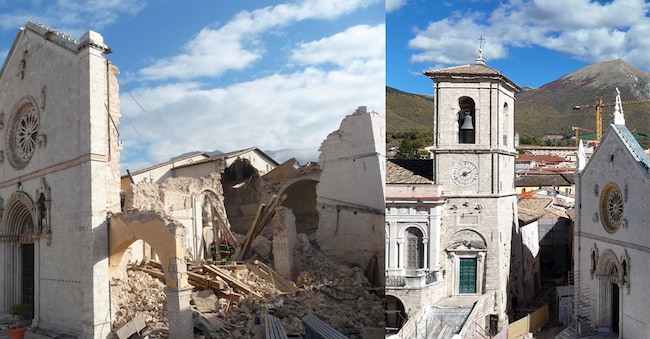
Una immagine diffusa in occasione della riapertura e riconsacrazione della Basilica di San Benedetto di Norcia, simbolo del sisma del 2016, 31 ottobre 2025. Ansa

3' min read

Translated by AI
Versione italiana

3' min read

Translated by AI
Versione italiana

It is 7.41 am when the earth begins to shake, once again. It is a Sunday, 30 October 2016. This time, the epicentre of the earthquake lies between Castelsantangelo sul Nera (Marche), Norcia and Preci (Umbria) and registers a magnitude of 6.5.

Miraculously, there were no deaths or injuries. This incident is just the latest in a series: a few days earlier, on 26 October, the Valnerina – the valley through which the River Nera flows, encompassing the provinces of Macerata, Perugia, Terni and Rieti – was struck by further tremors, measuring 5.4 and 5.9 on the Richter scale. And a few months earlier, on the night of 24 August 2016, a swarm of earthquakes with a magnitude of 6.0 destroyed the villages of Amatrice, Accumoli and Arquata del Tronto, claiming the lives of 303 people.

Loading...

Today, 30 October 2026, marks ten years since the basilica in Norcia, the home town of St Benedict, succumbed to the earthquake and collapsed.

Last year, the new basilica was inaugurated, and the event became a symbol of the town’s rebirth.

 Whilst reconstruction and restoration work in Norcia has now restored a large proportion of the damaged buildings, it is the surrounding villages that are still suffering the consequences of the earthquake: in Castelluccio, San Pellegrino, Ancarano and Campi work is progressing very slowly and residents are still waiting for their communities to be reborn. Alongside the physical reconstruction, there is also the intangible rebuilding of the communities. There are people who are staying behind because they do not want to leave their homeland. Because they do not want their home to become a ghost town.

The return of cultural and artistic heritage to the community 

From 30 October, the Umbria Region will host a series of institutional, cultural and community events in the Valnerina area to mark the tenth anniversary of the earthquake.

 The celebrations will get underway tomorrow morning in Norcia, with the opening of the municipal hospital and a preview of the exhibition ‘Gold and Earth. The Renaissance of the Valnerina’ organised by the Ministry of Culture.

The latter is intended as an ‘act of restitution’, as curator Caterina Fontanella described it, of the Valnerina’s artistic and cultural heritage to its inhabitants.

 A route that winds its way through the towns of Spoleto, Norcia, Ferentillo, Cascia, Vallo di Nera and Arrone, showcases artefacts salvaged from the rubble of the earthquake ten years ago and subsequently restored and preserved. One of the ideas behind the project is to ‘use the restored cultural artefacts as a means of encouraging people to visit or return to the areas affected by the earthquake’, explains curator Francesca Valentini. For each work on display, the location prior to the earthquake and the date of removal are indicated, along with details of any renovation or restoration carried out.

 ‘An important aspect is the connection between the artworks and their locations, and the sites waiting to be rediscovered. The exhibition is intended as a proposal for local residents, who may say ‘it makes sense to stay here’, and an invitation to feel a sense of belonging – through their own heritage – to a land that may feel almost hostile as a result of the earthquake,’ explains Valentini.

Loading...

‘Oro e Terra’ – a title that establishes a dialogue between the works and the areas affected by the earthquake, an idea conceived by the third curator, Alessandro Delpriori – bears witness to the care devoted to the heritage of the Valnerina region and its community.

  “It would be hypocritical to say that everything is fine and all is well, because the reconstruction is still ongoing. However, this is an important moment to help people understand what has been achieved. The hope is that the exhibition will help to showcase a cultural renaissance, highlighting how cultural heritage – a reflection of the local area – serves to mend the social fabric’, explains Fontanella.

The project was a collaborative effort: promoted by the Ministry of Culture through the Department for Cultural Heritage Protection and the Directorates-General for Archaeology, Fine Arts and Landscape, and Archives, it was organised by the relevant Superintendencies in Umbria in collaboration with Virart Odv, the association for the promotion of the region’s cultural heritage.

 However, many other organisations have contributed to this, such as the Umbria Regional Directorate for National Museums, the Opificio delle Pietre Dure in Florence and the Holy Nail repository in Spoleto, managed by the ABAP Superintendency and the Umbria Region. Not to mention, of course, the immediate action taken at the time of the earthquake by the Fire Brigade, the Civil Protection Agency and the Carabinieri to safeguard our cultural heritage.

Copyright reserved ©
Loading...

Brand connect

Loading...

Newsletter

Notizie e approfondimenti sugli avvenimenti politici, economici e finanziari.

Iscriviti