

5.6 million Italians are foregoing medical treatment, and life expectancy in Trento is three years higher than in Campania
New data on Italians’ health and access to services is revealed in the latest Report on Equitable and Sustainable Well-being (BES)

Key points
There are still nearly 6 million Italians who have foregone medical treatment for financial reasons, because of waiting lists, or because treatment is not accessible. The latest figures, updated to 2025, show that 5.6 million Italians reported having foregone at least one healthcare service despite needing it. These findings emerge from the latest Report on Equitable and Sustainable Well-being (BES), recently published by Istat. This new report, packed with data, also highlights the many regional disparities in health, such as those relating to average life expectancy at birth, which is narrowing between men and women but widening between regions – particularly between the North and the South: in Trento, for example, life expectancy is 2.9 years longer than for those living in Campania.
Life expectancy is rising, but there are significant differences between the North and the South
In 2025, life expectancy at birth reached a new all-time high of 83.7 years. This represents a slight increase compared with 2024 (+0.2 years) and a rise of 1.1 years compared with 2014, when it stood at 82.6 years. It is the highest level ever recorded by Istat: for men it stands at 81.7 years and for women at 85.7. Italia ranks third in Europe in this regard, just behind Spain and Sweden (84 and 83.8 years respectively), compared with an EU-27 average of 81.5. Healthy life expectancy is rising again after four consecutive years of decline and is set to reach 59.1 in 2025 (compared with 58.2 in 2024). At the age of 65, people are expected to live a further 10.8 years without limitations on the activities they usually carry out, slightly more than in 2024 (10.4 years), but significantly higher than in 2014 (9.6 years). The prevalence of chronic conditions and severe limitations among those aged 75 and over remains stable compared with 2024, but has improved compared with 2014: in 2025, the figure stands at 47.2 per cent, down from 51.9 per cent eleven years earlier
At a regional level, however, the disparity in life expectancy at birth is particularly striking: it stands at 82.8 years in the South, compared with 84.2 in the North and 84.0 in the Centre. This gap has, moreover, widened since 2004, when life expectancy in the North and the Centre was only 0.7 years higher than in the South. Campania, with 82.1 years, remains the region with the lowest life expectancy, 2.9 years lower than the Autonomous Province of Trento, which has the highest life expectancy (85 years). In 2025, most of the southern regions, as well as Lazio and Piedmont (both 83.6 years, 0.1 years below the Italia average), will be just below the national average (83.7 years).
5.6 million Italians are foregoing treatment
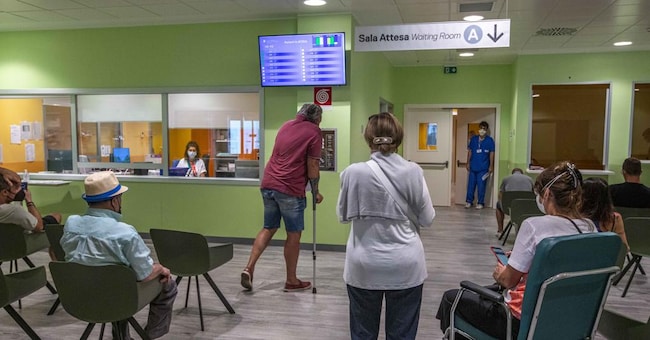
Following significant growth since 2019, in 2025, the indicator on the forgoing of healthcare recorded annually by Istat remained stable compared with 2024, standing at 9.6 per cent of Italians – equivalent to over 5.6 million people – who reported having foregone at least one healthcare service despite needing it. Long waiting lists remain the main reason for foregoing treatment (6.5 per cent), followed by the cost of treatment (5.2 per cent), whilst only 1.4 per cent state that they foregone treatment for reasons related to inconvenience. Between 2024 and 2025, the indicator for foregoing treatment fell in the North from 9.2% to 8.7%, whilst figures remained stable in the Centre (10.7%) and the South (10.3%), resulting once again in a widening of the regional gap.
The number of people opting out has fallen significantly in the Aosta Valley, the Autonomous Province of Trento, Friuli-Venezia Giulia and Emilia-Romagna; in the rest of Italy, an increase is recorded only in the Marche (from 10.6 per cent to 12.0 per cent) and in Sardinia (from 17.2 per cent to 19.5 per cent), the region with the highest figures. Istat emphasises that unmet demand in the healthcare sector – whether public or private, and whether part of the National Health Service or not – “is assessed by the proportion of people who, despite needing them, forgo medical consultations or diagnostic tests due to financial difficulties, long waiting lists or the inconvenience of travelling to healthcare facilities”.


