The interview

Space, Valente: ‘Together with Japan, we are building an ecosystem that goes beyond missions’

The president of the Italian Space Agency, who has been appointed head of COPUOS for the next two years, discusses the agreements reached between Italian and Japanese companies

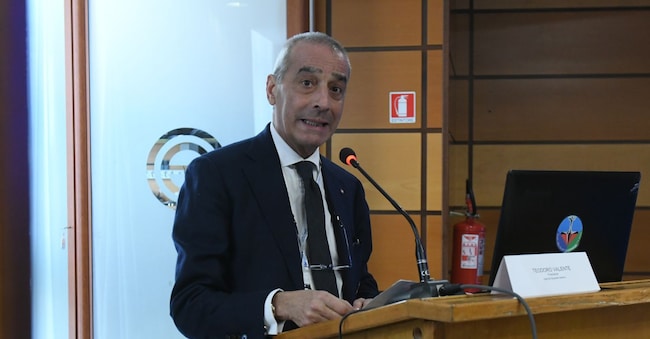
by Lorenzo Pace

TEODORO VALENTE  AGENZIA AEROSPAZIALE ITALIANA IMAGOECONOMICA

4' min read

Translated by AI
Versione italiana

4' min read

Translated by AI
Versione italiana

To speak solely of space missions would be an oversimplification. If anything, the bilateral talks between Italia and Japan, which took place on 28 and 29 May, served to foster an ‘ecosystem’ of collaboration through new scientific and industrial agreements. This view is supported by those who played a central role during the Tokyo Consultations, namely the Italian Space Agency (ASI), which engaged directly with its Japanese counterpart, JAXA. For the Agency’s president, Teodoro Valente, this ecosystem must encompass everything around it – from institutions to businesses – so as to become a lever for overall growth. This opportunity is also bolstered by the solid relationship between the two countries, as evidenced by Japan’s support for Valente’s presidency of the UN Committee on the Peaceful Uses of Outer Space (COPUOS) for the next two years. He is expected to take up the post in the coming days.

Mr President, what were the main outcomes of the bilateral meeting in Tokyo?

Loading...

Cooperation between ASI and JAXA has intensified on several fronts, in line with the 2024–2027 action plan. The objectives go beyond new space missions: we aim to create an ecosystem of collaboration between the ‘space sectors’, encompassing institutions, businesses and investment centres capable of generating innovation, skilled employment and new market opportunities. These consultations have paved the way for the Japanese Prime Minister’s forthcoming visit to Italia, scheduled for around mid-June: we are approaching this with a shared vision of viewing space not only as scientific research and exploration, but also as a strategic lever for innovation, industrial competitiveness and economic growth.

So, it also refers to the downstream sector. In that regard, how is cooperation with Japan going?

At the end of March, we renewed an agreement that strengthens a decade-long partnership in Earth observation, one of the fastest-growing sectors of the space economy and also crucial for security. The agreement expands on the 2016 agreement to integrate data from the Italian Cosmo-SkyMed constellation with that from the Japanese ALOS radar satellites. Thanks to the new agreement, cooperation is also extended to the ALOS-4 satellite, which was recently launched into orbit and is now operational.

What does this involve?

Combining data acquired across different radar bands enables the territory to be observed with greater precision and continuity, improving the monitoring of natural disasters such as earthquakes, fires or floods. In a context characterised by the growing vulnerability of critical infrastructure and the effects of climate change, the availability of timely and accurate information is a crucial factor in supporting the decisions of governments and businesses, such as civil protection authorities. But there are other agreements moving in this direction.

For example?

Egeos has signed an agreement with the Japanese company Synspective to develop new geospatial intelligence solutions by integrating data from the Cosmo-SkyMed and StriX constellations. This is a concrete example of how institutional cooperation can facilitate new industrial partnerships and also create new market opportunities for companies in both countries, based on data from Earth observation satellites.

She also spoke of progress in scientific cooperation.

Scientific cooperation is one of the key pillars. The first example I would like to mention is LiteBirdI, a mission led by JAXA that will study cosmic radiation to deepen our understanding of the origins of the universe. Italia will participate with a leading scientific and technological contribution through ASI, INFN, INAF and numerous universities, providing one of the mission’s main instruments. Another mission scheduled for 2028 is called Solar-C, and is dedicated to the study of the Sun and solar physics. Italia, through ASI and its public research bodies, is providing the main instrument, which is a very high-resolution extreme ultraviolet spectrometer. Gaining a better understanding of solar phenomena means observing the direct implications of solar storms, which can affect satellites or telecommunications and thus have a direct impact on the economy and the infrastructure on which our societies depend. Finally, I would mention the Calet mission, which measures cosmic radiation on the International Space Station; BepiColombo, led by the European Space Agency and aimed at exploring Mercury; and the planetary defence missions Hera and Ramses.

What about lunar exploration?

The Artemis programme is currently of central importance. Both Italy and Japan were among the first countries to sign the Artemis Accords and are now key participants. Italy and Japan are tasked with developing two fundamental components of the future lunar architecture. ASI is developing, in collaboration with NASA, the first pressurised habitation module, the Multipurpose Habitation Module, intended for the lunar surface and designed to house astronauts when they are not on the move. This is a major opportunity, as it will be manufactured in Turin but will involve the entire industrial sector. JAXA, on the other hand, is responsible, again in collaboration with NASA, for the development of a pressurised rover for exploration.

Copyright reserved ©
Loading...

Brand connect

Loading...

Newsletter

Notizie e approfondimenti sugli avvenimenti politici, economici e finanziari.

Iscriviti