
Tidal waves and works, five kilometres of coastline lost every year
One fifth of the coastline is occupied by hard defence structures: their presence is causing coastal erosion

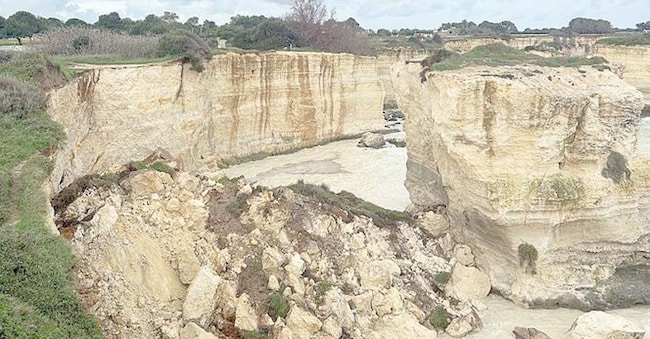
It has been the backdrop for thousands of photos, postcards, filming. Breathtaking and romantic scenery, so much so that it was called the lovers' bridge. Since 15 February, however, the arch of the Faraglioni di Sant'Andrea, in Melendugno, Salento, no longer exists, having collapsed due to sea storms and heavy rain. So suddenly the image has become a symbol of one of the most serious damages caused by coastal erosion. Not even a month earlier, waves up to seven metres high and winds gusting up to 120 kilometres per hour had unleashed so much water that even a section of the rail network between Messina and Palermo had been washed away. Within a few hours, Cyclone Harry had hit the coasts of Sicily, Calabria and Sardinia devastating them. And these are only some of the most significant and emblematic episodes of the growing fragility of our territory. That ours is a fragile country is dramatically well known; however, with Harry something unprecedented has begun to emerge that risks increasing the dimensions of the phenomenon: every year we lose five kilometres of natural coastline.
"Usually disturbances in the Mediterranean," explains Filippo D'Ascola, coordinator of the working group on coastal monitoring at the Ispra (Higher Institute for Environmental Protection and Research), "have a certain magnitude. To borrow an image used by a meteorologist, it was as if someone had punctured a basketball in Greece and someone else, at the same time, had opened a hoover in Tunisia. What do I mean by this? That while usually cyclones have a circular size and movement, here the wind went straight for hundreds of kilometres dumping a lot of energy on the sea'.
The effects of climate change
What we have learned so far is how climate change has led to an increase in the frequency and intensity of extreme weather phenomena, such as cyclones and storm surges. "At the same time," Ispra explains in a note, "rising sea levels and altered wind and current regimes amplify wave energy, accelerating coastal erosion processes and increasing the vulnerability of already fragile coastlines. The novelty is that "often," adds D'Ascola, "storm surges no longer come from where we expect them to: that is, changes in direction have become more random. There is, therefore, a phenomenon of randomness that we have yet to study'.
In this context, episodes such as Cyclone Harry are no longer isolated events, but are instead examples of a structural trend that adds up to effects resulting from certain human activities.
River Management
Effects that become very evident when coastline loss is counted. In this case, the trend is slow, visible over several years, but inexorable. This is mainly determined by two factors, both triggered by human intervention. The first concernsthe protection and management of rivers: "Beaches are disappearing because rivers no longer bring sand, and rivers no longer bring sand because often, let's say since the Second World War, we have acted by limiting the energy of rivers, i.e. floods; but floods are the ones that bring the most sand," explains D'Ascola. And here the first paradox is triggered: in many cases theflow of rivers has been limited to allow agricultural development or even the preservation of settlements, but doing so has triggered a fatal process for the coastline.

