Dessert symbol

Tiramisu Day, so a dessert has also become a (big) business

Packaged mascarpone alone is worth over 800 million worldwide and leads the export of mascarpone. In Treviso, the historic restaurant Le Becchiere creates an ad hoc spin-off that could become a chain

by Maria Teresa Manuelli

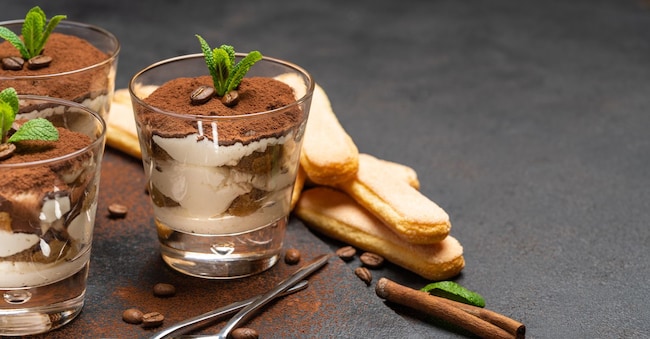
Tiramisù Adobe Stock

3' min read

Translated by AI
Versione italiana

3' min read

Translated by AI
Versione italiana

On 21 March, the first day of spring, we celebrate World Tiramisù Day: now in its tenth edition and organised in Treviso by the Tiramisù World Cup, it has become the stage for a phenomenon that goes beyond gastronomy: tiramisù is now a major economic asset, capable of moving markets, pulling supply chains and redrawing the maps of food and wine tourism.

Global Business

According to the Intel Market Research report, the global market for packaged tiramisu - the so-called 'boxed tiramisu' - reached an estimated value of $943 million (€817 million) in 2025 and is expected to reach $1.32 billion by 2034, with a compound annual growth rate of 6%. Even more optimistic are the estimates of industryresearch.biz, which values the market at $1.22 billion as early as 2026, with a projection to $2.55 billion by 2035 and a Cagr of 8.51%.

Loading...

Driving the expansion is the demand for premium ready-to-eat desserts and the spread of e-commerce. Western Europe remains the heart of the market, with over 70% of global consumption, but Asian markets are running faster: adoption of Western desserts in Asia is growing at 9% per year. There is no shortage of challenges: the limited shelf life of packaged products at 7-10 days and rising raw material costs - estimated by the same report at 12-15% per annum - weigh on margins and logistics.

In Italia it drags the entire supply chain

On the domestic front, the Accademia del Tiramisù - an association that brings together operators in the supply chain - estimates the value of the market in Italy at around 353 million euro. "Tiramisù is firmly established in the offer of almost all catering establishments, with a constant and transversal demand in both out-of-home and domestic consumption," explains Tiziano Taffarello, president of the Academy.

The knock-on effect on the supply chain is precisely measured: "approximately 80% of the consumption of mascarpone and ladyfingers in Italy is attributable to the preparation of tiramisu, a share that rises to almost 100% abroad, both in catering and in ready-to-eat products," Taffarello emphasises. Non-EU markets show the most lively performance, with increases of over 18% in countries such as China.

Le Beccherie, scalable flagship

It is precisely in the place that many consider to be the cradle of dessert that the business becomes more concrete. Le Beccherie, a historic restaurant in Treviso that claims paternity of the original recipe, has opened a space dedicated exclusively to tiramisù tasting, open from 10 a.m. to 7 p.m. A new format that Paolo Lai and Sergio Buongiovanni have christened 'Tiramisù Le Beccherie'.

"In the first days, we arrived at more than 300 tiramisu per day," says Buongiovanni. "That's frankly very high, we are in the best case: we didn't think we would reach those numbers." The comparison with previous volumes is eloquent: in the restaurant alone, Le Beccherie used to serve an average of around 500 tiramisu per week, with an estimated incidence on turnover of around 10-15%. With the new space, volumes are doubling.

The impetus came from a simple but revealing observation. "There was a Korean customer who came the day we were closed and was trying at all costs to get in to taste the tiramisu," says Lai. The stated goal is scalability: "This is the first tiramisu flagship, the first format," says Buongiovanni. "The idea is to make it replicable: first in a regional phase, then national, then international, always maintaining the quality of the ingredients and craftsmanship." A first step towards Venice is already underway, but without haste: 'We want to do things step by step,' Lai points out. 'Without making compromises'.

Tiramisu beats Colosseum (on Instagram)

Then there is the tourism dimension. Francesco Redi, founder of the Tiramisù World Cup and a scholar of European tourism policies, presented an analysis of hashtags on Instagram at the conference in Treviso that surprised those present: the tag "#tiramisù" counts 5.3 million uses since the social network's foundation in 2010, compared to the total 4 million attributable to the Colosseum - adding "#Colosseo" (1.9 million) and "#Colosseum" (2.1 million). "Food has become a tourist attraction, capable of competing with and, as we see, surpassing major cultural landmarks," said Redi. "Attractions are no longer just geographical, but also cultural, gastronomic and social. It is precisely in this intersection between digital data, tourism and the narration of territories that new strategic opportunities open up'.

In Treviso, on the day of the anniversary, the circle closes in Piazza dei Signori, where the champions of past editions of the Tiramisù World Cup distribute the dessert in its original recipe, and in the afternoon a tour of the places that still dispute the paternity of the dessert is scheduled. An identity dispute that, data in hand, is now worth more than a billion dollars.

Copyright reserved ©

Brand connect

Loading...

Newsletter

Notizie e approfondimenti sugli avvenimenti politici, economici e finanziari.

Iscriviti