Dfp in the House

Stability Pact, majority resolution on Dfp passed in parliament. Giorgetti: 'Country in debt is not totally free'

Ok from both the House and the Senate to the majority resolution on the Public Finance Document. Montecitorio approved the text with 180 votes in favour (97 against and 4 abstentions), while Palazzo Madama with 96 yes, 60 no and zero abstentions

by Rome Editorial Staff

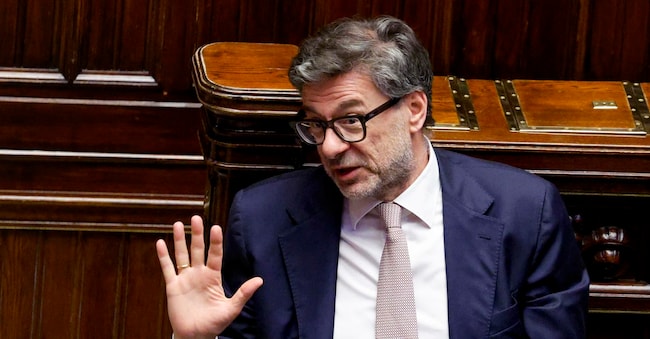
Il ministro dell’Economia Giancarlo Giorgetti durante la discussione sul Dfp, documento di finanza pubblica, alla Camera dei deputati ANSA

5' min read

Translated by AI
Versione italiana

5' min read

Translated by AI
Versione italiana

OK for the majority resolution on the Public Finance Document. Both the Chamber of Deputies and the Senate approved the text (180 yes and 97 no in Montecitorio and 96 yes and 60 no in Palazzo Madama) that commits the government to activate "interlocutions with the European Union aimed at recognising the exceptional nature of the situation in view of a possible activation of the safeguard clauses". Precluded, therefore, were the other two resolutions (a joint one by the oppositions and one by Azione).

The text of the resolution,' said Economy Minister Giancarlo Giorgetti, questioned by reporters in the Senate after the integration of the text of the majority resolution, 'I validated it, so it means that it was shared.

Loading...

Giorgetti: Country in debt not totally free, constraint we cannot ignore

Before, speaking in the Chamber during the examination on the Dfp, Giorgetti recalled that 'this country has the highest debt as a percentage in Europe. I envy my German colleague, who has fiscal space that we do not have, but this is a datum to start from, whoever ignores this datum ignores reality and you cannot make politics by ignoring reality'. "A country in debt is not totally free, it depends on this constraint that cannot be ignored," he added.

"We have to write forecasts that are realistic and what we have written today and what we are presenting to Parliament today on the GDP, is not an inflated GDP to give us the chance to spend or to do electoral things," said the head of the Mef. We have simply written that the GDP, which Istat certifies today, is already acquired for 0.5 per cent, so if nothing happens in the next three quarters, that is, if we do not go into recession, that is an acquired datum, which in some way refers to that used for the calculation of our accounts and our forecasts".

The initial divergences on the text

The starting points of the League and Fi on the resolution were far apart and the confrontation went on throughout the day. The "Azzurri" were more inclined to re-modulate the cohesion funds and the NRP on energy, also using flexibility to stimulate growth; the "leghisti" were pressing with their econonomic chief Alberto Bagnai to include a reference to the possibility of expanding the budget margins even unilaterally, if the EU should not agree. Although Matteo Salvini, in an interview with Il Sole 24 Ore yesterday, called for 'investing all resources to help families and businesses in difficulty' with 'the OK of Europe'.

Displacement not quoted, talks to activate safeguard clauses

In the end, unilateral initiatives were excluded from the text. And a direct reference to budgetary slippage is missing. However, without prejudice to compliance with the 'programmatic net expenditure path indicated in the Plan and envisaged in the Council's recommendations of January 2025', it commits the government to activate 'at the same time interlocutions with the European Union aimed at recognising the exceptional nature of the situation in view of a possible activation of the safeguard clauses'.

An explicit reference to safeguard clauses not contained in the penultimate draft of the text. And justified in the preamble by the "war events that have unfolded since 28 February" with the war in Iran, which have "an economic situation characterised by a significant asymmetric impact on energy costs, as a result of factors clearly beyond the control of the States of the Union, for which specific safeguard clauses are provided for in the discipline of European economic governance".

Flexibility within the framework of EU governance

The resolution commits the government to ask for all possible 'flexibility' in the EU Stability Pact, activating 'all appropriate initiatives, in the relevant European fora, to exploit the flexibilities of the European economic governance framework in order to meet the economic and energy security measures generated by the international crisis, and to provide effective and timely responses within the overall financial perimeter outlined in the Public Finance Planning Document (PFD) 2025'.

Targeted tax measures and tax on extra-profits

In particular, 'targeted, temporary and non-distorting tax measures are envisaged to mitigate the impact of the rise in fuel prices on households, and in particular on the most disadvantaged, on energy-intensive industry and on the transport, agriculture and fishing sectors'. In order to finance them, 'while respecting the net expenditure path', the government is also committed 'to pursue in all appropriate fora a solution at the European Union level that would allow the use of the extraordinary tax revenues deriving from the abnormal rise in fossil fuel prices, according to the actions already taken on extraordinary profits of energy sector companies referred to in the letter addressed to European Commissioner Hoekstra by five European Finance Ministers'

The most realistic path that the executive intends to take remains the one evoked by the prime minister on Tuesday in a press conference and detailed by Economy Minister Giancarlo Giorgetti in his hearing before the budget commissions. At stake is first and foremost the "flexibility of 0.15 per cent of GDP, equal to 3.7 billion," which had already been hypothesised in the October budget plan among the instruments available to the government to increase security and defence spending. The aim now is to include in this the outlays to cope with the energy shock, which would thus erode space for rearmament, which was not mentioned in the majority resolution.

Centre-Left Unity Resolution

As for the oppositions, there are two pieces of news: the resolution to be voted on today is unitary, which was not to be taken for granted, that is, signed by all the components of the coalition that will challenge the centre-right at the next political elections (Pd, M5s, Avs, Italia Viva and Più Europa); furthermore, despite the climate of confrontation and the negative judgement on the public finance document ("the picture that emerges almost four years after the Meloni government took office is that of a weaker country, impoverished and lacking in ambition in the face of the absolute lack of effective policies to support growth"), in the pre-electoral year the broad field opens up to the hypothesis of a deviation. 'A cautious and very conditional opening', is what Pd's economic chief Antonio Misiani, who worked on the text with colleagues from the other parties, is keen to clarify. Parliament commits the government to ensuring that any budget variance is exclusively aimed at fighting absolute poverty, supporting families and businesses affected by the energy crisis, and financing public health and not military spending,' reads the centre-left resolution.

Tinagli (Pd): where was the government two years ago on the reform of the Stability Pact?

"Where was the government two years ago when the reform of the stability pact was voted and they endorsed all the constraints reint introduced by Germany and other frugal countries, while we in Parliament were asking for more flexibility?", asks in a note the PD MEP Irene Tinagli, former president of the Committee on Economic and Financial Affairs in Brussels. "They woke up late and ran for cover today with a request for the suspension of the stability pact to deal with economic emergencies also due to the war,' she added. 'But where was the government in recent years when it had 200 billion at its disposal to make a real energy transition that among other things would have put us in a position to better deal with an energy crisis that has existed for at least four years, since the war broke out in Ukraine.

Copyright reserved ©
Loading...

Brand connect

Loading...

Newsletter

Notizie e approfondimenti sugli avvenimenti politici, economici e finanziari.

Iscriviti